
11467829
Beschreibung

Mindmap von Menna Emam, aktualisiert more than 1 year ago

|
Erstellt von Menna Emam
vor etwa 8 Jahre
|
|
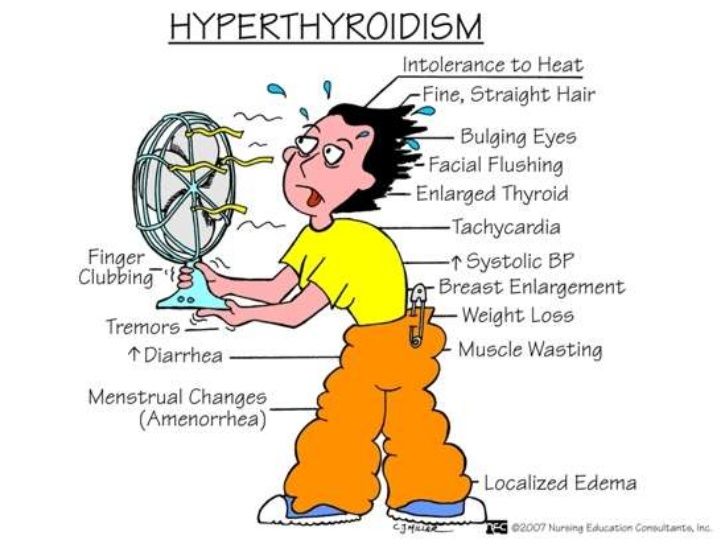
Losing Weight
- Laila
- presented with
- GOITER
- Is an enlargement of the thyroid gland.
- Can be physiological due to
increased demand of the
thyroid hormone as in
puberty, or due to mali-
gnant disease which needs
urgent diagnosis and
treatment
- causes
- Simple (non-toxic) goitre
- Simple hyperplastic goitre
- Multinodular goitre
- Multinodular goitre
- Simple hyperplastic goitre
- Neoplastic goitre
- Malignant
- Papillary
- Follicular
- Anaplastic
- Lymphoma
- Medullary
- Medullary
- Lymphoma
- Anaplastic
- Follicular
- Papillary
- Benign
- Adenoma
- Adenoma
- Malignant
- Autoimmune
- Hashimoto's thyroidits
- Hashimoto's thyroidits
- Inflammatory
- de Quervain's thyroditis
- Riedel's thyroiditis
- Riedel's thyroiditis
- de Quervain's thyroditis
- Toxic goitre
- Graves' disease
- Toxic nodule
- Toxic multinodular goitre
- Toxic multinodular goitre
- Toxic nodule
- Graves' disease
- Simple (non-toxic) goitre
- Is an enlargement of the thyroid gland.
- GOITER
- Later diagnosed with thyrotoxicosis
- Graves' Disease
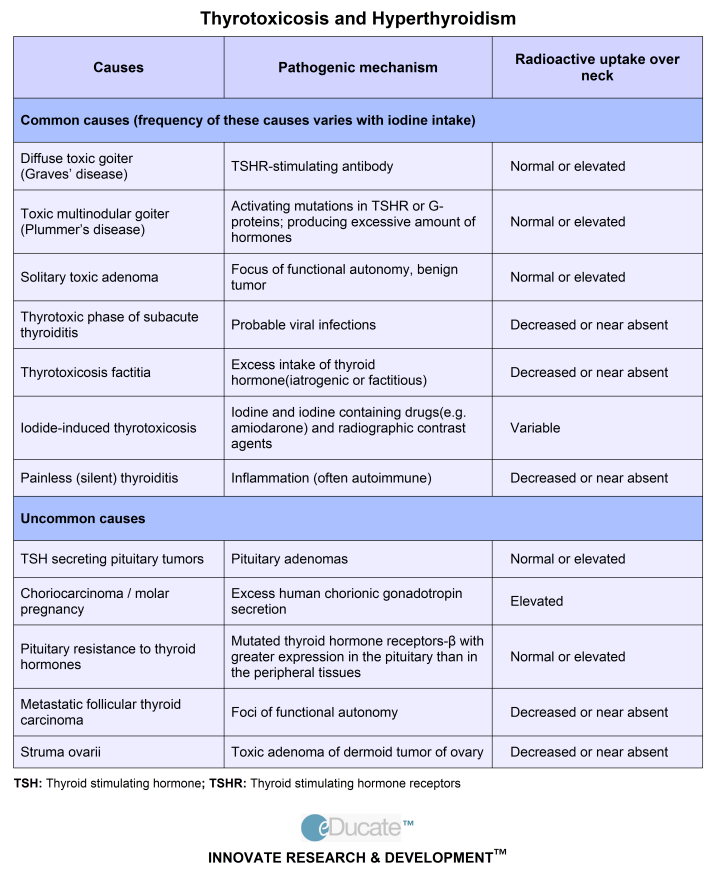
- Definition
- Graves disease is the
most common cause
of endogenous
hyperthyroidism.
- Graves disease is the
most common cause
of endogenous
hyperthyroidism.
- Pathogenesis
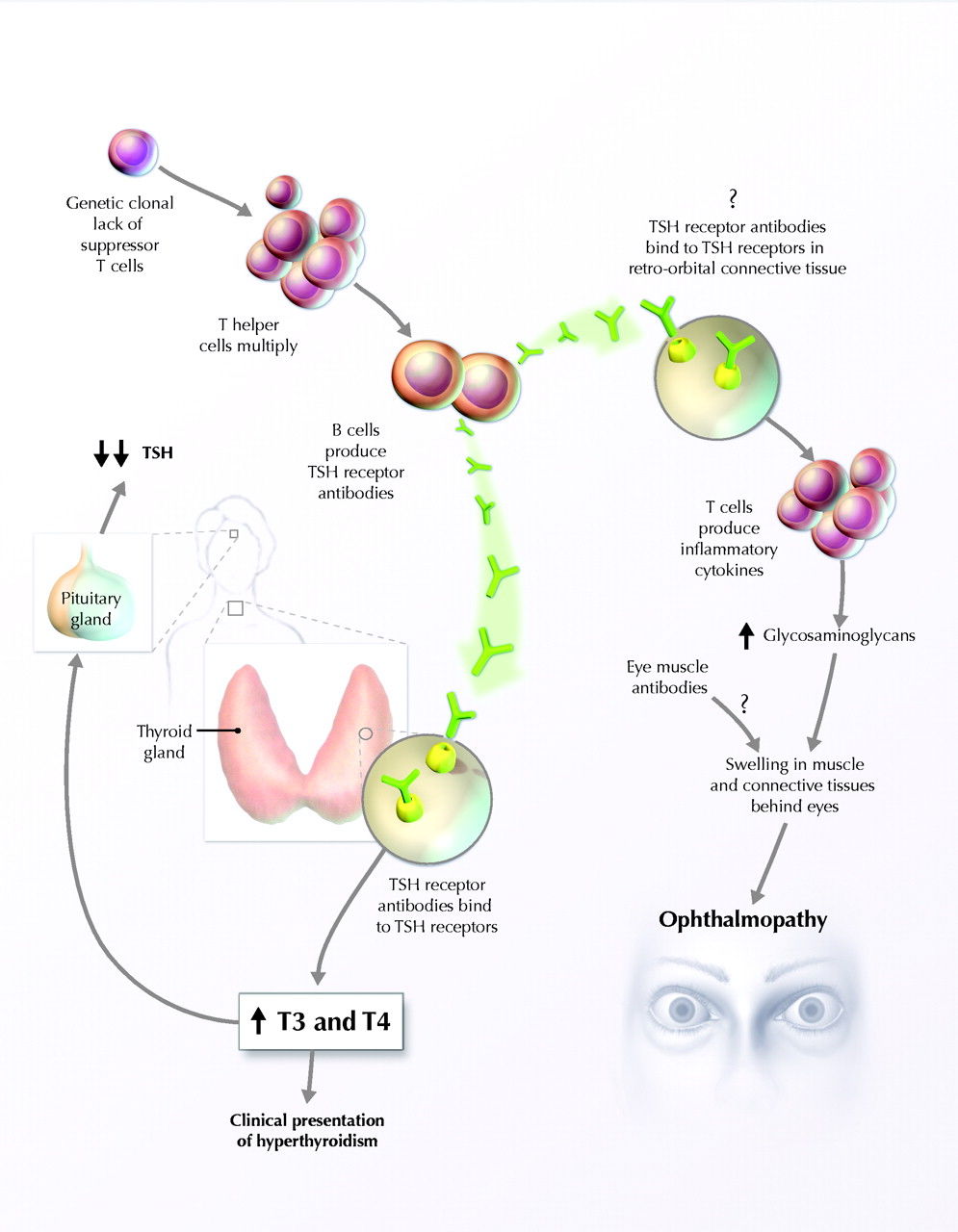
- Graves disease is an autoimmune disorder in which
a variety of antibodies may be present in the
serum, including antibodies to the:
- Autoantibodies to the
TSH receptor are central
to disease pathogenesis
and they include:
- Thyroid-stimulating immunoglobulin
- Thyroid growth-stimulating immunoglobulins (TGIs)
- TSH-binding inhibitor immunoglobulins (TBII)
- TSH-binding inhibitor immunoglobulins (TBII)
- Thyroid growth-stimulating immunoglobulins (TGIs)
- Thyroid-stimulating immunoglobulin
- TSH receptor
- Thyroid peroxisomes
- Thyroglobulin
- Thyroglobulin
- Thyroid peroxisomes
- Autoantibodies to the
TSH receptor are central
to disease pathogenesis
and they include:
- Morphology
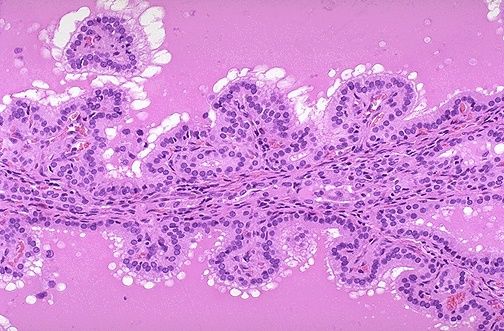
- Diffusely hyperplastic
thyroid in a case of Graves
disease. The follicles are
lined by tall, columnar
epithelium. The crowded,
en- larged epithelial cells
pro- ject into the lumens of
the follicles. These cells
actively resorb the colloid
in the centers of the
follicles, resulting in the
scalloped appearance of
the edges of the colloid.
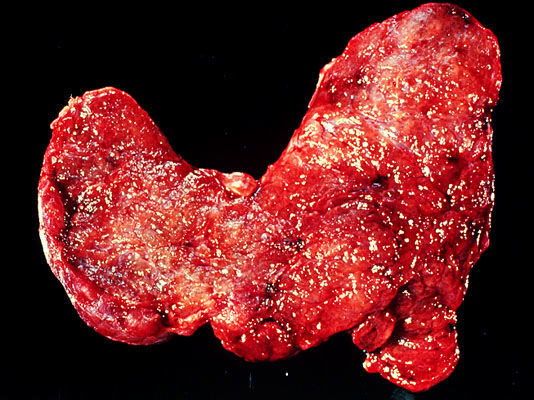
- Hyperemic “juicy”
appearance. The gland is
usually smooth and soft,
and its capsule is intact.
- Diffusely hyperplastic
thyroid in a case of Graves
disease. The follicles are
lined by tall, columnar
epithelium. The crowded,
en- larged epithelial cells
pro- ject into the lumens of
the follicles. These cells
actively resorb the colloid
in the centers of the
follicles, resulting in the
scalloped appearance of
the edges of the colloid.
- Risk factors
- occurs more often in
women, mostly 20-40
years old
- occurs more often in
women, mostly 20-40
years old
- Characterised by
a triad of
- Thyrotoxicosis, caused by a diffusely
enlarged, hyperfunctional thyroid, is present
in all cases.
- An infiltrative ophthalmopathy with resultant
exophthalmos is noted in as many as 40% of
patients.
- A localized, infiltrative dermopathy
(sometimes designated pretibial myxedema) is
seen in a minority of cases.
- A localized, infiltrative dermopathy
(sometimes designated pretibial myxedema) is
seen in a minority of cases.
- An infiltrative ophthalmopathy with resultant
exophthalmos is noted in as many as 40% of
patients.
- Thyrotoxicosis, caused by a diffusely
enlarged, hyperfunctional thyroid, is present
in all cases.
- Laboratory Findings
- Elevated serum free T4 and T3
- depressed serum TSH
- radioactive iodine uptake is
increased
- Because of ongoing
stimulation of the
thyroid follicles by
thyroid-stimulating
immunoglobulins
- Because of ongoing
stimulation of the
thyroid follicles by
thyroid-stimulating
immunoglobulins
- radioactive iodine uptake is
increased
- depressed serum TSH
- Elevated serum free T4 and T3
- Treatment
- 1- Propranolol
- 2- Thiourea drugs (Antithyroid drugs)
- 3- Iodinated contrast agents
- 4- Radioactive iodine
- 5- Thyroid surgery
- Laila finally required
- Thyroidectomy
- Indications
- Developmental Thyroid Abnormalities
- Hyperthyroidism
- Thyroiditis
- Thyroid Nodules
- Thyroid Nodules
- Thyroiditis
- Hyperthyroidism
- Developmental Thyroid Abnormalities
- could be
- either
- Subtotal
thyroidectomy:
Bilateral
removal of >50%
of each lobe and
an
isthmusectomy
- Subtotal
thyroidectomy:
Bilateral
removal of >50%
of each lobe and
an
isthmusectomy
- or
- Total
thyroidectomy:
Complete removal
of both thyroid
lobes, isthmus,
and pyramidal
lobe
- Total
thyroidectomy:
Complete removal
of both thyroid
lobes, isthmus,
and pyramidal
lobe
- either
- Indications
- Thyroidectomy
- Laila finally required
- 5- Thyroid surgery
- 4- Radioactive iodine
- 3- Iodinated contrast agents
- 2- Thiourea drugs (Antithyroid drugs)
- 1- Propranolol
- Definition
- Hyperthyrodism
- Signs & symptoms
- Graves' Disease
- presented with
Medienanhänge
Möchten Sie kostenlos Ihre eigenen Mindmaps mit GoConqr erstellen? Mehr erfahren.