
1318660
Beschreibung

Mindmap von daniwumiash, aktualisiert more than 1 year ago

|
Erstellt von daniwumiash
vor mehr als 11 Jahre
|
|
FunMed 2: Genetics
- Keywords
- Tay Sachs: A rare disease- causes progressive damage to the CNS: normally genetically inherited
- Bronchopneumonia: Acute inflammation of the lungs and bronchioles
- Autosomal Recessive: A characteristic/condition taht only appears in individuals who have both copies of an altered gene; one from each parent
- Obstetrician:
- Chorionic Villus Sampling: A form of prenatal diagnosis to determine chromosomal or genetic disorders in the foetus (10-12 weeks)
- Amniocentesis: Used in prenatal diagnosis of chromosomal abnormalities & foetal infections, & also for sex determination (16 -22 weeks)
- Prenatal/ Antenatal: 'Occurring before birth'
- Prenatal/ Antenatal: 'Occurring before birth'
- Amniocentesis: Used in prenatal diagnosis of chromosomal abnormalities & foetal infections, & also for sex determination (16 -22 weeks)
- Chorionic Villus Sampling: A form of prenatal diagnosis to determine chromosomal or genetic disorders in the foetus (10-12 weeks)
- Obstetrician:
- Autosomal Recessive: A characteristic/condition taht only appears in individuals who have both copies of an altered gene; one from each parent
- Bronchopneumonia: Acute inflammation of the lungs and bronchioles
- Tay Sachs: A rare disease- causes progressive damage to the CNS: normally genetically inherited
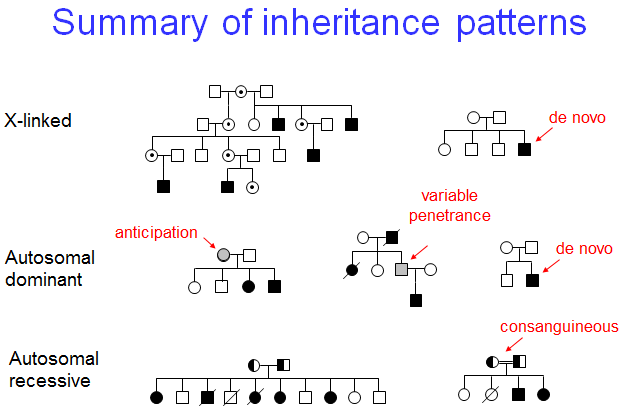
- What are the different patterns for inheritance?
- Single Gene Disorders
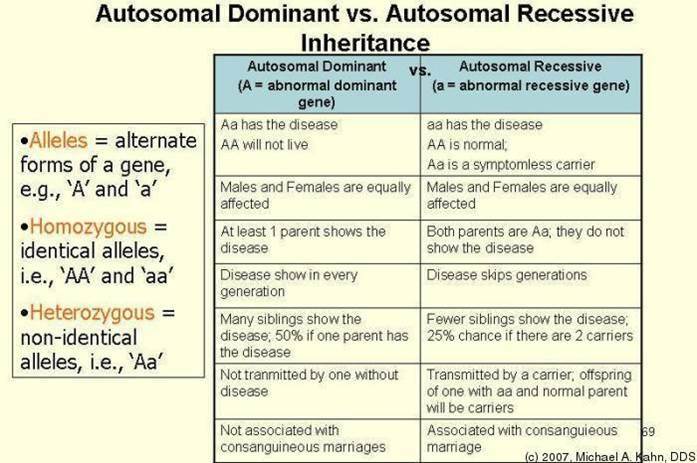
- Autosomal Dominant
- Autosomal Recessive
- X-linked Recessive
- X- linked Dominant
- Y- linked
- Mitochondrial
- Mitochondrial
- Y- linked
- Affected males usually born to unaffected parents- mother usually
asymptomatic carrier; Mainly males affected- Sons will be unaffected,
daughters will be carriers; No male to male transmission; Carrier
females have 50% chance of having affected son
- Duchenne Muscular Dystrophy;
Haemophilia; Colour Blindness;
Fragile X; Glucose 6-Phosphate
Dehydrogenase Deficiency
- Duchenne Muscular Dystrophy;
Haemophilia; Colour Blindness;
Fragile X; Glucose 6-Phosphate
Dehydrogenase Deficiency
- X- linked Dominant
- Parents of affected individuals are usually asymptomatic carriers;
Affects either sex; After birth of an affected child, each subsequent
child has a 25% chance of being affected; *Consanguinity
- CF; Haemochromatosis;
Sickle Cell; Thalassaemia
- CF; Haemochromatosis;
Sickle Cell; Thalassaemia
- X-linked Recessive
- Usually at least one affected parent; Transmitted by
either sex; A child w/ one affected & one unaffected
parent has a 50% chance of being affected
- Marfan's; Huntington's;
Achondroplasia; Neufibromatosis
- Marfan's; Huntington's;
Achondroplasia; Neufibromatosis
- Autosomal Recessive
- Autosomal Dominant
- Single Gene Disorders
- What is Tay Sachs?
- PNEUMONIC
- Testing recommended
- Autosomal recessive
- Young death (4yrs)
- Spot in macula (cherry red spots)
- Ashkenazi Jews
- CNS degeneration
- Hex A deficiency
- Storage diseae
- Storage diseae
- Hex A deficiency
- CNS degeneration
- Ashkenazi Jews
- Spot in macula (cherry red spots)
- Young death (4yrs)
- Autosomal recessive
- Testing recommended
- A genetic disease in which hexosaminidase enzyme of lysosomes is
defective (Cellular Pathology- D.J.Cook)
- Prevents the destruction of one type of glycolipid
(GANGLIOSIDES), which then accumulates in the lyssosmes
- Epidemiology: Childhood form of disease high in Ashkenazi Jews (Eastern Europe): 1in
25 people being a carrier, compared to 1 in 250 in general population!
- S&S's: Swelling of neurones- can lead to seizures; Poor development; Blindness
- Onset: 3 to 6 months- death at ~4/5 y/o
- Rare autosomal genetic disorder
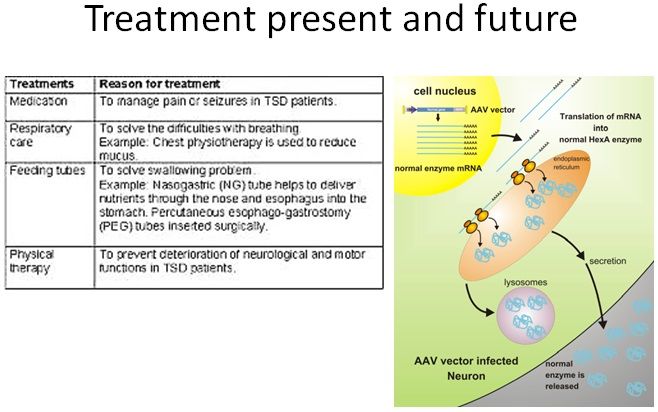
- Treatment: None yet! But experimental work is on going
- Treatment: None yet! But experimental work is on going
- Rare autosomal genetic disorder
- Onset: 3 to 6 months- death at ~4/5 y/o
- S&S's: Swelling of neurones- can lead to seizures; Poor development; Blindness
- Epidemiology: Childhood form of disease high in Ashkenazi Jews (Eastern Europe): 1in
25 people being a carrier, compared to 1 in 250 in general population!
- Prevents the destruction of one type of glycolipid
(GANGLIOSIDES), which then accumulates in the lyssosmes
- Lysosomal Storage Disease
- Produced by accumulations of substrates (in this case the glycolipid-
Ganglioside) which aren't metabolised because of deficiencies in
lysosomal enzymes. Excess substrate leads to cell, tissue & organ
dysfunction.
- Enzymes need to be delivered across the cell membrane & this has
been achieved by modification
- Enzymes need to be delivered across the cell membrane & this has
been achieved by modification
- Produced by accumulations of substrates (in this case the glycolipid-
Ganglioside) which aren't metabolised because of deficiencies in
lysosomal enzymes. Excess substrate leads to cell, tissue & organ
dysfunction.
- Also known as GM2 Gangliosidosis or Hexosaminidase A
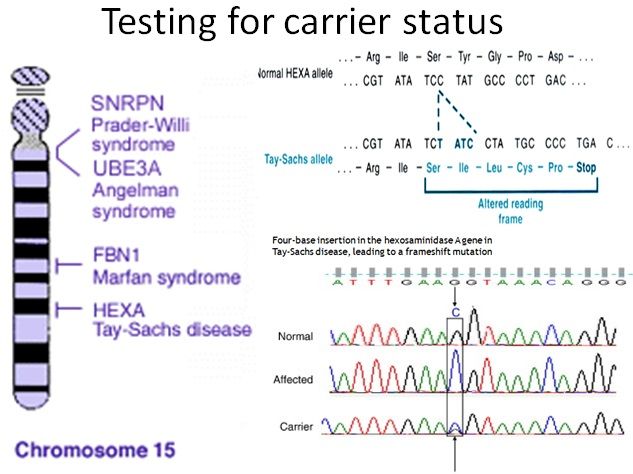
- Results from mutations in the HEXA gene on human chromosome 15
- Results from mutations in the HEXA gene on human chromosome 15
- ONSET
- Types of Tay-Sachs
- Classic Infantile
- Juvenille
- Late Onset
- Late Onset
- Juvenille
- Classic Infantile
- Age of Symptoms Appearance
- Around 6 months of age
- Between 2 & 5, or anytime during childhood
- Adolescence/ early adulthood or even later
- Adolescence/ early adulthood or even later
- Between 2 & 5, or anytime during childhood
- Around 6 months of age
- Types of Tay-Sachs
- PNEUMONIC
- What types of Genetic Screening will the family have to undergo? And how do they work? (Benefits & Risks)
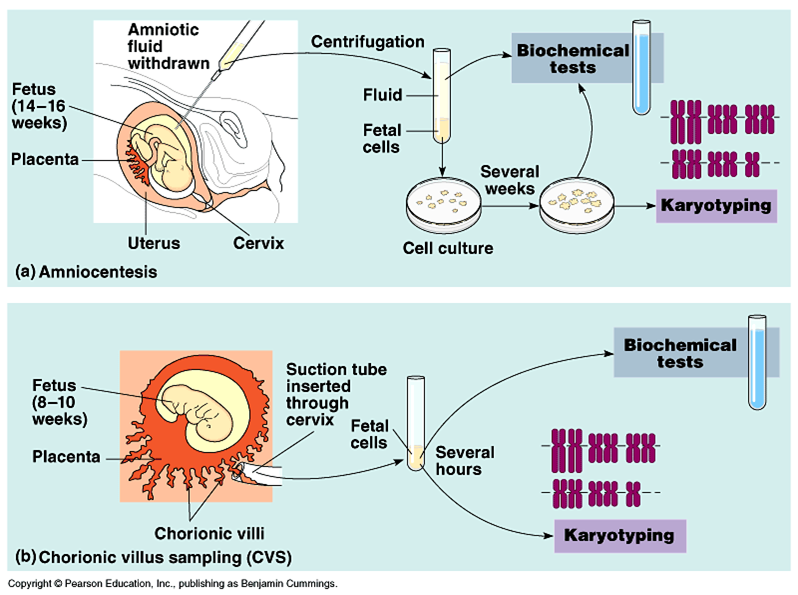
- Chorionic Villus Sampling
- What: Procedure carried out to determine chromosome/ single-gene disorders. Sample of cells-
CHORIONIC villi cells will be taken from the placenta
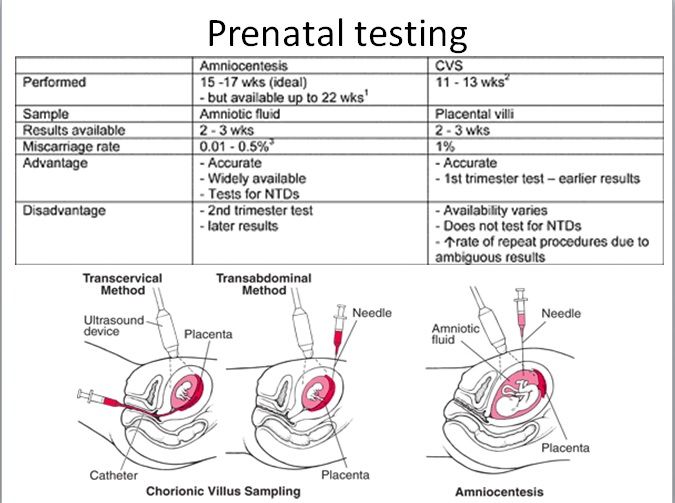
- When: Between 11-13th week
- Why: An earlier antenatal screening test suggests a possible problem. Had previous preg's w/
these problems (chromosome abnormality). Family hx of condition like CF or muscular dystrophy
- How: Transabdominal CVS- needle inserted through abdo. Transcervical CVS tube/ forceps inserted through the cervix
- How: Transabdominal CVS- needle inserted through abdo. Transcervical CVS tube/ forceps inserted through the cervix
- Why: An earlier antenatal screening test suggests a possible problem. Had previous preg's w/
these problems (chromosome abnormality). Family hx of condition like CF or muscular dystrophy
- When: Between 11-13th week
- What: Procedure carried out to determine chromosome/ single-gene disorders. Sample of cells-
CHORIONIC villi cells will be taken from the placenta
- AMNIOCENTESIS
- What: a Diagnostic test to detect serious or potentially serious disorder in foetus.
- When:15-20 weeks
- Why:
- How: A needle is used to extract a sample of amniotic fluid. Amniotic fluid contains cells shed from
the foetus that can be examined for a no. of conditions
- Conditions: (((Chromosomal)))- Down's. Edward's syndrome. Patau's syndrome.
(((Blood)))- Sickle Cell Anaemia. Thalassaemia. Haemophilia.(((Neural Tube Defects)))
(((Muscoloskeletal Disorders))) (((Others- Marfan's Syndrome)))
- Conditions: (((Chromosomal)))- Down's. Edward's syndrome. Patau's syndrome.
(((Blood)))- Sickle Cell Anaemia. Thalassaemia. Haemophilia.(((Neural Tube Defects)))
(((Muscoloskeletal Disorders))) (((Others- Marfan's Syndrome)))
- How: A needle is used to extract a sample of amniotic fluid. Amniotic fluid contains cells shed from
the foetus that can be examined for a no. of conditions
- Why:
- When:15-20 weeks
- What: a Diagnostic test to detect serious or potentially serious disorder in foetus.
- Factors that INCREASE the RISK of ASNORMAILITY
- Mother's Age
- Mother's Medical Hx
- Familt Hx of inherited genetic conditions
- Ethnic Background
- Ethnic Background
- Familt Hx of inherited genetic conditions
- Mother's Medical Hx
- Mother's Age
- Types of Screening
- Ultrasonography. Matternal Serum Screens. Embryoscopy/ Fetoscopy. Percutaneous Umbilical Cord Blood Sampling (PUBS).
- Molecular Genetic Tests: Look @ single genes/ short lengths of DNA taken from a person's blood/ body fluids to identify large changes in the gene
- Chromosomal Genetic Tests: Look @ features of a person's chromosomes (structure, arrangement,
number). Parts of chromosomes may be missing, there may be extra or even be moved to a diff. part
of another chromosome
- Karyotyping- a picture of all of a person's chromosomes. Identity's changes in the no. of chromosomes
- Fluorescent In Situ Hybridisation (FISH) analysis- looks @ certain parts of the
chromosomes & can detect very small pieces of chromosomes that are
missing/ extra
- Karyotyping- a picture of all of a person's chromosomes. Identity's changes in the no. of chromosomes
- Chromosomal Genetic Tests: Look @ features of a person's chromosomes (structure, arrangement,
number). Parts of chromosomes may be missing, there may be extra or even be moved to a diff. part
of another chromosome
- Molecular Genetic Tests: Look @ single genes/ short lengths of DNA taken from a person's blood/ body fluids to identify large changes in the gene
- Ultrasonography. Matternal Serum Screens. Embryoscopy/ Fetoscopy. Percutaneous Umbilical Cord Blood Sampling (PUBS).
- Chorionic Villus Sampling
- What are the Guidelines & Ethics surrounding Abortion?
- Abortion is legal in the UK up to 24 weeks under the Abortion At 1967
- There is no age limit for treatment
- Abortions must be carried out in a hospital/ specialist licensed clinic
- 2 doctors must agree that an abortion would cause less damage to a woman's physical/ mental health than ontinuing the pregnancy
- 24 weeks +: Necessary to save woman's life; Prevent frave permanent injury to physical/ mental
health of pregnant woman; There's substantial risk that child would be born w/ serious physical/
mental disabilities
- Generally should be carried out as early as poss. Usually <12 weeks and ideally <9 weeks
- Risks: Haemorrhage (1 in 1,000); Damage to Cervix (10 in 1,000; Damage to womb (4in 1,000)
- Risks (After abortion): Infection>>> PID, Infertility, Eptopic Preg.; Miscarriages (repeated abortions)
- Procedure: Depends on stage of pregnancy- either Medication or Surgical Procedure
- Procedure: Depends on stage of pregnancy- either Medication or Surgical Procedure
- Risks (After abortion): Infection>>> PID, Infertility, Eptopic Preg.; Miscarriages (repeated abortions)
- Risks: Haemorrhage (1 in 1,000); Damage to Cervix (10 in 1,000; Damage to womb (4in 1,000)
- Generally should be carried out as early as poss. Usually <12 weeks and ideally <9 weeks
- 24 weeks +: Necessary to save woman's life; Prevent frave permanent injury to physical/ mental
health of pregnant woman; There's substantial risk that child would be born w/ serious physical/
mental disabilities
- 2 doctors must agree that an abortion would cause less damage to a woman's physical/ mental health than ontinuing the pregnancy
- Abortions must be carried out in a hospital/ specialist licensed clinic
- There is no age limit for treatment
- Abortion is legal in the UK up to 24 weeks under the Abortion At 1967
- Cell Tissue & Structure
- Organelles
- Cilia
- Membrane
- Centrioles
- Nucleus
- Chromatin (DNA complexed w/ protein). Gene Transcription- DNA to RNA.
Heterochromatin/ Euchromatin. Double membrane/ Nuclear pores- regulate
transport- mRNA export. Nucleolus- rRNA transcription & ribosome assembly
- Chromatin (DNA complexed w/ protein). Gene Transcription- DNA to RNA.
Heterochromatin/ Euchromatin. Double membrane/ Nuclear pores- regulate
transport- mRNA export. Nucleolus- rRNA transcription & ribosome assembly
- RER
- Protein synthesis & transport and sorting.
Ribosomes protein synthesis translate RNA into
protein. Proteins made by bound ribosomes
cross the rER membrane. Proteins folded &
modified in ER. Sugars added- glycosylation to
protect proteins
- Protein synthesis & transport and sorting.
Ribosomes protein synthesis translate RNA into
protein. Proteins made by bound ribosomes
cross the rER membrane. Proteins folded &
modified in ER. Sugars added- glycosylation to
protect proteins
- Cytoplasm
- Lysosomes
- Originate @ Golgi. Contain digestive enzymes.
Defence against disease. Autophagy-clean up of cell
organelles. Autolysis after cell death
- Originate @ Golgi. Contain digestive enzymes.
Defence against disease. Autophagy-clean up of cell
organelles. Autolysis after cell death
- Mitochondrion
- Energy production as ATP- needed for metabolic
functions, apoptosis. Outer/ Inner Membrane, Cristae
(increases s.a. of inner membrane), Matrix. mtDNA
- Energy production as ATP- needed for metabolic
functions, apoptosis. Outer/ Inner Membrane, Cristae
(increases s.a. of inner membrane), Matrix. mtDNA
- sER
- Synthesis- Carbs, Lipids. Storage (calcium).
Detoxification- ER enzymes detoxify absorbs drugs
toxin (liver & kidney). Modify/ detoxify hydrophobic
chemicals e.g pesticides & carcinogens by converting
them to more water-soluble, conjugated products
- Synthesis- Carbs, Lipids. Storage (calcium).
Detoxification- ER enzymes detoxify absorbs drugs
toxin (liver & kidney). Modify/ detoxify hydrophobic
chemicals e.g pesticides & carcinogens by converting
them to more water-soluble, conjugated products
- G.A.
- Synthesis & Packaging of secretiongs (hormones/ enzymes). Packaging
of enzymes w/in vesicles for cellular use. Cell membranes. Proteins
tagged for delivery
- Synthesis & Packaging of secretiongs (hormones/ enzymes). Packaging
of enzymes w/in vesicles for cellular use. Cell membranes. Proteins
tagged for delivery
- Peroxisome
- Originate @ rER. Metabolism of lipids (fatty
acids). Detoxifying free radicals from normal
metabolic process : hydrogen peroxide, alcohol.
Liver & Kidner
- Originate @ rER. Metabolism of lipids (fatty
acids). Detoxifying free radicals from normal
metabolic process : hydrogen peroxide, alcohol.
Liver & Kidner
- Cilia
- Imaging: Microscopy (Light, Electron).
- Labelling Techniques: Immunocytochemistry or Immunohistochemistry
- Labelling Techniques: Immunocytochemistry or Immunohistochemistry
- Organelles
Medienanhänge
Möchten Sie kostenlos Ihre eigenen Mindmaps mit GoConqr erstellen? Mehr erfahren.