
1421354
Beschreibung

Mindmap von sebastian1862, aktualisiert more than 1 year ago

|
Erstellt von sebastian1862
vor mehr als 11 Jahre
|
|
The Hydrological cycle
- Properties of Water
- Polar, H-O covalent bond (104.5 degrees), inter-molecular hydrogen bonds, high boiling point,
heat capacity (4.18 J g-1K-1), very good solvent, density decreases on freezing
- Polar, H-O covalent bond (104.5 degrees), inter-molecular hydrogen bonds, high boiling point,
heat capacity (4.18 J g-1K-1), very good solvent, density decreases on freezing
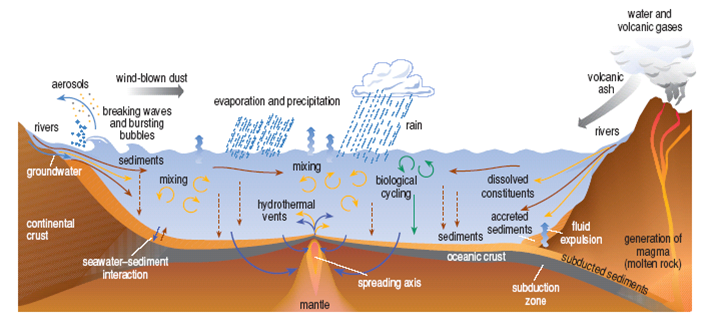
- Cycle: Evaporation mainly oceanic regions, preceiptation on high mountains/land masses, seasonal systems such as Monsoon 80% rainfall India, some rivers
dominate river inout such as the Amazon (20% fresh water input to oceans)
- Physical erosion
- Physical weathering is caused by the effects of changing temperature on rocks, causing the rock to
break apart. The process is sometimes assisted by water.
- Freeze-thaw occurs when water continually seeps into cracks, freezes and expands, eventually
breaking the rock apart.
- Exfoliation occurs as cracks develop parallel to the land surface a consequence of the reduction in
pressure during uplift and erosion.
- Glaciers-base of glacier rubs on rock due to temperature and increases surface area of rock to cause chemical erosion vulnerablitiy
- Freeze-thaw occurs when water continually seeps into cracks, freezes and expands, eventually
breaking the rock apart.
- Physical weathering is caused by the effects of changing temperature on rocks, causing the rock to
break apart. The process is sometimes assisted by water.
- Chemical Erosion
- Chemical weathering is caused by rain water reacting with the mineral grains in rocks to form new
minerals (clays) and soluble salts. These reactions occur particularly when the water is slightly acidic.
- Solution - removal of rock in solution by acidic rainwater. In particular, limestone is weathered by
rainwater containing dissolved CO2, (this process is sometimes called carbonation).
- Hydrolysis - the breakdown of rock by acidic water to produce clay and soluble salts.
- Oxidation - the breakdown of rock by oxygen and water, often giving iron-rich rocks a rusty-coloured
weathered surface.
- Solution - removal of rock in solution by acidic rainwater. In particular, limestone is weathered by
rainwater containing dissolved CO2, (this process is sometimes called carbonation).
- Chemical weathering is caused by rain water reacting with the mineral grains in rocks to form new
minerals (clays) and soluble salts. These reactions occur particularly when the water is slightly acidic.
- Rivers
- Rivers from mountains more concentrated amounts of sediment
- Rivers in contact to sediment, large amount of specific sediment such as the Yankize River
- Rivers from mountains more concentrated amounts of sediment
- Weathering and Global climate
- Change overtime via river input changes
- Chemical weathering reactions results in drawdown of CO2 thus
CO2 in climate: CaSi03 + 2CO2+3H20=Ca2+ + 2HCO3- + H4SiO4
- Chemical weathering reactions results in drawdown of CO2 thus
CO2 in climate: CaSi03 + 2CO2+3H20=Ca2+ + 2HCO3- + H4SiO4
- Biochemical processes in ocean
- Marine life to form sediment in subduction zone. Inputs are rivers, ground water, vents, volcanic material, etc
- Marine life to form sediment in subduction zone. Inputs are rivers, ground water, vents, volcanic material, etc
- Change overtime via river input changes
- Iron, case study
- Iron low in surface of ocean due to it being a nutrient to microrganisms
- Iron increases at depth due to reinduction to system via recycling
- Sources Dissolution of deserts and melting of ice bergs (antarctica),mid ocean ridges where hydrothermal vents occur
- Sources Dissolution of deserts and melting of ice bergs (antarctica),mid ocean ridges where hydrothermal vents occur
- Iron increases at depth due to reinduction to system via recycling
- Iron low in surface of ocean due to it being a nutrient to microrganisms
- Summary: Cycle links ocean to atmosphere, terrestrial GEOSPHERE/BIOSPHERE
- Material transported via chemical and physical erosion
- Magnitude of processes changed over time and affect climate
- Distribution of material in ocean and record fluxes and internal processing
- Distribution of material in ocean and record fluxes and internal processing
- Magnitude of processes changed over time and affect climate
- Material transported via chemical and physical erosion
Medienanhänge
Möchten Sie kostenlos Ihre eigenen Mindmaps mit GoConqr erstellen? Mehr erfahren.