
1421496
Beschreibung

Mindmap von matthewr0921, aktualisiert more than 1 year ago

|
Erstellt von matthewr0921
vor mehr als 11 Jahre
|
|
Atomic Structure
- Definitions
- Isotopes
- any of two or more forms of a
chemical element, having the same
number of protons in the nucleus,
or the same atomic number, but
having different numbers of
neutrons in the nucleus, or
different atomic weights. There are
275 isotopes of the 81 stable
elements, in addition to over 800
radioactive isotopes, and every
element has known isotopic forms.
Isotopes of a single element possess
almost identical properties.
- any of two or more forms of a
chemical element, having the same
number of protons in the nucleus,
or the same atomic number, but
having different numbers of
neutrons in the nucleus, or
different atomic weights. There are
275 isotopes of the 81 stable
elements, in addition to over 800
radioactive isotopes, and every
element has known isotopic forms.
Isotopes of a single element possess
almost identical properties.
- Protons
- a positively
charged
elementary
particle that is
a fundamental
constituent of
all atomic
nuclei. It is the
lightest and
most stable
baryon, having
a charge equal
in magnitude
to that of the
electron
- a positively
charged
elementary
particle that is
a fundamental
constituent of
all atomic
nuclei. It is the
lightest and
most stable
baryon, having
a charge equal
in magnitude
to that of the
electron
- Neutrons
- an elementary particle having no
charge, mass slightly greater than
that of a proton, and spin of ½: a
constituent of the nuclei of all
atoms except those of hydrogen
- an elementary particle having no
charge, mass slightly greater than
that of a proton, and spin of ½: a
constituent of the nuclei of all
atoms except those of hydrogen
- Electrons
- Also called negatron. Physics, Chemistry.
an elementary particle that is a
fundamental constituent of matter
- Also called negatron. Physics, Chemistry.
an elementary particle that is a
fundamental constituent of matter
- Atomic Mass
- the mass of an isotope of an
element measured in units
formerly based on the mass of
one hydrogen atom taken as a
unit or on 1/16 (0.0625) the mass
of one oxygen atom, but after
1961 based on 1/12 (0.0833) the
mass of the carbon-12 atom.
- the mass of an isotope of an
element measured in units
formerly based on the mass of
one hydrogen atom taken as a
unit or on 1/16 (0.0625) the mass
of one oxygen atom, but after
1961 based on 1/12 (0.0833) the
mass of the carbon-12 atom.
- Radioactive
Decay
- Beta Decay
- a radioactive process in
which a beta particle is
emitted from the nucleus
of an atom, raising the
atomic number of the
atom by one if the particle
is negatively charged,
lowering it by one if
positively charged.
- a radioactive process in
which a beta particle is
emitted from the nucleus
of an atom, raising the
atomic number of the
atom by one if the particle
is negatively charged,
lowering it by one if
positively charged.
- Alpha Decay
- a radioactive
process in
which an alpha
particle is
emitted from
the nucleus of
an atom,
decreasing its
atomic
number by
two.
- a radioactive
process in
which an alpha
particle is
emitted from
the nucleus of
an atom,
decreasing its
atomic
number by
two.
- Gamma Decay
- type of radioactivity
in which an unstable
atomic nucleus
dissipates energy by
gamma emission,
producing gamma
rays.
- type of radioactivity
in which an unstable
atomic nucleus
dissipates energy by
gamma emission,
producing gamma
rays.
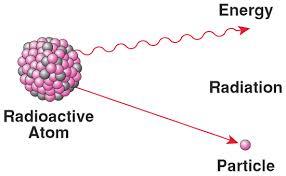
- Spontaneous
disintegration of a
radionuclide with
the emission of
energetic particles
or radiation, such
as alpha or beta
particles or
gamma rays.
- Beta Decay
- Atom
- the smallest component of an
element having the chemical
properties of the element,
consisting of a nucleus
containing combinations of
neutrons and protons and one
or more electrons bound to the
nucleus by electrical
attraction; the number of
protons determines the
identity of the element.
- the smallest component of an
element having the chemical
properties of the element,
consisting of a nucleus
containing combinations of
neutrons and protons and one
or more electrons bound to the
nucleus by electrical
attraction; the number of
protons determines the
identity of the element.
- Isotopes
- Diagrams
- Electron Shells
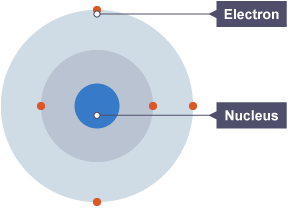
- n chemistry and atomic
physics, an electron shell, also
called a principal energy level
may be thought of as an orbit
followed by electrons around an
atom's nucleus
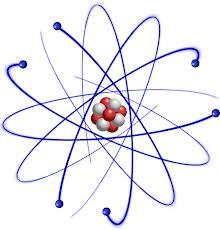
- The nuclear model Atoms contain three sub-atomic particles called protons, neutrons and
electrons. The protons and neutrons are found in the nucleus at the centre of the atom. The
nucleus is very much smaller than the atom as a whole. The electrons are arranged in shells
around the nuc
- The number of protons in the
nucleus of an atom is called its
atomic number: the atoms of a
particular element all have the
same number of protons the
atoms of different elements
have different numbers of
protons The total number of
protons and neutrons in an
atom is called its mass
number. Chlorine 35 square
from the periodic table. The
mass number (35) is top-left.
The atomic number (17) is
bottom-left. Chemical symbol
of chlorine-35 The proton
number is shown below the
chemical symbol, and the
mass number is shown above.
In this example the atomic
number is 17 and the mass
number is 35. This means that
each of these atoms has: 17
protons 17 electrons 35 - 17 =
18 neutrons Isotopes are atoms
of an element with the normal
number of protons and
electrons, but different
numbers of neutrons. Isotopes
have the same atomic number,
but different mass numbers.
Isotopes can either be
radioactive or non-radioactive.
For example, 14C is used in
radiocarbon dating to
determine the age of histori
- n chemistry and atomic
physics, an electron shell, also
called a principal energy level
may be thought of as an orbit
followed by electrons around an
atom's nucleus
- Electron Shells
- Experiment
- Problem Solving And Calculations
- Compound Formula Calculation Relative formula mass Water H2O 1 + 1 + 16 = 18 Sodium
hydroxide NaOH 23 + 16 + 1 = 40 Magnesium hydroxide Mg(OH)2 24 + 16 + 16 + 1 + 1 = (remember
that there are two of each atom inside the brackets) 58 Ar of H = 1 Ar of O = 16 Ar of Na = 23 Ar of
Mg = 24
- The relative atomic mass of an element shows its mass compared with the mass of atoms of other
elements. The relative atomic mass of carbon is 12, while the relative atomic mass of magnesium is
24. This means that each magnesium atom is twice the mass of a carbon atom.
- Relative atomic masses can be used to find the relative formula mass of a compound. To find the
relative formula mass (Mr) of a compound, you add together the relative atomic mass values (Ar
values) for all the atoms in its formula.
- Compound Formula Calculation Relative formula mass Water H2O 1 + 1 + 16 = 18 Sodium
hydroxide NaOH 23 + 16 + 1 = 40 Magnesium hydroxide Mg(OH)2 24 + 16 + 16 + 1 + 1 = (remember
that there are two of each atom inside the brackets) 58 Ar of H = 1 Ar of O = 16 Ar of Na = 23 Ar of
Mg = 24
Medienanhänge
Möchten Sie kostenlos Ihre eigenen Mindmaps mit GoConqr erstellen? Mehr erfahren.