
1423194


C1a-b
- CRUDE OIL
- HYDROCARBON: is a compound that contains only carbon and hydrogen.
Crude oil is a mixture of hydrocarbons. Crude oil is a finite and non-renewable resource
- FINITE: a resource that is no longer being made or is being made slowly
NON-RENEWABLE: a resource that is being used up faster than it's being made
- HYDROCARBON: is a compound that contains only carbon and hydrogen.
Crude oil is a mixture of hydrocarbons. Crude oil is a finite and non-renewable resource
- FRACTIONAL DISTILLATION
- Crude oil is heated and enters the tower
- It boils and turns into a gas which rises up
- The gas then condenses at boiling point.
There's a temperature gradient in the tower
with the coolest being 25c and the hottest
350c at the bottom
- The hydrocarbons all boil at a different
temperature depending on f they're big or
small
- The big chain hydrocarbons condense at
the bottom as it's hot and they boil at a
high BP and small chain hydrocarbons
condense at the top where it's cold as they
have a low BP
- When each hydrocarbon condenses it flows
into a fraction. Each fraction have similar
sized hydrocarbons in
- All the hydrocarbons that are small go to the
top as it's cooler, for example petrol, and the
bigger chain hydrocarbons go to the hotter
point at the bottom. Bitumen is too big to
boil, so sinks to the bottom
- All the hydrocarbons that are small go to the
top as it's cooler, for example petrol, and the
bigger chain hydrocarbons go to the hotter
point at the bottom. Bitumen is too big to
boil, so sinks to the bottom
- When each hydrocarbon condenses it flows
into a fraction. Each fraction have similar
sized hydrocarbons in
- The big chain hydrocarbons condense at
the bottom as it's hot and they boil at a
high BP and small chain hydrocarbons
condense at the top where it's cold as they
have a low BP
- The hydrocarbons all boil at a different
temperature depending on f they're big or
small
- The gas then condenses at boiling point.
There's a temperature gradient in the tower
with the coolest being 25c and the hottest
350c at the bottom
- It boils and turns into a gas which rises up
- Long chain hydrocarbons have strong
intermolecular forces that hold the chains close
together. These break during boiling, because
they're strong, lots of energy is needed to break and
so they have a high boiling point
- Crude oil is heated and enters the tower
- CRACKING
- DEFINITION: cracking turns the surplus
long-chain hydrocarbons into useful short-chain
hydrocarbons
- There is now more of a demand for petrol and not
enough petrol being made quick enough. So cracking is
used to turn long-chain hydrocarbons into short-chain
hydrocarbons, which makes enough petrol to meet the
demand of it
- DEFINITION: cracking turns the surplus
long-chain hydrocarbons into useful short-chain
hydrocarbons
- FUELS AND COMBUSTION
- T = toxicity E = energy value A = availability C =
costs U = usability P = pollution caused S = storage
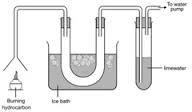
- COMPLETE COMBUSTION: fuel + oxygen -------> carbon dioxide + water
- methane + oxygen -------> carbon dioxide + water
- methane + oxygen -------> carbon dioxide + water
- INCOMPLETE COMBUSTION: fuel + oxygen -------> carbon monoxide + carbon + water
- ethane + oxygen -------> carbon monoxide + carbon + water
- ethane + oxygen -------> carbon monoxide + carbon + water
- T = toxicity E = energy value A = availability C =
costs U = usability P = pollution caused S = storage
- BALANCING EQUATIONS
- CH4 + O2 -------> CO2 + H20
- CH4 +2O2 -------> CO2 + 2H20
- CH4 +2O2 -------> CO2 + 2H20
- LEFT HAND SIDE = C: 1 H: 4 O: 2
RIGH HANDSIDE = C: 1 0: 3 H: 2
- CH4 + O2 -------> CO2 + H20
- CLEAN AIR
- NITROGEN: 78% OXYGEN: 21%
CARBON DIOXIDE: 0.035% NOBLE
GASES: approx. 1%
- The early atmosphere was rich in ammonia. The
degassing of volcanoes lead to an atmosphere rich
in carbon dioxide and water vapour. As the
temperature started to cool the water vapour
condensed. This formed oceans. Some of the co2
started to dissolve in the oceans. Ammonia was
converted into nitrogen through a series of chemical
reactions and by bacteria , because nitrogen is so
unreactive it's levels start to evolve. These converted
co2 into oxygen. This meant that oxygen levels rose
and co2 levels fell. This is how today's atmosphere
formed.
- The early atmosphere was rich in ammonia. The
degassing of volcanoes lead to an atmosphere rich
in carbon dioxide and water vapour. As the
temperature started to cool the water vapour
condensed. This formed oceans. Some of the co2
started to dissolve in the oceans. Ammonia was
converted into nitrogen through a series of chemical
reactions and by bacteria , because nitrogen is so
unreactive it's levels start to evolve. These converted
co2 into oxygen. This meant that oxygen levels rose
and co2 levels fell. This is how today's atmosphere
formed.
- NITROGEN: 78% OXYGEN: 21%
CARBON DIOXIDE: 0.035% NOBLE
GASES: approx. 1%
Medienanhänge
Möchten Sie kostenlos Ihre eigenen Mindmaps mit GoConqr erstellen? Mehr erfahren.