
15142394
Beschreibung

Mindmap von Jakub Trybull, aktualisiert more than 1 year ago

|
Erstellt von Jakub Trybull
vor mehr als 7 Jahre
|
|
Macbeth
- The Supernatural
- Witches and The Supernatural
- The witches are sometimes referred to as the 'weird sisters'
by other characters, showing that they are rejected from
society, and are not welcome and are outcasts in the natural
realm. This can symbolise that they're supernatural
presence is rejected from the real world.
- In Act 1 Scene 1, the Witches are the first characters that the audience experience of
the play. The scene starts of with 'Thunder and Lightning' to set the background for
the play. This pathetic fallacy technique acts as symbol of nature's response to the
witches. This shows disturbance in tranquility and the 'natural order' (-showing that
even nature fears them due to them beyond beyond nature)
- Historical Context: Jacobean
audience scared of storms due to
vast destruction to their houses
and buildings.
- Historical Context: Jacobean
audience scared of storms due to
vast destruction to their houses
and buildings.
- Trochaic Tetrameter: Intonation/stress on the off beat - opposite to
iambic pentameter, opposite to how people speak in the play. Iambic
pentameter imitates the sound of a heartbeat - the purity of life, this
sounds like something wrong like a disease..
- When answering a question about the supernatural: START WITH THE WITCHES!
- The witches are sometimes referred to as the 'weird sisters'
by other characters, showing that they are rejected from
society, and are not welcome and are outcasts in the natural
realm. This can symbolise that they're supernatural
presence is rejected from the real world.
- Macbeth and The Supernatural
- Macbeth first experiences the witches' visions, he
says: 'Stay you imperfect speakers, tell me more
- He is already vulnerable to The
Supernatural and its influence upon
him, he pleads and years for the
witches to tell him more
- 'Imperfect' - Macbeth knows that
they are evil and ungodly yet he is
drawn by his curiosity.
- He is already vulnerable to The
Supernatural and its influence upon
him, he pleads and years for the
witches to tell him more
- Compare to Banquo. SHOW THE INFLUENCE OVER HIM - POSSESSION
- Banquo is a foil character - the opposite of Macbeth.
- 'Have we eaten on the insane root?' - Are we
drugged, hallucinating, is this even real?
- 'Insane' - not normal, unnatural
- 'Insane' - not normal, unnatural
- 'Oftentimes, to win us to our harm, the
instruments of darkness tell us truths' - they tell
us truths to harm or deceive us - he knows what
they are doing.
- He resists the temptation, he sees the bigger
clearer picture, he is not under their influence.
- Shakespeare uses foil characters to show the protagonists
characteristics and FLAWS for the audience to contrast and
understand the character of Macbeth. To understand his
temptation.
- 'Have we eaten on the insane root?' - Are we
drugged, hallucinating, is this even real?
- ' I will not fight with thee' -
Macbeth gives in, his tragic fall -
climax - he was being toyed.
- Macbeth first experiences the witches' visions, he
says: 'Stay you imperfect speakers, tell me more
- Lady Macbeth and The Supernatural
- Witches and The Supernatural
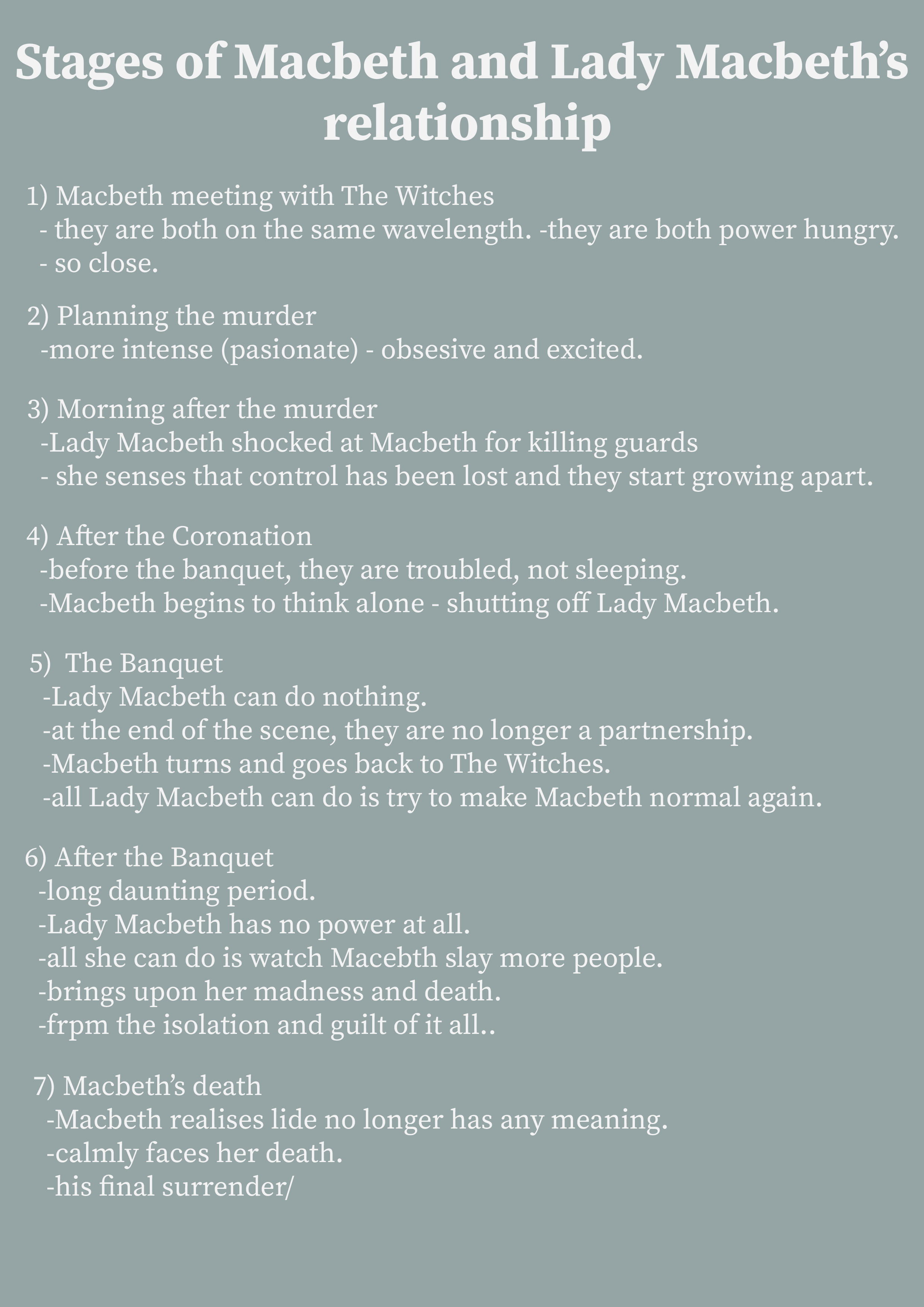
- Macbeth and Lady Macbeth
- APPEARANCE Vs. REALITY
- Appearance
- Presents them as a
strong couple in front
of subjects.
- Macbeth is like a marionette played on
strings by Lady Macbeth which is
yearning for power.
- Presents them as a
strong couple in front
of subjects.
- Reality
- At the end, they are alone -
battling their demons
- Quest for power -> relationship
and sanity crumbles
- Quest for power -> relationship
and sanity crumbles
- Lady Macbeth has the POWER
- She plans the murders
- ACT 3 SCENE 1
- She has lost all power and control over her husband
- Her tctics don't work anymore
- She insists they still preesent themselves as a strong beautiful couple
through imagery - RELATING BACK TO APPEARANCE Vs. REALITY
- 'Look like th' innocent flower, But
be the serpent under ’t'
- How they present themselves in the public eye is not the same behind closed doors
- Lady Macbeth loses power behind closed doors
- She sleepwalks due to her involvement in the murders
- THEME OF GUILT - Blames herself
- THEME OF GUILT - Blames herself
- She sleepwalks due to her involvement in the murders
- She no longer seeks the husband she married
- As he continues to kill innocent women and children
- Her isolation from her husband has added to her insanity
- But Macbeth's hunger for power
has pulled him away.
- Leaving Lady Macbeth alone - adrift.
- Leaving Lady Macbeth alone - adrift.
- She saw them as a power couple
- Together through it all
- Partners in greatness
- Appearance
- Eventhough Shakespeare presented Lady Macbeth
as being the powerful one in the relationship
- With her influence over her husband
- She never really had any power
- She needed a husband to be powerful - to
become Queen.
- She is poweless without him
- Alone and weak
- Suicide not too big of a surprise
- Suicide not too big of a surprise
- Alone and weak
- She is poweless without him
- She needed a husband to be powerful - to
become Queen.
- She asked the spirits to 'Unsex' her
- But all they did was take her power
away - the very thing she longed for
- But all they did was take her power
away - the very thing she longed for
- She never really had any power
- With her influence over her husband
- Eventhough Shakespeare presented Lady Macbeth
as being the powerful one in the relationship
- Appearance
- Partners in greatness
- Together through it all
- But Macbeth's hunger for power
has pulled him away.
- Her isolation from her husband has added to her insanity
- As he continues to kill innocent women and children
- Lady Macbeth loses power behind closed doors
- How they present themselves in the public eye is not the same behind closed doors
- 'Look like th' innocent flower, But
be the serpent under ’t'
- Her tctics don't work anymore
- She has lost all power and control over her husband
- ACT 3 SCENE 1
- Lady Macbeth was
meant to kill the King.
- 'my knife' 'my fell purpose'
- 'my knife' 'my fell purpose'
- She plans the murders
- At the end, they are alone -
battling their demons
- SELFISH
- Macbeth's fault or Lady Macbeth's fault?
- Or was it external forces?
- Macbeth's fault or Lady Macbeth's fault?
- Appearance
- When Macbeth finds out that Lady
Macbeth is dead he is not shocked.
- 'she should have died hereafter, there
would have been a time for such word.'
- She would have died anyway - this news
was inevitable.
- She would have died anyway - this news
was inevitable.
- 'she should have died hereafter, there
would have been a time for such word.'
- ACT 1 SCENE 5
- Macebth sends letter about
witches to Lady Macbeth
- 'Art not without ambition, but without
The illness should attend it.'
- 'Too full o' th' milk of human kindness'
- Could foreshadow being driven my ambition - referring to Lady
Macbeth's illness towards the end.
- 'Too full o' th' milk of human kindness'
- A good wife would tell him its a bad idea, that
he shouldn't trust the witches - to not kill. She
should put him over anything else.
- However: she makes the decision to persuade him to do it -
driven my her ambition
- However: she makes the decision to persuade him to do it -
driven my her ambition
- 'Art not without ambition, but without
The illness should attend it.'
- Macebth sends letter about
witches to Lady Macbeth
- 'Dearest partner in Greatness'
- Both their ambition
- Both driven mad by it
- Both driven mad by it
- Both their ambition
- Lady Macbeth holds power in
relationship - NOT the expectation in
the Jacobean era.
- When Macbeth has doubts she use various techniques/tactics to persuade him.
- Reminding him that it was HIS idea
- Violent imagery - infantcide
- 'dashed the brains out, had I so sworn as you Have done to this.'
- 'dashed the brains out, had I so sworn as you Have done to this.'
- Emasculates and insults him
- Reminding him that it was HIS idea
- Unusual presentation of
powerful women on stage.
- When Macbeth has doubts she use various techniques/tactics to persuade him.
- ACT 2 SCENE 3
- Macbeth announces he has
killed the guard.
- Lady Macbeth then faints
- Perhaps a distraction?
- Perhaps she is shocked that he has killed without her knowledge
- Showing us that he is not too full of the
'milk of human kindness' after all
- Showing us that he is not too full of the
'milk of human kindness' after all
- Perhaps a distraction?
- Lady Macbeth then faints
- Macbeth announces he has
killed the guard.
- At beginning they are deeply in love
and united in their ambition.
- But by the end, power became more important.
- She should've never have persuaded
Macbeth in the first place
- She had no right, she had no relationship to
Duncan whereas Macbeth has a close one.
- She had no right, she had no relationship to
Duncan whereas Macbeth has a close one.
- She should've never have persuaded
Macbeth in the first place
- But by the end, power became more important.
- APPEARANCE Vs. REALITY
Medienanhänge
Möchten Sie kostenlos Ihre eigenen Mindmaps mit GoConqr erstellen? Mehr erfahren.