
15698741
Beschreibung

Mindmap von Soledad Gomez, aktualisiert more than 1 year ago

|
Erstellt von Soledad Gomez
vor fast 8 Jahre
|
|
CLIL PRINCIPLES BY SOLEDAD
- WHAT IS CLIL
- CLIL refers to situations where subjects, or parts of subjects, are taught through a foreign language with dual-focussed
aims, namely the learning of content, and the simultaneous learning of a foreign language". (Marsh, 1994)
- "Generic umbrella term encompassing any activity in which a foreign language is used as a tool in the learning of a
non-language subject in which both language and the subject have a joint curricular role". (Marsh, 2002)
- DUAL FOCUS: CONTENT AND LEARNING BEING MORE IMPORTANT THE CONTENT
- "Generic umbrella term encompassing any activity in which a foreign language is used as a tool in the learning of a
non-language subject in which both language and the subject have a joint curricular role". (Marsh, 2002)
- "CLIL is dynamic, a flexible concept where topics and subjects – foreign language and non-language subject/s – are
integrated in some kind of mutually beneficial way so as to provide value-added to educational outcomes for the
widest possible range of learners." (Doyle, 2006)
- WHEN STUDENTS LEARN CONTENTS IN ANOTHER LANGUAGE THE STUDENTS CREATE MEANING (A VALUE
ADDED) , MAKE THE MEANING ACCESIBLE
- WHEN STUDENTS LEARN CONTENTS IN ANOTHER LANGUAGE THE STUDENTS CREATE MEANING (A VALUE
ADDED) , MAKE THE MEANING ACCESIBLE
- CLIL refers to situations where subjects, or parts of subjects, are taught through a foreign language with dual-focussed
aims, namely the learning of content, and the simultaneous learning of a foreign language". (Marsh, 1994)
- WHY CLIL
- Foreing and minority language promotion and respect
- Communicative approach: acquisition is effecive
- Involves language learning
- L2 learning to know culture, social, contexts.
- Foreing and minority language promotion and respect
- THEORIES SUPPORTING CLIL
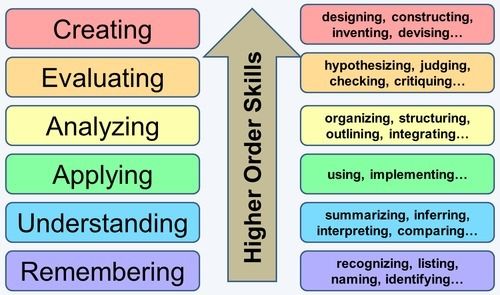
- BLOOM'S TAXONOMY
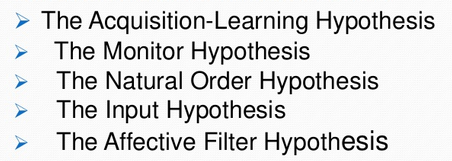
- KRUSHEN COMMUNICATIVE APPROACH
- BLOOM'S TAXONOMY
- 4Cs
- CONTENT
- CONTENT
- CONTENT
- COMMUNICATION
- COMMUNICATION
- COMMUNICATION
- CONGNITION
- COGNITION
- COGNITION
- CULTURE
- ENVIROMENT
- CULTURE
- 5 DIMMENSIONS
- 5 DIMMENSIONS
- ENVIROMENT
- CONTENT
- ESSENTIALS ELEMENTS (CRETON, 2009)
- Safe environment
- 1lang-1person-1room
- Students L1-Silence Period
- Speak Slowly, repetition, using appropiate level of language
- variety: language models, resources,
opportunities to use language
- 4 language Skills
- Fluency >Accuracy
- Safe environment
Medienanhänge


Möchten Sie kostenlos Ihre eigenen Mindmaps mit GoConqr erstellen? Mehr erfahren.