
1588200
Beschreibung

Mindmap von Kristi Brogden, aktualisiert more than 1 year ago

|
Erstellt von Kristi Brogden
vor etwa 11 Jahre
|
|
Cell death in neural development
- Ways
to die
- Programmed
cell death
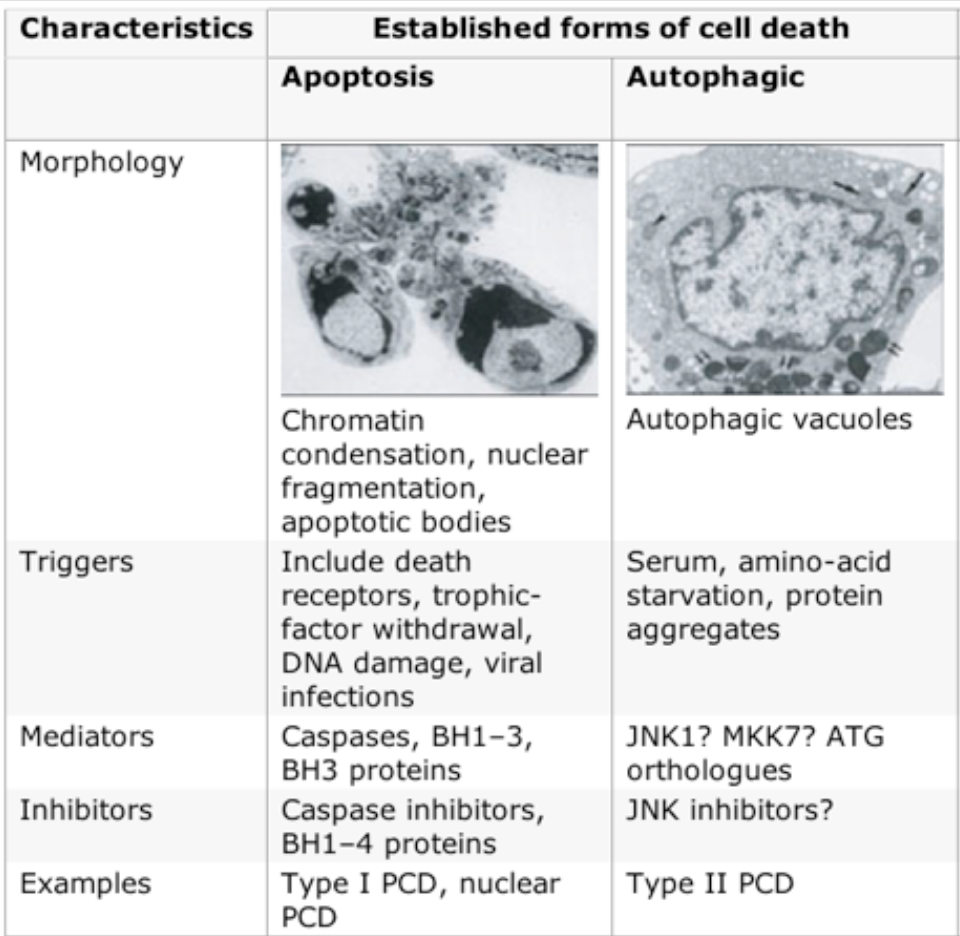
- Apoptosis (Type 1)
- Most well studied
- Activated by extrinsic
and intrinsic signals
- Important in
development and disease
- Most well studied
- Autophagy (Type 2)
- Less well
studied
- Triggered by starvation,
Protein aggregates
- Important
in disease
- Tumor supressive
- Neurodegeneration
- Tumor supressive
- Less well
studied
- Cytoplasmic
(Type 3)
- Apoptosis (Type 1)
- Necrosis
- Programmed
cell death
- Apoptosis
- Experiments
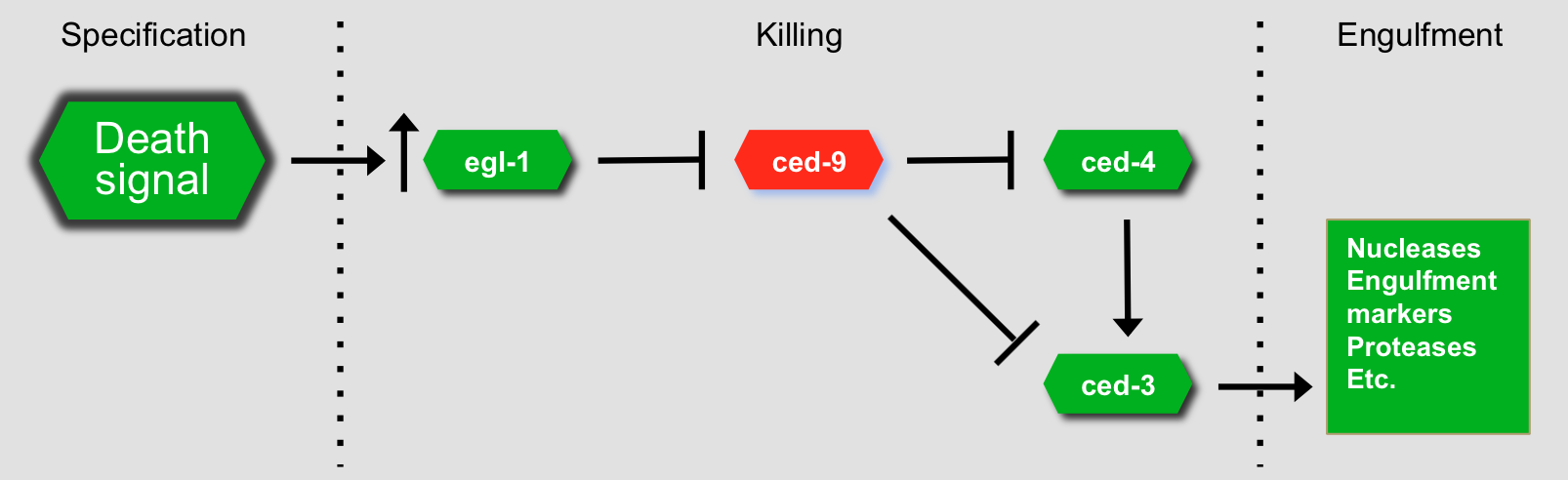
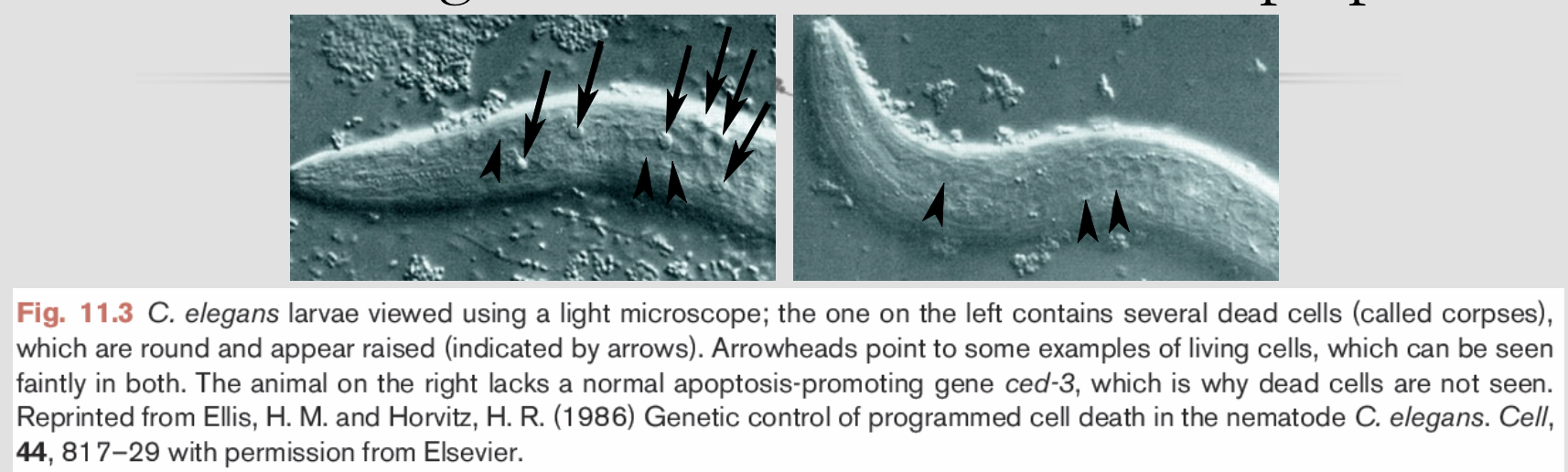
- Knockout of ced-3
(Cell death abnormal)
or egl-1 (Egg laying
defective)
- Too many cells
- These are 'pro-apoptotic' proteins
- These are 'pro-apoptotic' proteins
- Too many cells
- Knockout
of ced-9
- Too much
cell death
- ''Anti-apoptotic"
protein
- ''Anti-apoptotic"
protein
- Too much
cell death
- Knockout of ced-3
(Cell death abnormal)
or egl-1 (Egg laying
defective)
- Homologs of
c.elegans cell death
proteins conserved
in vertebrates -
regulate cell death
- With some
new
elements
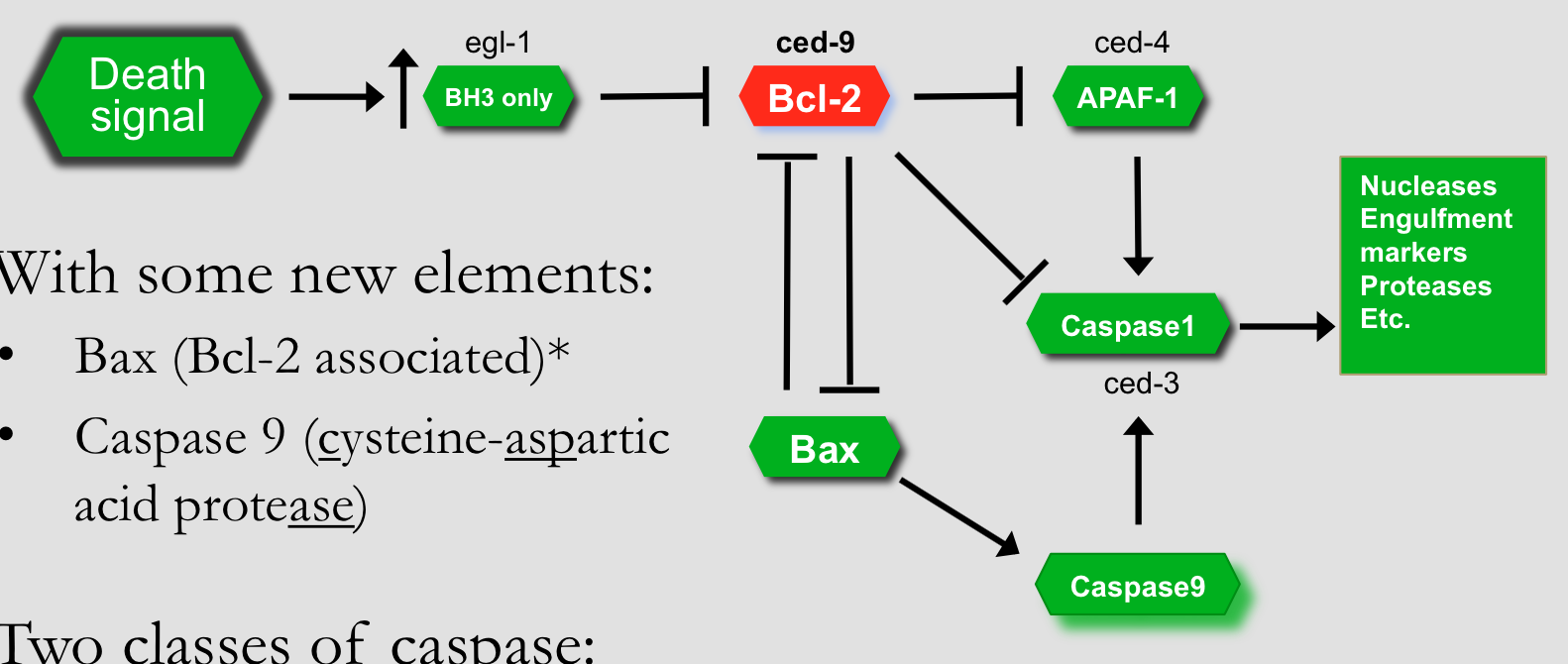
- Bax (Bcl-2 associated)*
- *Bcl-2homology(BH)domain
proteins, including BH3-only,
Bax
- *Bcl-2homology(BH)domain
proteins, including BH3-only,
Bax
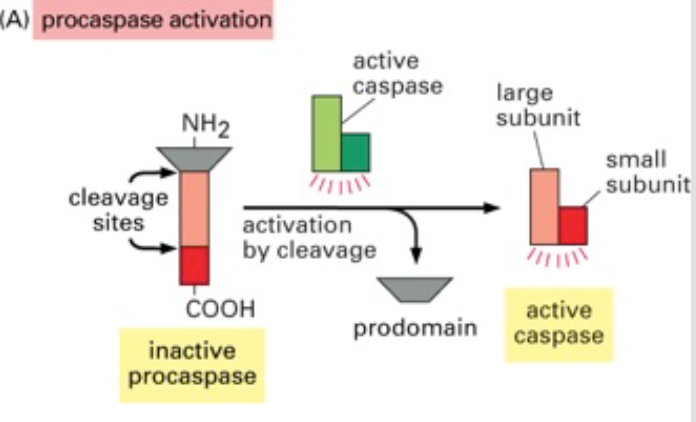
- Caspase 9
(cysteine-aspartic acid
protease)
- Two classes
of caspase
- Executioner
(or effector)
caspase
(e.g.caspase1)
- Initiator caspase
(e.g. caspase 9)
- Executioner
(or effector)
caspase
(e.g.caspase1)
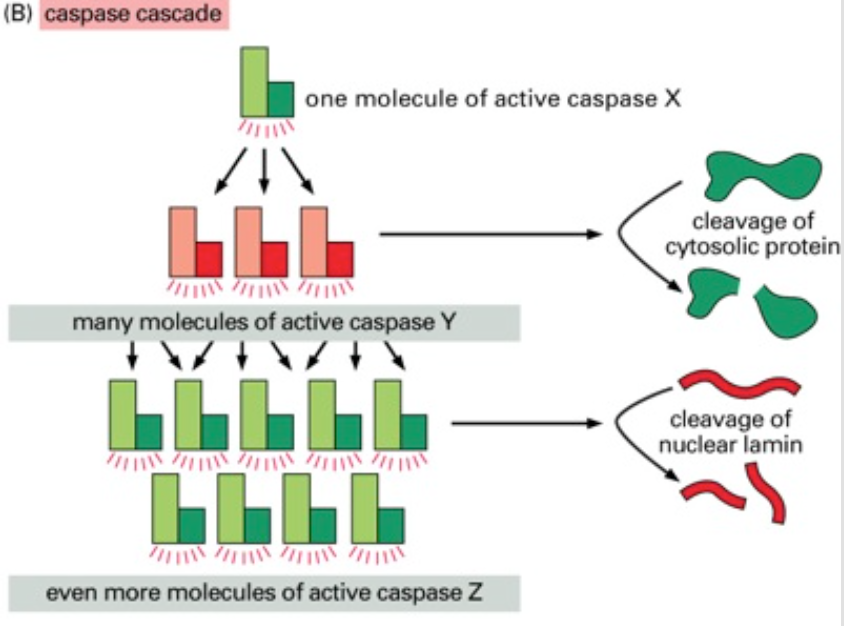
- Caspase
cascade
- At least 10
mammalian
caspases
- Activated by
auto-proteolysis
- Cascade
effect
- Cascade
effect
- Activated by
auto-proteolysis
- At least 10
mammalian
caspases
- Also have many
other substrates
- DNA repair
enzymes
(PARP)
- Nuclear
Lamins
- Maybe as many
as 5% of cell
proteins are
targets!
- DNA repair
enzymes
(PARP)
- Two paths
to
activation
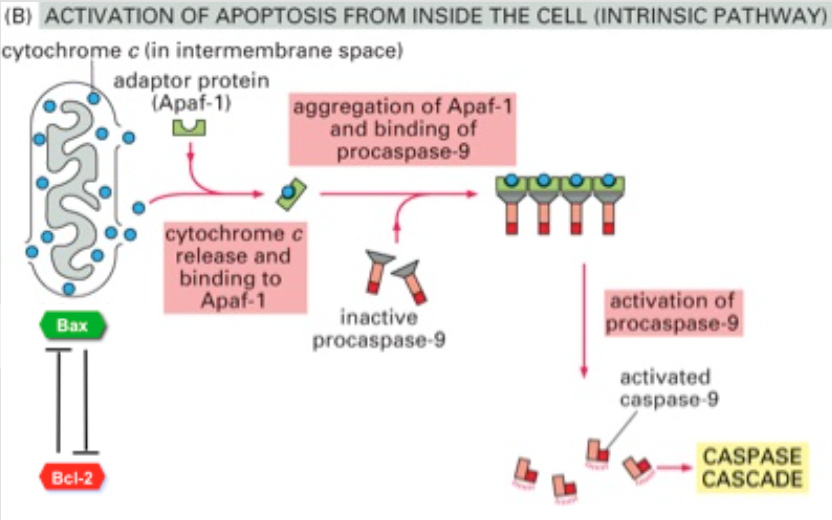
- Intrinsic
Pathway
- Pro-apoptotic BH
domain proteins (Bax,
Bak) permeablise
mitochondrial wall
- BalancebetweenBcl-2(anti-
apoptotic) and Bax/Bak
controls initiation
- Released cytochrome c
binds APAF-1, which
binds and activates
procaspase 9
- Released cytochrome c
binds APAF-1, which
binds and activates
procaspase 9
- BalancebetweenBcl-2(anti-
apoptotic) and Bax/Bak
controls initiation
- Pro-apoptotic BH
domain proteins (Bax,
Bak) permeablise
mitochondrial wall
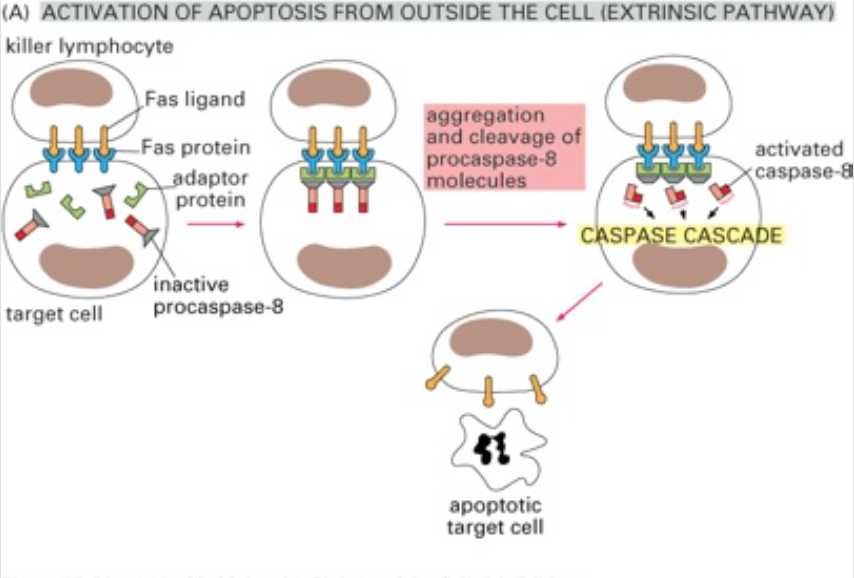
- Extrinsic
pathway
- Due to activation of Death
Receptors by external
ligands, e.g. TNF
- Death receptors have intracellular Death
Domains which bind adaptor proteins and
procaspase 8 into a Death Inducing
Signalling Complex (DISC), thus releasing
active caspase 8
- Death receptors have intracellular Death
Domains which bind adaptor proteins and
procaspase 8 into a Death Inducing
Signalling Complex (DISC), thus releasing
active caspase 8
- Due to activation of Death
Receptors by external
ligands, e.g. TNF
- Intrinsic
Pathway
- Two classes
of caspase
- Bax (Bcl-2 associated)*
- With some
new
elements
- Experiments
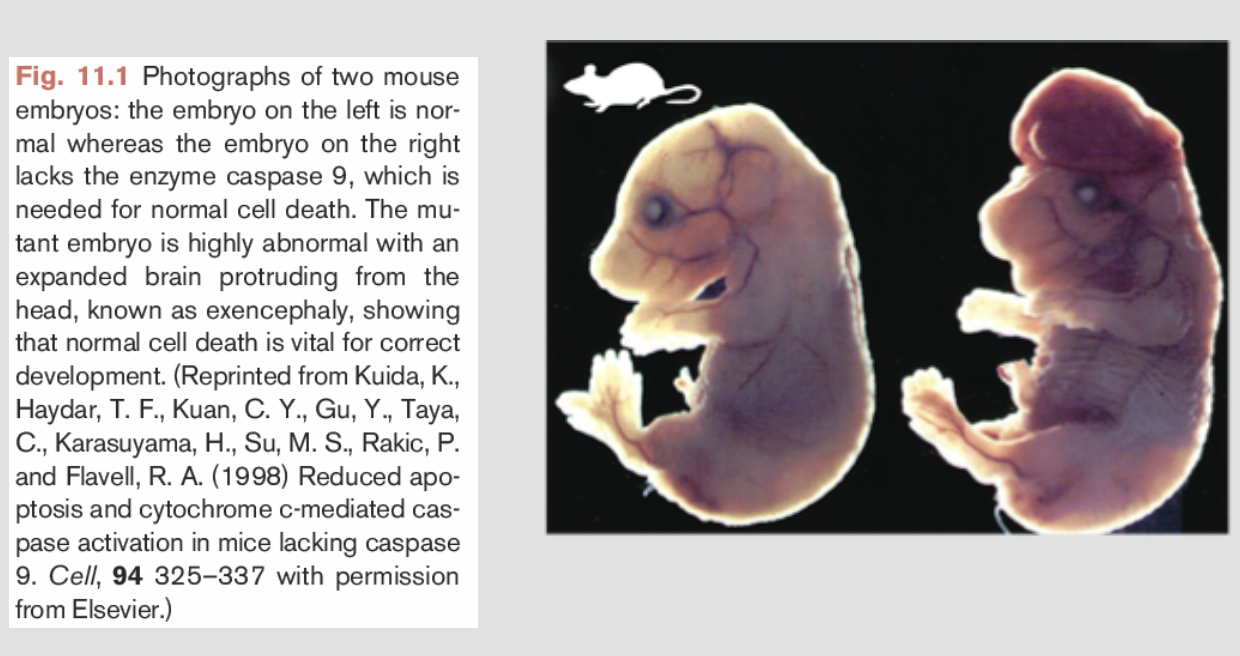
- Role in development
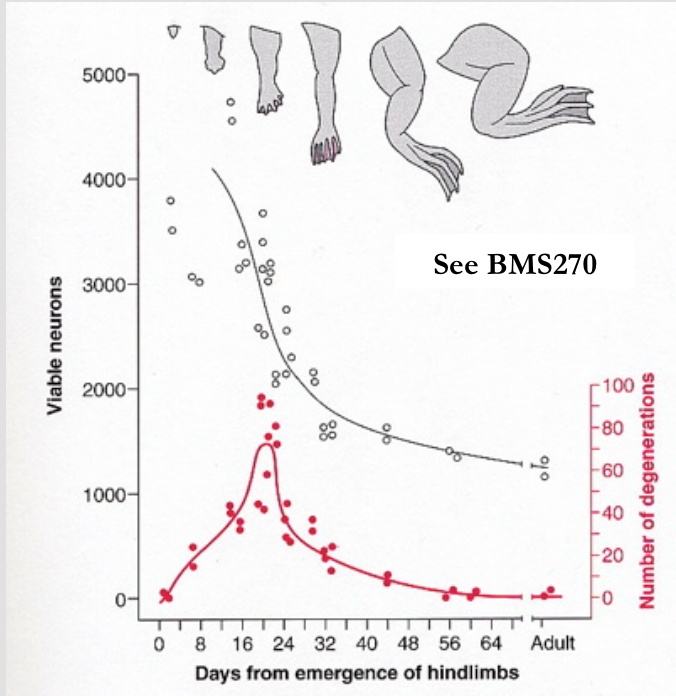
- Cell death is critical
- Loss of caspase 9 leads to exencephaly
- Why cell death?
- PCD occurs in all tissues in
development and throughout life
- Why? (see Raff 1996, Cell v86,
p173, for great discussion)
- Why? (see Raff 1996, Cell v86,
p173, for great discussion)
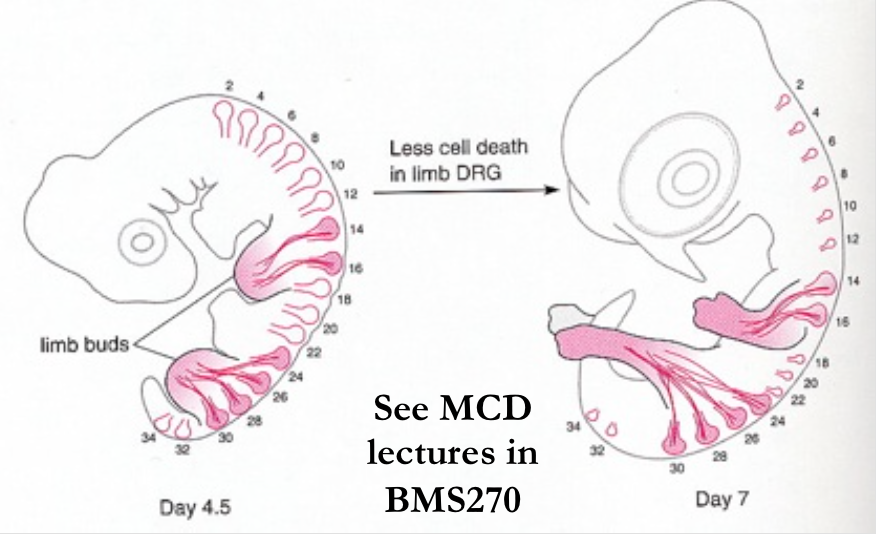
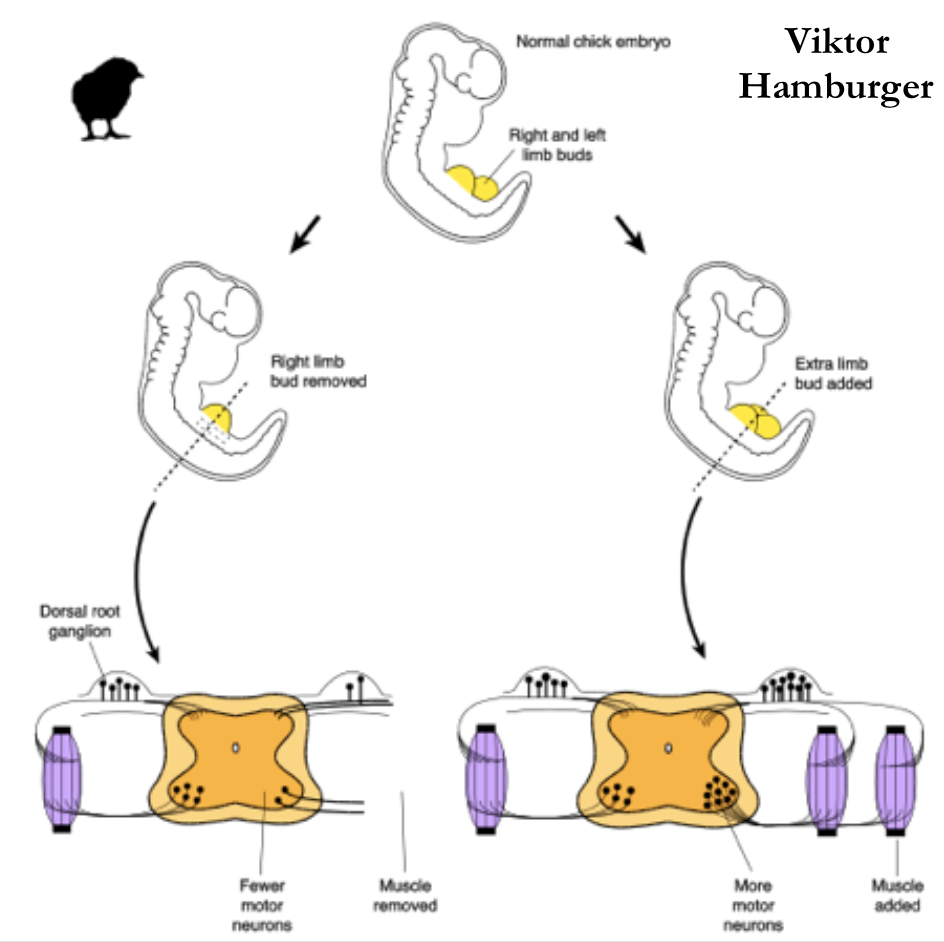
- Size control
- Most tissues are
inter-dependent, you
must keep things in
proportion
- Axons receive ‘trophic
support’ from their
targets (and vice-versa)
- Most tissues are
inter-dependent, you
must keep things in
proportion
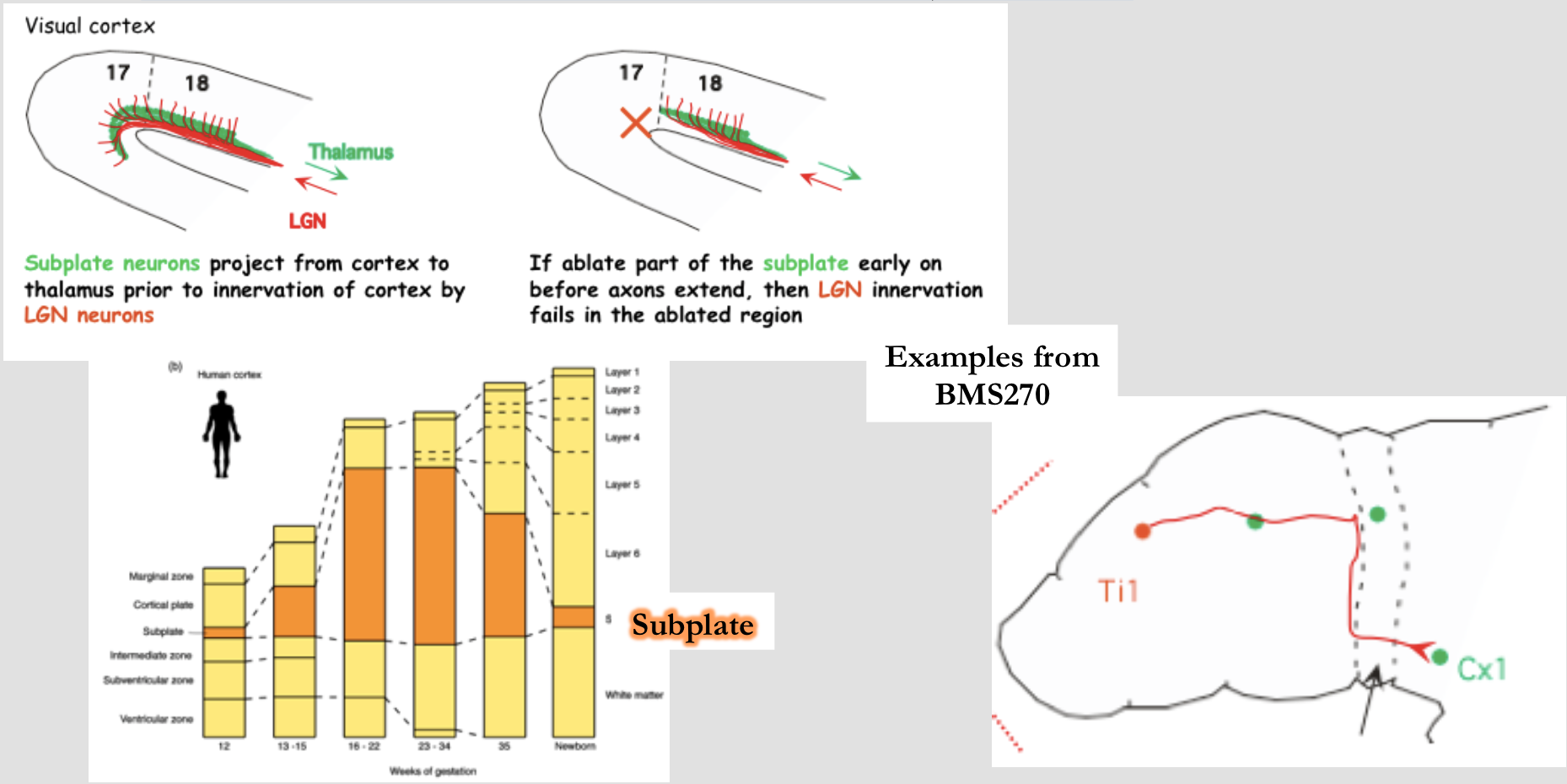
- Removal of
transient
structures
- E.g. subplate neurons in
cortex, Ti1 axons in
grasshopper limb: both are
scaffolds for later axons and
die once their job is done
- E.g. subplate neurons in
cortex, Ti1 axons in
grasshopper limb: both are
scaffolds for later axons and
die once their job is done
- Functional
tuning -
matching
- Elimination of synapses
- Viktor Hamburger 1900-2001 Student of
Hans Spemann, mentor to Levi-Montalcini
and Stanley Cohen, discoverers of NGF.
- What factors
underlie this
interdependence?
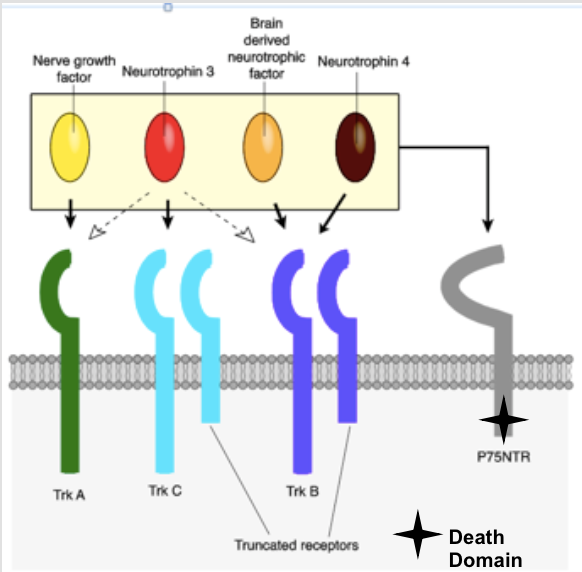
- Neurotrophins
- lack of NGF
promotes survival
and in some
contexts its
absence actively
promotes cell
death.
- Over expression of
p75NTR in
Trk-expressing cells
drives cell death
- Lowered expression
of p75NTR promotes
cell survival
- Binding of a neurotrophin to
p74NTR in the absence of its
appropriate Trk drives death
- p75NTR acts as a complex ‘death
switch’ to tune neuronal survival
to innervation of appropriate
targets
- Because of its 'death switch' properties,
P75NTR is known as a 'dependence receptor'
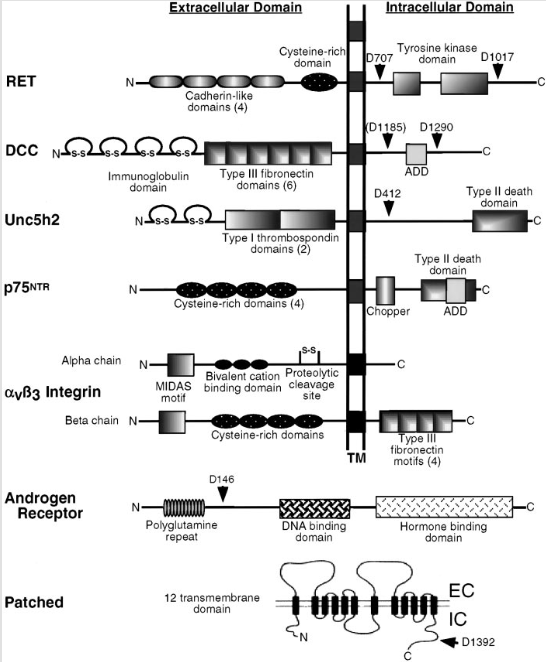
- There are now a large group of ‘dependence
receptors’ defined by their ability to induce
PCD in the absence of their respective
ligands via caspase- dependent cleavage of
their ICDs to release, poorly- defined,
proapoptotic peptides
- Interestingly, many of the identified
dependence receptors are known guidance
receptors (also include EphA4 and TrkC)
- DCC = Deleted in Colon Cancer
- DCC = Deleted in Colon Cancer
- Interestingly, many of the identified
dependence receptors are known guidance
receptors (also include EphA4 and TrkC)
- There are now a large group of ‘dependence
receptors’ defined by their ability to induce
PCD in the absence of their respective
ligands via caspase- dependent cleavage of
their ICDs to release, poorly- defined,
proapoptotic peptides
- Because of its 'death switch' properties,
P75NTR is known as a 'dependence receptor'
- p75NTR acts as a complex ‘death
switch’ to tune neuronal survival
to innervation of appropriate
targets
- Binding of a neurotrophin to
p74NTR in the absence of its
appropriate Trk drives death
- Lowered expression
of p75NTR promotes
cell survival
- Electrical activity can also
modify response to death
signals through activation of
neurotrophin expression
- lack of NGF
promotes survival
and in some
contexts its
absence actively
promotes cell
death.
- Neurotrophins
- What factors
underlie this
interdependence?
- Elimination of synapses
- PCD occurs in all tissues in
development and throughout life
- Loss of caspase 9 leads to exencephaly
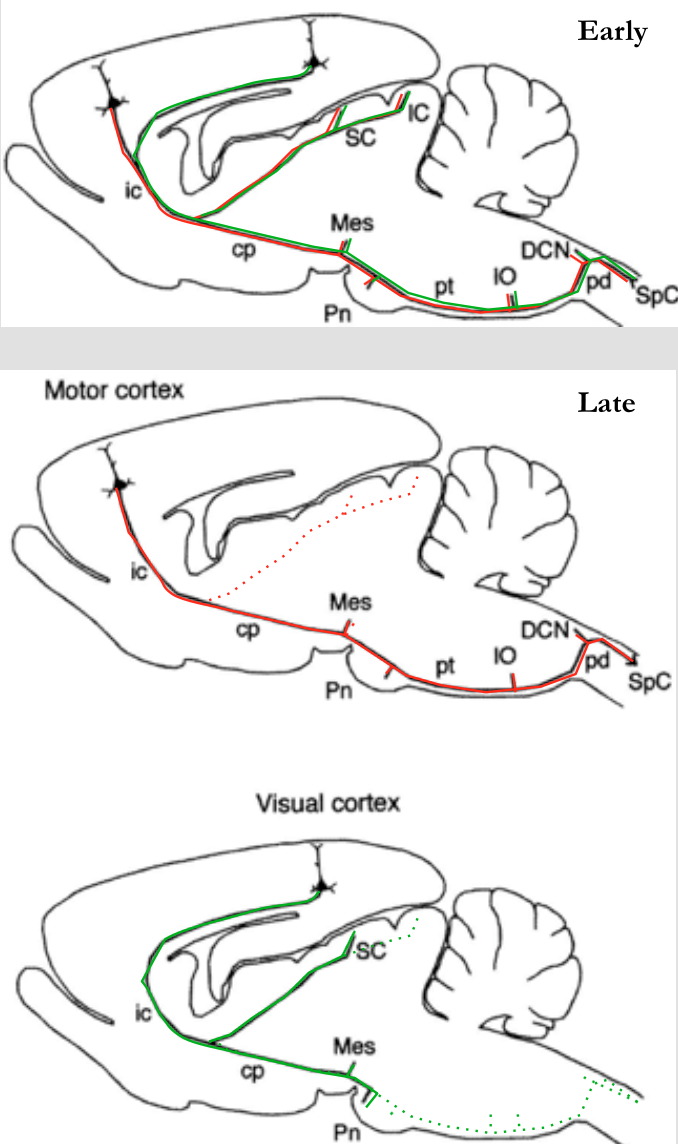
- Its not all about cells dying
- The pruning back of initially
exuberant growth is a widespread
feature of NS development
- e.g. cortico-spinal and
cortico-collicular projections
are initially similar, but are
differentially pruned
- Many features of pruning are
shared with Wallerian
degeneration and with
apoptosis, including
- Cell
fragmentation
- Clearing by
phagocytosis
- Led to the speculation
that PCD pathways may
be involved in both...
- Local caspase
activity directs
pruning
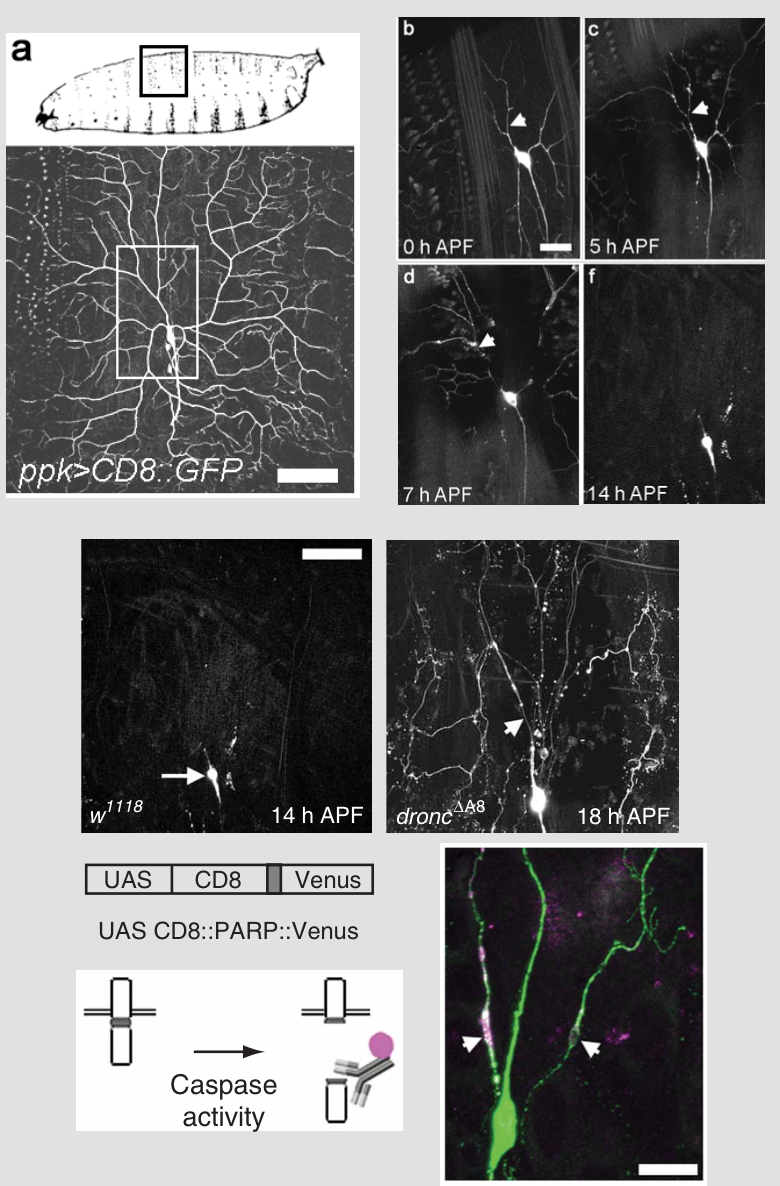
- DRONC is the caspase9 (ie initiator
caspase) equivalent in drosophila
- Dendrites of local sensory neurons are pruned by
local degeneration, involving branch severing,
blebbing and fragmentation cf. Wallerian deg
- Bloackade of DRONC (Lof
or DN) blocks pruning
- A reporter of caspase activation
(based on PARP, an Effector caspase
substrate), shows local activity at
sites of branch severing
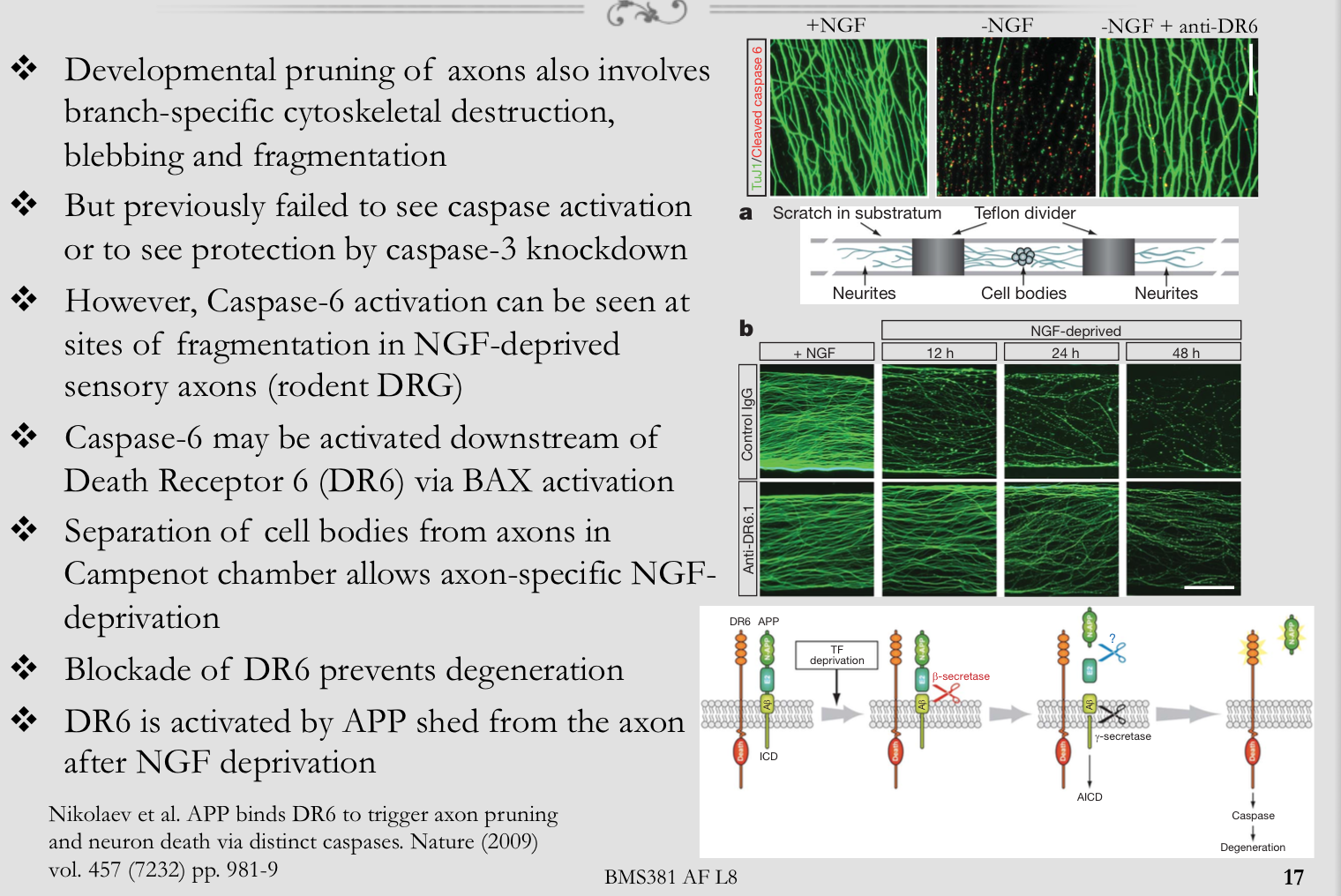
- Evidence suggests caspases do not
initiate severing of branches but are
involved in the subsequent process of
engulfment by phagocytes
- Evidence suggests caspases do not
initiate severing of branches but are
involved in the subsequent process of
engulfment by phagocytes
- Caspases also involved
in axon degeneration
- DRONC is the caspase9 (ie initiator
caspase) equivalent in drosophila
- Local caspase
activity directs
pruning
- Cell
fragmentation
- e.g. cortico-spinal and
cortico-collicular projections
are initially similar, but are
differentially pruned
- The pruning back of initially
exuberant growth is a widespread
feature of NS development
- Cell death is critical
- See ppt for last 4 slides
Medienanhänge

Möchten Sie kostenlos Ihre eigenen Mindmaps mit GoConqr erstellen? Mehr erfahren.