
1662455
Beschreibung

Mindmap von Blublue yong, aktualisiert more than 1 year ago

|
Erstellt von Blublue yong
vor etwa 11 Jahre
|
|
Vacuum Science and Technology
- Why?
- To remove active
atmospheric
constituents (e.g.
deposition of Al
which may end up
Al2O3)
- To decrease energy
transfer (so that only
transfer by radiation
only)
- To remove
occluded or
dissolved gas
or volatile
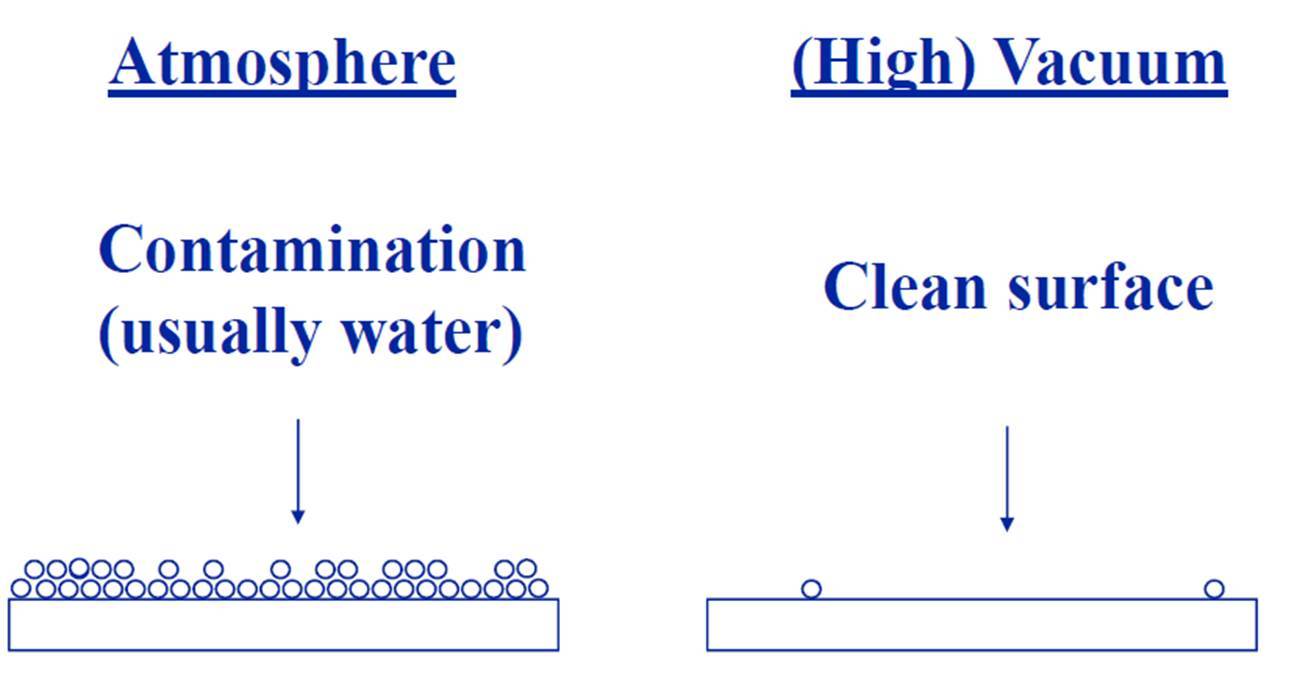
liquid (clean
substrate
surface)
- To extend the long
mean free path
(prevent collision)
- Particles move in a
straight line over
large distance
- To remove active
atmospheric
constituents (e.g.
deposition of Al
which may end up
Al2O3)
- Gas flow, conductance,
pressure ranges
- Assumption: Gaseous
molecules = hard spheres
- Maxwell speed distribution
- Gases at atmospheric
pressure: - change in
velocity is due to gas
phase conditions
- 1. A molecule with
diameter, d moving
randomly in a gas
- 2. collisions occur
- 3. molecule has a collision
cross section of pi d square
- 1. A molecule with
diameter, d moving
randomly in a gas
- Primary
standards to
describe gas
flow
- Throughput
- Standard volume
or standard liter
- Throughput
- Flow regimes
- Viscous flow
- Distance between is small;
collisions between molecules
dominate, flow through
momentum transfer, generally
P>0.1mbar
- Distance between is small;
collisions between molecules
dominate, flow through
momentum transfer, generally
P>0.1mbar
- Transition flow
- Region between viscous
and molecular flow
- Region between viscous
and molecular flow
- Molecular flow
- Distance between
molecules is large;
collisions between
molecules and wall
dominate; flow
through random
motion, generally
P<10^-3mbar
- Distance between
molecules is large;
collisions between
molecules and wall
dominate; flow
through random
motion, generally
P<10^-3mbar
- Viscous flow
- Assumption: Gaseous
molecules = hard spheres
- Vacuum pumps
- Rough vacuum pump
- Involves 3 steps: (i)
capture of a volume of
gas; (ii) compression of
the captured gas; (iii)
gas expulsion
- Low-medium vacuum
- Rotary vane pump
- Ways to
increase
thoughout
- increase the
volume pumped
- increase the
rotational
speed
- increase the
volume pumped
- Backstreaming
- Solution: molecular
sieve trap, dry pump,
inert gas purge flow
- Cause contamination
- As pump
operate, oil
gets hot
- Solution: molecular
sieve trap, dry pump,
inert gas purge flow
- Condensation
of vapour
- solution: oil free pump
- poor sealing, short
lifetime, dusty
- liquids mixed with
oil may cause
corrosion
- if the pressure of vapour is
high (due to compression), gas
will condense to liquid droplets
- solution: oil free pump
- poor sealing, short
lifetime, dusty
- Purpose of oil
- to compress the gas
- to cool the pump
- as lubricant
- to seal the vane
- to compress the gas
- Ways to
increase
thoughout
- Roots blower
- pump
without
sliding seals
- consists of two figure-8 rotors
that revolve at high speed in
opposite direction
- compression is
achieved by
narrow clearance
- normally used as
pre-compressor for a
conventional rotary
vane pump
- pump
without
sliding seals
- Rotary vane pump
- High vacuum
- Momentum
transfer pump
- gas is pumped by
transferring
momentum
- requires
rough pump
- pumping corrosive
and toxic gases or
high flows of gases
- gas is pumped by
transferring
momentum
- Diffusion pump
- Working principle
- 1. momentum of
oil molecules
- 2. heating the oil at the
bottom of the pump
- 3. pump oil vapour rise
through the centre stack
and are ejected through
vents at very high speeds
- 4. then strike to cooled walls at the
top of the pump, condense and
run down the walls
- 1. momentum of
oil molecules
- Gas are pumped by:
- momentum transfer between the vapour
stream and the gas molecules
- gas molecules may also be
transported by dissolving in the
vapour droplets
- momentum transfer between the vapour
stream and the gas molecules
- Advantages
- simple, cheap,
robust (no
moving parts)
- simple, cheap,
robust (no
moving parts)
- Drawbacks
- slow heat up (~0.5 hr)
and cool down (~2hr)
- high power consumption
- high pumping speed as
long as the inlet pressure
is in the molecular flow
regime
- low purity, may
cause contamination
- slow heat up (~0.5 hr)
and cool down (~2hr)
- Working principle
- Turbomolecular
pump
- working mechanism
- high speed fan
- a large number of stages in series and each
stage consists of a fan blade that rotates at
extremely high speed (>20,000rpm)
- blade speed ~molecular speed
- stator (stationary
set of blades)-to
avoid bounce bacl
- high speed fan
- Advantages
- very clean
- high compression rate
- very clean
- working mechanism
- Capture (gas
entrainment) pump
- working mechanis
- pump that capture and hold
all the gaseous
- require forepumps
(because limited
holding capability)
- need to be generated regularly
- require high purity
- pump that capture and hold
all the gaseous
- working mechanis
- Momentum
transfer pump
- Involves 3 steps: (i)
capture of a volume of
gas; (ii) compression of
the captured gas; (iii)
gas expulsion
- Rough vacuum pump
- Vacuum valves and seals
- Valves
- to isolate high vacuum trapping pumps,
allowing chamber to be pumped by medium
and rough vacuum pumps when fist pumping
down from an atmosphere and once the
process gas begins to flow
- to isolate high vacuum trapping pumps,
allowing chamber to be pumped by medium
and rough vacuum pumps when fist pumping
down from an atmosphere and once the
process gas begins to flow
- Seals
- O-ring
- seal the vacuum chamber
- elastomers (vulcanized rubber)
- begin to leak at pressure below 10^-7 torr
- seal the vacuum chamber
- Metal seals
- Withstand higher pressure
- deform during sealing process
- Gold, Cu
- Cu/silver alloy
- Withstand higher pressure
- O-ring
- Valves
- Pressure measurement
- Bourdon gauge
- Capacitance manometer
- Pirani gauge
- Thermocouple gauge
- Ion gauge
- Hot filament
- Advantage
- simpler to operate as compared to cold cathode
- simpler to operate as compared to cold cathode
- Disadvantages
- might face problem in highly corrosive ambient or in
ultraclean chamber where filament outgassing is a concern
- cannot be operated at pressure >10^-4
torr due to short filament life
- might face problem in highly corrosive ambient or in
ultraclean chamber where filament outgassing is a concern
- Advantage
- Bourdon gauge
Medienanhänge
Möchten Sie kostenlos Ihre eigenen Mindmaps mit GoConqr erstellen? Mehr erfahren.