
1679306


Unit 1 - Introduction to Human
Geography
- Humans Create Places
- Sense of Place
- Place Matters
- Determines our
access to
services, such as
education,
health care
- Where we live
changes everything
- Where we live
changes everything
- Determines our
access to
services, such as
education,
health care
- Spatial Arrangements are
Important because we can see
patterns.
- Five Themes of Geography help us
to conceptualize the spatial
perspective
- Location
- The geographical osition of
people and things on Earth in
terms of where, how and why
- The geographical osition of
people and things on Earth in
terms of where, how and why
- Regions
- Formal Region
- Have similar traits
- Have similar traits
- Functional or Nodal Region
- A particular set of activities or interactions that occur within it.
- Places that are part of the same
functional region share a political, social
or economic purpose
- Places that are part of the same
functional region share a political, social
or economic purpose
- A particular set of activities or interactions that occur within it.
- Perceptual Region
- Impressions or
constructs that help
us to understand
the distribution of a
phenomenon
- Impressions or
constructs that help
us to understand
the distribution of a
phenomenon
- Help us to
organize a
large amount
of information
and make
sense of it.
- Formal Region
- Landscape
- The character of a place
- Carl Sauer, Cultural Landscapes
- Derwent Whittlesey
Sequent Occupance
- Carl Sauer, Cultural Landscapes
- The character of a place
- Movement
- Interconnectedness
of places
- Interconnectedness
of places
- Place
- Placelessness is a
recent phenomenon
- Placelessness is a
recent phenomenon
- Location
- Maps - Simplify the world
- Reference Maps
- Absolute and
Relative Location
- Absolute and
Relative Location
- Thematic Maps
- Show the degree
of one attribute
or phenomenon
- Show the degree
of one attribute
or phenomenon
- Mental Maps
- The better we know our
activity spaces, the more
detailed these maps are.
- The better we know our
activity spaces, the more
detailed these maps are.
- Geotechnologies
include Global
Positioning Systems,
Remote Sensing and
Geographic
Information Systems
- Reference Maps
- Patterns are important and we look
for patterns on maps because it
helps us to understand the
relationships that exist between
different places and things
- Dr. Snow Cholera Example
- Dr. Snow Cholera Example
- Five Themes of Geography help us
to conceptualize the spatial
perspective
- Sense of Place
- We interact with others across Places
- Globalization
- Is a set of process that reflect
deepening relationships and
interdependence among and between
places without regard to borders.
- Are uneven across the world
- Are uneven across the world
- Is a set of process that reflect
deepening relationships and
interdependence among and between
places without regard to borders.
- Scale
- Geographers use
scale to
understand the
interrelationships
- Local
- Regional
- National
- Global
- What happens at one scale can
affect what happens at other
scales.
- Can start at Global and affect Local, or
can start at Local and affect Global. Not
all scales need to be affected.
- Can start at Global and affect Local, or
can start at Local and affect Global. Not
all scales need to be affected.
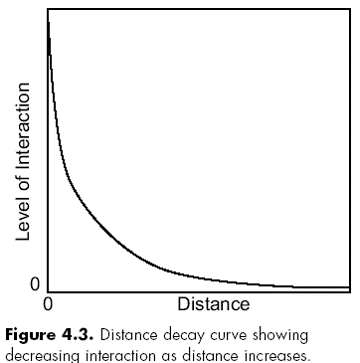
- Time Distance Decay
- The farther a place is from the hearth, the less
likely it is to be adapted.
- The farther a place is from the hearth, the less
likely it is to be adapted.
- Local
- Geographers use
scale to
understand the
interrelationships
- Diffusion
- Expansion Diffusion
- Contagious
- Occurs when nearly all
adjacent individuals and places
are affected
- Muhammad founded Isla in
500s around Mecca and
nearly all adjacent
individuals adopted the
religion.
- Muhammad founded Isla in
500s around Mecca and
nearly all adjacent
individuals adopted the
religion.
- Occurs when nearly all
adjacent individuals and places
are affected
- Stimulus
- An idea
might not
spread
throughout a
population,
but just affect
parts of it.
- Birkenstocks
- Birkenstocks
- An idea
might not
spread
throughout a
population,
but just affect
parts of it.
- Hierchical
- Not all ideas are readily and
directly adopted by a receiving
population. They may be vague,
unattainable, too different or
impractical, but the ideas still have
an impact.
- McDonalds in India
- McDonalds in India
- Not all ideas are readily and
directly adopted by a receiving
population. They may be vague,
unattainable, too different or
impractical, but the ideas still have
an impact.
- Contagious
- Relocation Diffusion
- The actual movement of individuals who
have already adopted the idea or
innovation and carry it to a new place.
- Chinatowns
- Chinatowns
- The actual movement of individuals who
have already adopted the idea or
innovation and carry it to a new place.
- When people, goods,
or ideas move across
space
- Starts from a Hearth
- Cultural Barriers work against Diffusion
- Starts from a Hearth
- Expansion Diffusion
- Globalization
- PLACE
- Human-Environment Relationships
- Everywhere on Earth has been affected by humans
- Everywhere on Earth has been affected by humans
- Includes Change over time
- Geography Through History
- Categorize, Classify
- Environmental Determinism
- Possibilism
- Regional Geography
- Spatial Science
- Humanistic and Behavioral
- Radical and Marxist
- Geography and Identity
- Postmodernism
- Starting in the 1980s postmodernism began to challenge assumptions about the nature of
truth and knowledge. While this will not be explored in this course, Geographers are taking
these concepts into consideration.
- Starting in the 1980s postmodernism began to challenge assumptions about the nature of
truth and knowledge. While this will not be explored in this course, Geographers are taking
these concepts into consideration.
- Introduced the idea that gender influences Geography. Spaces and places are gendered. At
times, ideas of gender are constructed and regulated in the spatial.
- Postmodernism
- Wanted to make Geography more useful and
relevant. Used the spatial approach to look at
social justice issue to give Geography a role
in working for and reshaping society.
- Geography and Identity
- Said that models and laws did not explain human reasoning for decisions. The main focus
should be the human aspect of a place, including human emotions, values and desires.
- Radical and Marxist
- Argued that regions had too many exceptions. Geography should be about a spatial analysis
that explained why phenomenon are located they way they are.
- Humanistic and Behavioral
- Divided the world into natural
regions by identifying phenomena
that grouped themselves in
distinctive ways in particular area.
Places are unique.
- Spatial Science
- Response to Environmental
Determinism. Humans can adapt their
environments with technology. All
comes back down to the physical
- Regional Geography
- Human behaviour is strongly influenced, maybe
even controlled by the physical environment.
Certain cultures decided that their climates were
ideal.
- Possibilism
- During age of exploration,
geographers catalogued, classified
and categorized. Geographers
looked for underlying patterns.
- Environmental Determinism
- Categorize, Classify
- Geography Through History
Medienanhänge
Möchten Sie kostenlos Ihre eigenen Mindmaps mit GoConqr erstellen? Mehr erfahren.