
1774708


Business IT/IS Strategic Alignment
- Business Alignment
Anmerkungen:
- Business alignment is concerned with “Linking and configuring the strategic elements, key organisation systems, processes and structure in such a way that their implementation achieves the organisation's shared vision and results beyond expectations” Strategic Alignment Inc, 2007
- WHY? to improve business processes, reduce operational costs, and promote real-time visibility in business performance”
- Five eras of alignment
Anmerkungen:
- Technological Era • 60s and 70s • Tech led •Efficiency driven
- Nexus Era • 70s, 80’s (mid) • Demand driven •Increasing volumes
- Impact Era • mid 80’s, 90’s •Innovation & alignment • Competitive advantage
- Fusion Era • mid/late 90’s and now? •Innovation, Value, Benefits, •Knowledge •Business transformation
- Complexity era? • co evolutional, governance, eco …
- Why - We know we are all now connected – economically, technically and socially. But being connected is not sufficient. • We also have to infuse intelligence into our systems and ways of working. • The world has become flatter and smaller. Now it must become smarter
- IS Alignment
Anmerkungen:
- There has to be a balance between the business, the information technology and the information system
- Some definitions • A Strategic Information System – is any system that will support the strategic goals and objectives of a business and its ability to affect its environmental relationships. • Information System (IS) – procedures which collect, process, store and communicate to support the work of the organisation (much broader) • Information & Communication Technology (ICT) – chip based technologies used to store. process, recall and transfer information. • IS Strategy – reflects the demand for IS to support the business • IT/ICT Strategy – how to supply or meet these demands • eg decision to use the cloud
- Data processing
- MIS
Anmerkungen:
- Management effectiveness
- SIS
Anmerkungen:
- Strategic information systems Business competitiveness
- Information Strategy
Anmerkungen:
- As a concept has evolved through investigating complex relationships existing between:
- Information and Communication Technologies (ICT)
- Information systems (IS)
- Business Strategy
- Planning the organisation’s information resource • What information is required and how it should be collected,processed, archived, maintained and destroyed » Legal & regulatory aspects FOI and Data Protection • Who has access to what information » Security management • What information systems are needed – in short, medium & long term • Lifecycle management – How information systems and PCs will be procured, maintained, developed in house or outsourced; replaced • Organisational management of information – central/local
- Strategic systems
Anmerkungen:
- Four types of IS/IT SYSTEM that might be considered strategic These are those which: 1. Use technology to share information between customers and suppliers 2. Produce better integration of internal processes 3. Enable the organisation to enhance products or services based on information 4. Provide executive management with information to support strategic decisions
- Technology itself is an enabler - any organisation can buy IT • Over time Information Systems can be developed to match another organisations • The information owned by an organisation and how information is used is key to » strategic development of products, services, » future developments
- share
information
with
customers
and/or
suppliers
- facilitate
improved
integration of
internal
processes
- enhance the
development
of products
and services
- provide
executive
management
with relevant
strategic
information
- Ward & Peppard
- Strategic IT/IS Alignment
- Organisational
performance
depends on
structures and
capabilities that
support the
successful
realization of
strategic decisions
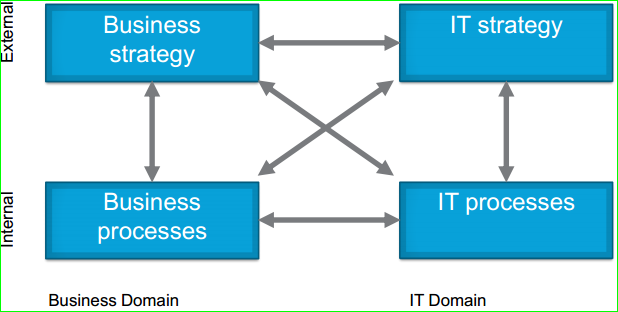
- Alignment is a
two-way process,
where business
and IS strategies
can act as mutual
drivers.
- Strategic IS
alignment “is not
an event but a
process of
continuous
adaptation and
change”
- Henderson and Venkatraman (1993)
Hirschheim & Sabherwal (2001)
- Business
Benefits
Anmerkungen:
- Alignment form the beginning leads to non-incremental & consistent approaches which provides for: • Organisational agility: – holistic, planned alignment provides agility through standardisation & integration • Operational efficiency: – ability to cope with complex business relationships (supply chain etc) • IT cost reduction: – single consolidated solutions avoid redundant multiple systems • Risk management: – alignment gives visibility of commercial and legal issues and reduces risk.
- Phases of alignment
Anmerkungen:
- Plan Model Manage Measure
- Organisational
performance
depends on
structures and
capabilities that
support the
successful
realization of
strategic decisions
- ALIGNMENT TRAP
Anmerkungen:
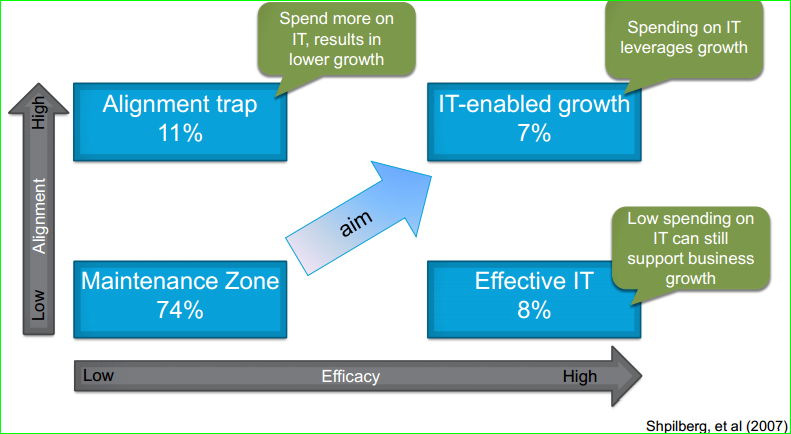
- Alignment is not a panacea or cure-all • Competing demands from functional strategies and business units • Lack of standardisation • Additional complexity on top of existing legacy systems • Poor project management & spiralling costs • Alignment trap: – right business objectives identified • BUT: IT department is performing badly » Result: Business objectives not achieved
- Get Out Of It
Anmerkungen:
- Invest in IT effectiveness: • Reduce complexity • emphasize simplicity eg standardised infrastructure; • company-wide standards; • reduce customisation; • centralise where necessary
- ‘Right’-sourcing • In-house if value can be added by company’s IT dept • Outsource more effectively (understand systems before outsourcing; set key performance indicators) • Outsource more selectively (eg legacy systems; routine activities)
- Create end-to-end accountability • Set up IT governance structures • provide appropriate resources • monitor outcomes
- IMPLEMENTATION FRAMEWORKS
- Enterprise
Architecture
(EA)
Anmerkungen:
- An attempt to define a future state of the organisation, in which both the business functions and the Information Systems (IS) functions of the business are integrated and optimised for the ultimate good of the organisation. • Considers the enterprise as a whole and promotes the use of modelling and planning at different levels and different perspectives • Gives rise to various Enterprise Architecture frameworks – Zachmann (1999) – The Open Group Architecture Framework (TOGAF) – There are many others – i.e. CORBA
- The Zachman
Framework
Anmerkungen:
- A schema representing the intersection of • First: the six basic interrogatives – What, How, Where, Who, When, and Why • Second: six distinct perspectives relating to stakeholder groups – Planner, Owner, Designer, Builder, Implementer and Worker). • The intersecting cells of the Framework correspond to models – can provide a holistic view of the enterprise. An ontology: • A theory of the existence of a structured set of essential components of an object for which explicit expression is necessary and perhaps even mandatory for creating, operating, and changing the object.
- TOGAF: The
Open Group
Architecture
Framework
Anmerkungen:
- Business (or business process) architecture Applications architecture Data architecture Technology architecture
- Enterprise
Architecture
(EA)
- IT/IS Alignment Health
Check
Anmerkungen:
- Communication Competency/Value Measurements Governance Partnerships Scope & Partnerships Skills
- Luftman's Maturity Assessment Model
Medienanhänge
Möchten Sie kostenlos Ihre eigenen Mindmaps mit GoConqr erstellen? Mehr erfahren.