
1795340


Radioactivity
- Three types of particles make up and atom
- Protons
Anmerkungen:
- found in the nucleus Relative mass 1 Relative charge +1
- nutrons
Anmerkungen:
- Found in the nucleus Relative mass = 1 Relative charge = 0
- Electrons
Anmerkungen:
- Surrounds the nucleus Relative mass= Alsomost zero Relative charge = -1
- Protons
- Unstable nucleus
Anmerkungen:
- Some materials are radioactive because the nucleus of each atom is unstableand can decay, or split up, by giving out nuclear radiation in the form of alpha particles, beta particles or gamma rays.
- example
Anmerkungen:
- If a radioactive material has an activity of 200 Bq, in 1 second 200 of its nuclei will decay and give off radiation. In 1 minute 12,000 (= 200 x 60) nuclei will decay. The activity of a radioactive material will decrease with time. This will be shown by a falling count rate, measured using the Geiger counter.
- Three types of radiation particle
- Alpha
Anmerkungen:
- 2 nutrons to electrons same as a helium particle. Weak penertration Very ionising
- alpha decay
Anmerkungen:
- When an alpha particle is emitted from the nucleus it, the nucleus, looses to neutrons and two protons from the nucleus. This means that its atomic number goes down by two and its mass number goes down by 4.
- example
Anmerkungen:
- radon goes to polonium because of alpha decay. We see in the equation that a helium particle is lost.
- beta
Anmerkungen:
- This is a very fast moving electron Moderately penertrating Moderately ionizing
- beta decay
Anmerkungen:
- In Beta decay a neutron changes into a proton plus an electron. The proton stays in the nucleus and the electron leaves the atom with high energy, and we call it a beta particle. When a beta particle is emitted from the nucleus the nucleus has one more proton and one less neutron. This means the atomic mass number remains unchanged and the atomic number increases by 1.
- exapmle
Anmerkungen:
- Carbon-14 is a radioactive isotope of carbon. (It's a carbon atom with 8 neutrons instead of the usual 6.) This due to beta decay produces one electron and Nitrogen
- Gamma
Anmerkungen:
- High energy electro magnetic radiation most penetrating Weak ionising ability
- Alpha
- ionisation ability
Anmerkungen:
- Ionising radiation is radiation that has enough energy to cause other atoms to lose electrons and form ions.
- How an atom is represented
Anmerkungen:
- A = atomic mass (number of protons + neutrons) Z = atomic number (number of protons) X = chemical symbol (as shown on the periodic table)
- penetrating ability
- alpha
Anmerkungen:
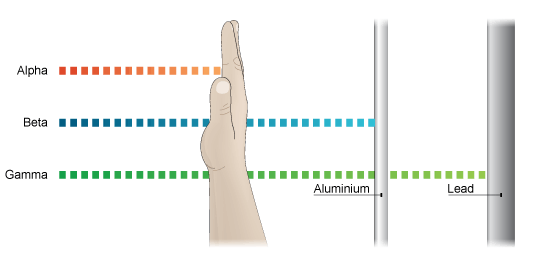
- Alpha has a very weak penetrating ability. It can be stopped by your hand or even just a piece of paper.
- gamma
Anmerkungen:
- Very high penetrating ability. It can go through most materials. Can be stopped/absorbed by lead because of its very high density.
- beta
Anmerkungen:
- As per most of abilities is it in-between gamma and alpha particles. It can go through your hand and a sheet of paper for example but it can be stopped by aluminium which is of medium density.
- alpha
- Deflecting radiation
- electircal fields
Anmerkungen:
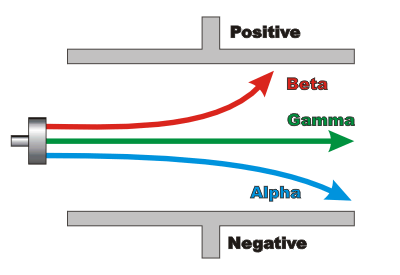
- Alpha particles= positve charge Beta particle= negative charge Gamma particles= nuetral charge This means that alpha and beta particles can be deflected and gamma cannot.
- alpha goes to
oppositely charged
negative plate
- beta goes to
oppositely charged
positive plate
- magnetic fields
Anmerkungen:
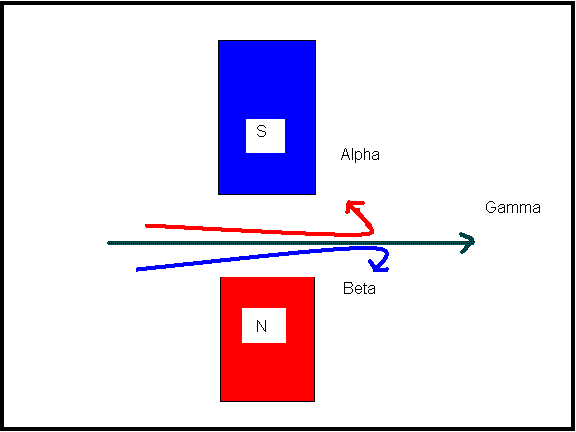
- Because they consist of charged particles, alpha radiation and beta radiation can also be deflected by magnetic fields. Just as with electric fields, gamma radiation is not deflected by magnetic fields.
- electircal fields
- Detecting radiation
- Photographic film
Anmerkungen:
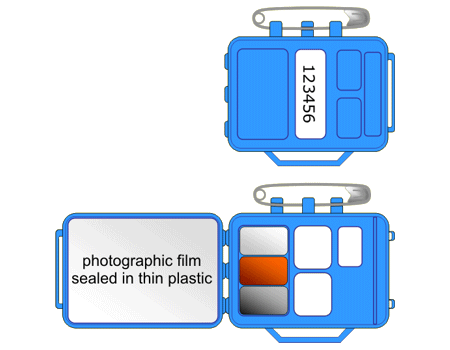
- People who work on radioactive plants will wear badges with photographic film inside. The darker the film the higher amounts of radiation they have been exposed to. The get an accurate measure of how much radiation they are receiving the badges will have different materials such as Alumminium and copper.
- Geiger-Muller tube
Anmerkungen:
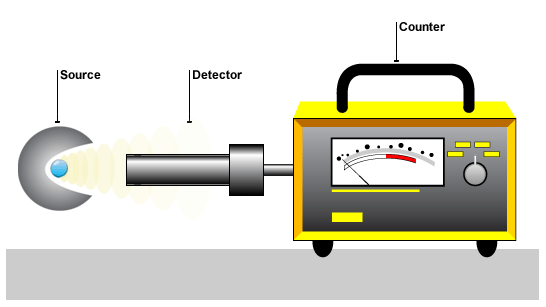
- The Geiger-Muller tube detects radiation. Each time it absorbs radiation, it transmits an electrical pulse to a counting machine. This makes a clicking sound or displays the count rate. The greater the frequency of clicks, or the higher the count rate, the more radiation the Geiger-Muller tube is absorbing.
- Photographic film
- hazards
Anmerkungen:
- When a radioactive particle reaches a cell it can damage the cell and potentially make the cell cancerous.
- inside the body
- Alpha
Anmerkungen:
- When inside the body it can cause great health problems due to its high ionising ability and the fact that it has nothing to penetrate.
- Betta and Gamma
Anmerkungen:
- Betta and gamma particles due to there low ionising ability don't have that great effect when the body.
- Alpha
- Outside the body
- ALpha
Anmerkungen:
- Not very dangerous because it cannot penetrate the body
- ALpha
- half life
Anmerkungen:
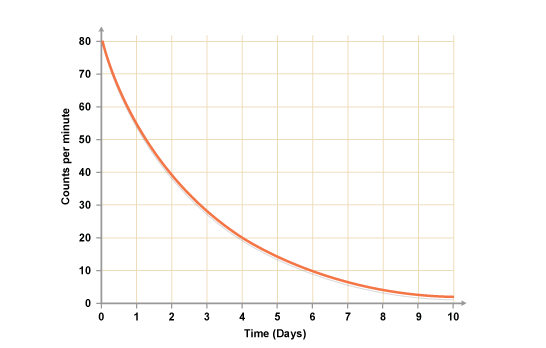
- There are two definitions of half-life, but they mean essentially the same thing: the time it takes for the number of nuclei of the isotope in a sample to halvethe time it takes for the count rate from a sample containing the isotope to fall to half its starting level
- graphs
Anmerkungen:
- It is possible to find out the half-life of a radioactive substance from a graph of the count rate against time. The graph shows the decay curve for a radioactive substance.
- the use of the substances
Anmerkungen:
- in smoke detectorsfor sterilising medical instrumentsfor killing cancer cellsfor dating rocks and materials such as archaeological findsin chemical tracers to help with medical diagnosisfor measuring the thickness of materials in, for example, a paper facto
- Nuclear Fission
Anmerkungen:
- Used in power plant Fission- means the splitting of
- process
Anmerkungen:
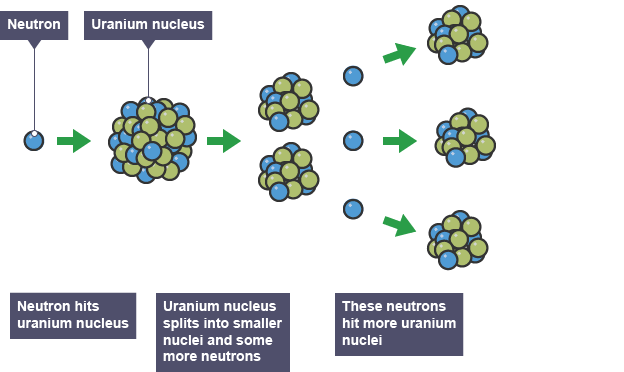
- Uranium or plutonium is used because they're atoms have rather large nuclei and are very easy to split up.
- hit by a neutron
Anmerkungen:
- This causes the nuclei to: Split into two smaller nuclei known as daughter nuclei which are radioactive. Two or three more neutrons are released Energy is released in the form of kinetic energy.
- The extra flying neutrons cause more collisions
Anmerkungen:
- The more neutrons there are the higher chance of they're being more collisions with the other uranium atoms this means that they're is a chain effect occurring leading to more and more kinetic energy being produced.
- The rate of reactions is controlled
Anmerkungen:
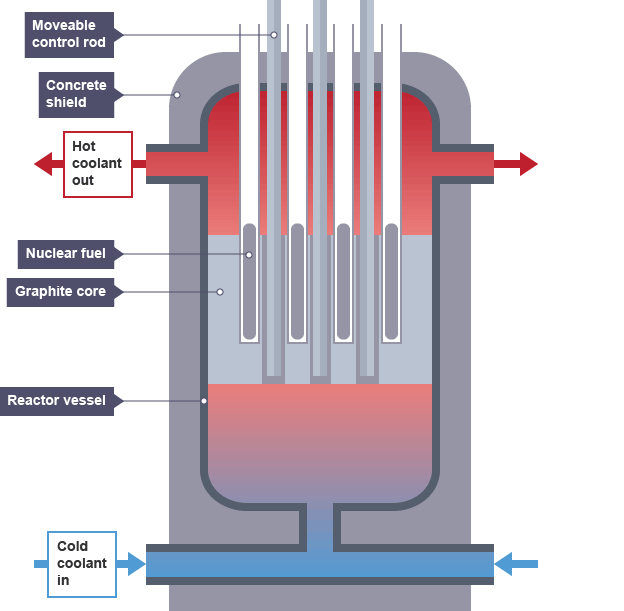
- The 'controllers' will insert and remove carbon rods into the container to maintain a steady rate of reaction.
- how energy is harvested
Anmerkungen:
- Nuclear reactors use the heat from nuclear reactions in the nuclear fuel to boil water. Just as in conventional power stations, the steam from the boiling water makes a turbine spin, which in turn makes the generator turn.
- Waste products
Anmerkungen:
- No CO2 is produced unlike many energy making processes. Plutonium can be used to make nuclear bombs. Other waste products are strored in barrels underground.
Medienanhänge



Möchten Sie kostenlos Ihre eigenen Mindmaps mit GoConqr erstellen? Mehr erfahren.