
20018207
Beschreibung

Mindmap von Linnéa Ekberg, aktualisiert more than 1 year ago

|
Erstellt von Linnéa Ekberg
vor mehr als 6 Jahre
|
|
Game Theory
- Defintions
- Social situations
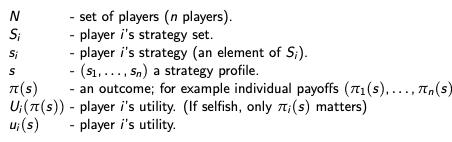
- Players
- Strategies
Anmerkungen:
- Complete plan of action
- Outcomes
Anmerkungen:
- Can be many things. Monetary, material, immaterial...
- Players
- Games
- Players
- Strategies
- Outcomes for each
strategy profile
- Utility function
for each player
- Captures
preferences
Anmerkungen:
- The preferences of another person creates an uncertainty for me. I don't know what they will do in the game. If I know their preferences, I know what they are likely to do
- Risk-neutral selfish materialist
Anmerkungen:
- Risk-neutral implies a linear function. There are no diminishing returns to the utility of money
- u(i) = m(i)
- Risk-neutral egalitarian
- u(i) = min {m(j)}
Anmerkungen:
- Prefers to minimise inequality, so my utility equals the outcome of the person who gets the least
- u(i) = min {m(j)}
- Altruistic
- u(i) = m(i) + γ m(j)
Anmerkungen:
- Assign some weight to the outcome of the other person
- u(i) = m(i) + γ m(j)
- Captures
preferences
- Players
- Social situations
- Matrices
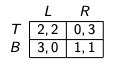
- Outcome matrices
Anmerkungen:
- With outcomes expressed in terms other than utility, we can never know which strategy is dominant for a player. The highest monetary value may not yield the highest utility because of selfless preferences and so is not the dominant strategy
- Row player: Rowena (first values) Column player: Colin (second values)
- Conditionally cooperative
Anmerkungen:
- A normal argument against Rowena choosing T instead of B. If Colin chooses R, she would only lose 1 (from 1 in B to 0 in T), whereas Colin would earn 2. Conditionally cooperative means that she is unwilling to help someone who wouldn't help her back
- Differences between
countries
Anmerkungen:
- Is this related to why some countries are richer than others? Are they better at changing the situation so they end up in 2.2? Do they have more efficient contracts? Does the culture promote cooperation?
- Utility matrices
Anmerkungen:
- There is a dominant strategy when the preferences are known. Players will always choose the highest utility
- Notation
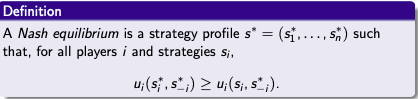
- Nash equilibrium
Anmerkungen:
- Each player's strategy is a best reply to he opponent's strategies
- Pure strategy equilibria
Anmerkungen:
- All players pick a pure strategy
- Mixed strategy equilibria
Anmerkungen:
- At least one player chooses several pure strategies with positive probability
- If you don't want to deviate in pure strategy, you TYPICALLY don't want to deviate in mixed
- Theorem: All games with a finite number
of pure strategies have at least one
equilibrium
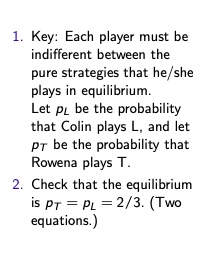
- u(T) = PL*1 + (1-PL)*0 = u(B) = PL*0 + (1-PL)*2
- u(T) = PL*1 + (1-PL)*0 = u(B) = PL*0 + (1-PL)*2
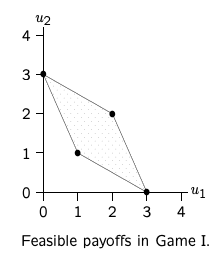
- Equilibrium vs efficiency
Anmerkungen:
- Equilibrium is on (1,1). This is far below the Pareto frontier
- Outer line: Pareto frontier
Anmerkungen:
- Possible to improve without making other person worse off
- Interpretations
- Outcome of
rational
deliberations
Anmerkungen:
- How rational is it to assume that everyone else is rational?
- Rest point of learning
dynamics or evolutionary
selection
- Self-enforcing agreement
Anmerkungen:
- A player who believes that other players will stick to an agreement of the Nash equilibrium will not herself violate the agreement
- Outcome of
rational
deliberations
- Outcome matrices
Medienanhänge
Möchten Sie kostenlos Ihre eigenen Mindmaps mit GoConqr erstellen? Mehr erfahren.