
32598007
Beschreibung

Erzeugt von María Alejandra Lainfiesta Wahl

|
Erstellt von María Alejandra Lainfiesta Wahl
vor etwa 5 Jahre
|
|
Ecology
- Kinesis and taxis
- Behavioral Biology
- Behavior = change in
activity as a response to
a stimulus. Ethology =
the study of animal
behaviors.
- Behavior = change in
activity as a response to
a stimulus. Ethology =
the study of animal
behaviors.
- Biodiversity
- Keystone species maintain
biodiversity and are often top
predators.
- Keystone species maintain
biodiversity and are often top
predators.
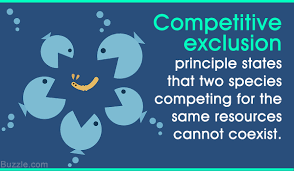
- Competitive
Exclusion Principle
- No two species can occupy the same niche.
One species will drive the other to extinction
or resource partitioning occurs.
- No two species can occupy the same niche.
One species will drive the other to extinction
or resource partitioning occurs.
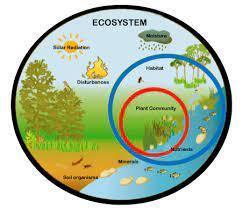
- Ecology: the study of
interactions of organisms with
other organisms and with the
physical environment (word
means "study of house")
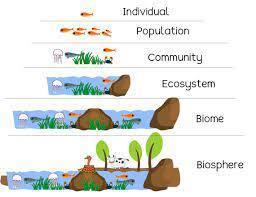
- A population includes
members of the same
species living in the same
area, they can interbreed.
- A community refers to
all of the different
populations in an area.
- Ecosystem
- the community plus
the non-living
factors
- Biotic (living) - animals
and plants
- Abiotic (nonliving) -
water, soil, air,
temperature
- Biotic (living) - animals
and plants
- the community plus
the non-living
factors
- Biosphere: all the
areas of the earth
that supports life
- BIOMES: a large naturally
occurring community of flora
and fauna occupying a major
habitat.
- Life tables divide the population into
age groups and often sexes, and show
how long a member of that group is
likely to live.
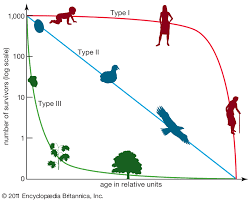
- Survivorship Curve
- probability of individuals
surviving to a particular
age .
- probability of individuals
surviving to a particular
age .
- Density Dependent Factors
- As a population becomes more dense, the
greater the mortality rate (disease,
competition, parasites), results in lower
FECUNDITY
- As a population becomes more dense, the
greater the mortality rate (disease,
competition, parasites), results in lower
FECUNDITY
- Density Independent Factors
- Factors that cause death that aren’t
related to density, ex natural disasters.
- Factors that cause death that aren’t
related to density, ex natural disasters.
Medienanhänge

Möchten Sie kostenlos Ihre eigenen Mindmaps mit GoConqr erstellen? Mehr erfahren.