
374592
Beschreibung

Mindmap von jadepalmer98, aktualisiert more than 1 year ago

|
Erstellt von jadepalmer98
vor mehr als 12 Jahre
|
|
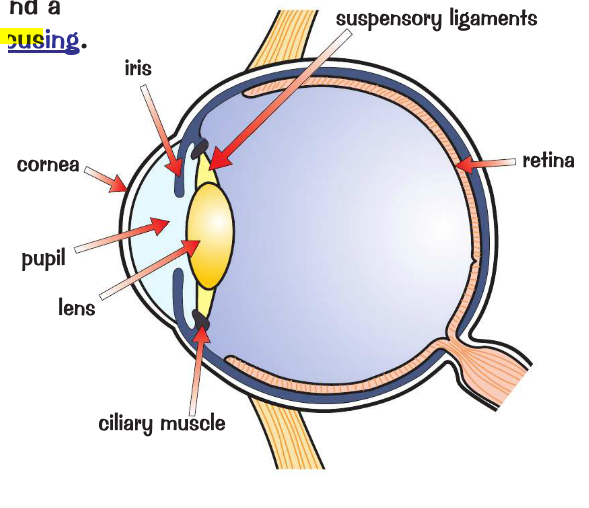
The Eye
- The Basic Structure
- Cornea
- Transparent 'window' with a convex shape,
and a high refractive index - cornea does
most of the eyes focusing
- Transparent 'window' with a convex shape,
and a high refractive index - cornea does
most of the eyes focusing
- Iris
- Coloured part of the eye
- Made of muscles that control the
size of the pupil - the hole in the
middle of the iris
- This controls the intensity of light entering the eye
- This controls the intensity of light entering the eye
- Coloured part of the eye
- Lens
- Change shape to focus light
from objects at varying
distances
- Connected to ciliary muscles by
suspensory ligaments and when
the muscles contract, tension is
released and lens takes on a fat,
spherical shape
- When they relax, the suspensory
ligaments pull the lens into a
thinner, flatter shape
- When they relax, the suspensory
ligaments pull the lens into a
thinner, flatter shape
- Connected to ciliary muscles by
suspensory ligaments and when
the muscles contract, tension is
released and lens takes on a fat,
spherical shape
- Change shape to focus light
from objects at varying
distances
- Retina
- Images are formed on the retina -
covered in light-sensitive cells
- These cells detect light and send
signals to the brain to be interpreted
- These cells detect light and send
signals to the brain to be interpreted
- Images are formed on the retina -
covered in light-sensitive cells
- Cornea
- The eye can focus on objects
between the near and far points
- The far point is the furthest distance that
the eye can focus comfortably
- Infinity for normal-sighted people
- Infinity for normal-sighted people
- The near point is the closest
distance that they eye can
focus on
- 25cm for adults
- 25cm for adults
- As the eye focuses on closer
objects, its power increases - the
lens changes shape and the focal
length increases
- Distance between lens and image
stays the same
- Distance between lens and image
stays the same
- The far point is the furthest distance that
the eye can focus comfortably
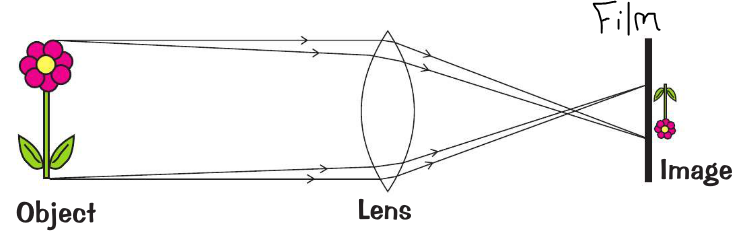
- A camera forms images in a similar way to the eye
- When you take a photo of a flower, light
from the object travels to the camera and is
refracted by the lens, forming an image on
the film
- 1 - The image on the film is a real
image, because light rays actually
meet there
- 2 - The image is smaller than the object,
because the object's a lot further away than
the focal length of the lens
- Image is inverted
- Image is inverted
- 3 - The same thing happens in our eye - a
real, inverted image forms on the retina
- Our very clever brains flip the
image so we see it the right way
up
- Our very clever brains flip the
image so we see it the right way
up
- 4 - The film in a camera or the
CCD in a digital camera, are
the equivalent of the retina in
the eye - they all detect the light
focused on them and record it
- When you take a photo of a flower, light
from the object travels to the camera and is
refracted by the lens, forming an image on
the film
Medienanhänge
Möchten Sie kostenlos Ihre eigenen Mindmaps mit GoConqr erstellen? Mehr erfahren.