
37494928
Beschreibung

Mindmap von Fernanda Granados, aktualisiert more than 1 year ago

|
Erstellt von Fernanda Granados
vor mehr als 3 Jahre
|
|
Foreign Language Acquisition and
Learning.
- COURSE DESCRIPTION.
- It is a methodological course
(theoretical, practical).
- 32 hours of practice are
developed.
- 32 hours of practice are
developed.
- It focuses on the practical
component, in the participant
observation phase.
- It is part of the disciplinary field of
the disciplinary component of the
program.
- It is part of the disciplinary field of
the disciplinary component of the
program.
- It is characterized by the
fact that the person who
observes constitutes a
participatory method of
data collection.
- It is characterized by the close
relationship with the problems
of interdisciplinary fields.
- It is characterized by the close
relationship with the problems
of interdisciplinary fields.
- It is a methodological course
(theoretical, practical).
- NUMBER OF PHASES.
- Phase 2 – Participant
Observation Practice 8 hours
(Participant Observation
Practice) 2 hours (Material
Development) 3 hours (ESAPEC).
- Phase 3 – Participant - Observation
practice 8 hours (Participant
observation practice) 2 hours
(Development of materials).
- Phase 4 – Participant -
Observation Practice 3 hours for
ESAPEC 3 hours for E-portfolio 3
hours for Simulated Scenario
- Phase 2 – Participant
Observation Practice 8 hours
(Participant Observation
Practice) 2 hours (Material
Development) 3 hours (ESAPEC).
- LEARNING OUTCOMES:
- 1: Review the characteristics of the course and the
particularities of the pedagogical and educational
practice process.
- 2: Examine the factors that influence the process of
acquiring and learning foreign languages in a methodical
and detailed way within the scenarios of pedagogical
practice.
- 4: Evaluate the teaching strategies used in the
classroom based on the student's learning
characteristics.
- 3: Compare the main theories on the acquisition
of foreign languages in the context of the
scenario of pedagogical practice.
- 5: Make a proposal related to new
assessment approaches in the
classroom.
- 1: Review the characteristics of the course and the
particularities of the pedagogical and educational
practice process.
- NUMBER OF UNITS:
- Unit 1: Acquisition of Foreign
Languages, from theory to
practice.
- PRE-PRACTICE SEMINAR.
- ECEDU strategy that seeks reflection and understanding of pedagogical
practices, so that the student has what is necessary for the optimal
development of PPE.
- ECEDU strategy that seeks reflection and understanding of pedagogical
practices, so that the student has what is necessary for the optimal
development of PPE.
- PRE-PRACTICE SEMINAR.
- Unit 2: Learning Trends in Foreign
Language.
- Unit 1: Acquisition of Foreign
Languages, from theory to
practice.
- IDENTIFY EACH CHAPTER OF THE REGULATION
AGREEMENT ON PEDAGOGICAL AND EDUCATIONAL
PRACTICES AND THE ARTICLES IT HAS.
- It has IX chapters and 24 articles.
- It has IX chapters and 24 articles.
- REFERENTES NORMATIVOS:
- 1994: Ley 30 y ley 115.
- 2010: Resolución 4443 y 6966.
- 2015: Decreto 2450 y 1075.
- 2015: Decreto 2450 y 1075.
- 2016: Resolución 2041.
- 2017: Resolución 18583.
- 2019: Decreto 1330.
- 2020: Resolución 21795
- 2019: Decreto 1330.
- 2017: Resolución 18583.
- 2010: Resolución 4443 y 6966.
- 1994: Ley 30 y ley 115.
- PRINCIPLES OF ACTION
- 1. Integrality of the teaching pedagogical
practice.
- 2. Dialogicity between
educational actors.
- 5. Excellence in service.
- 4. Respect for differences.
- 3. Promotion of protective
environments for boys, girls and
teenagers.
- 1. Integrality of the teaching pedagogical
practice.
- PROGRAMAS DE LICENCIATURA EN ECEDU.
- Licenciatura en pedagogía
infantil.
- Licenciatura en
etnoeducación.
- Licenciatura en
matemáticas.
- Licenciatura en
Filosofía.
- Licenciatura en lenguas extranjeras
con énfasis en inglés.
- Licenciatura en pedagogía
infantil.
- DEFINITIONS.
- Practical component.
- Pedagogical and
educational practice –
PPE.
- Specific regulation of pedagogical
and educational practice – PPE.
- Nature and offer of the practical component
courses.
- Teacher in
training.
- Practical component.
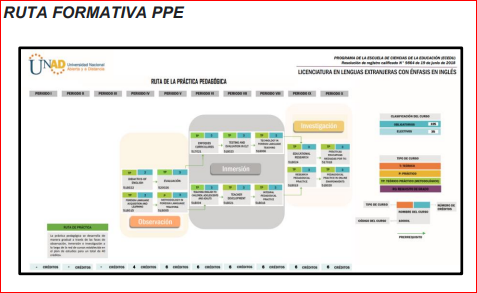
- ROUTE OF PEDAGOGICAL AND EDUCATIONAL PRACTICE
FOR YOUR PROGRAM.
- ESAPEC
- Face-to-face accompaniment strategy
by the ECEDU.
- Synchronous accompaniments to students. ESAPEC evaluates each
meeting in order to advance in the process of learning and
appropriation of what to do as a teacher in pedagogical practice.
- Synchronous accompaniments to students. ESAPEC evaluates each
meeting in order to advance in the process of learning and
appropriation of what to do as a teacher in pedagogical practice.
- Face-to-face accompaniment strategy
by the ECEDU.
- SIMULATOR
- It is a space where students are allowed to
propose and carry out simulated
pedagogical and didactic practices, in order
to improve their skills and learning.
- It is a space where students are allowed to
propose and carry out simulated
pedagogical and didactic practices, in order
to improve their skills and learning.
Medienanhänge
Möchten Sie kostenlos Ihre eigenen Mindmaps mit GoConqr erstellen? Mehr erfahren.