
3824674
Beschreibung

Mindmap von Robyn Oelofse, aktualisiert more than 1 year ago

|
Erstellt von Robyn Oelofse
vor mehr als 10 Jahre
|
|
The Foreign Sector
- successful economies compete internationally
- globalisation
- factors of production are more mobile
- countries effect each other
- extent of involvement known as 'openess'
- aka 'integration'
- aka 'integration'
- factors of production are more mobile
- globalisation
- imports, exports, capital movements
- GATT reduced trade tariffs
- later Marrakesh Agreement addressed
other unresolved issues
- post WWII: World Bank and International
Monetary Fund
- IMF provides loans to 29 members
- IMF conditionality
- IMF conditionality
- only developing
countries can borrow
from World Bank
- IMF provides loans to 29 members
- post WWII: World Bank and International
Monetary Fund
- later Marrakesh Agreement addressed
other unresolved issues
- Why countries trade
- self-sufficiency not viable
- specialise
- interdependent
- interdependent
- specialise
- factors of
production not
available
- Absolute advantage
- when a country can produce a product more efficiently
- when a country can produce a product more efficiently
- Comparitive (aka relative) advantage
- opportunity cost of production differs
- each country shifts
limited resources to
produce that which it
produces most
efficiently
- these decisions taken by
firms as a reaction to the
market
- these decisions taken by
firms as a reaction to the
market
- each country shifts
limited resources to
produce that which it
produces most
efficiently
- opportunity cost of production differs
- need incentives to trade
- mutually beneficial comparative advantage
- mutually beneficial comparative advantage
- self-sufficiency not viable
- Trade Policies
- Import tariffs
- believed to protect
domestic products (not
the case)
- believed to protect
domestic products (not
the case)
- Import quotas
- physical level of
imports controlled. Same
lack of effect as tariffs.
- physical level of
imports controlled. Same
lack of effect as tariffs.
- subsidies
- granted to
domestic firms.
Lack effect.
- granted to
domestic firms.
Lack effect.
- non-tariff barriers
- beucratic
limits ie red
tape
- beucratic
limits ie red
tape
- exchange controls
- limit foreign currency
available to use to
purchase
- limit foreign currency
available to use to
purchase
- exchange rate policy
- probably most effective
- probably most effective
- Import tariffs
- Exchange rates
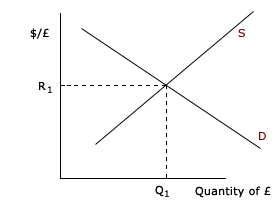
- foreign trade requires foreign currency
- imports create a demand for
currency, and exports create
a supply of currency
- this exchange
called 'foreign
exchange rate'
- ratio: price of one
currency in relation to
another
- appreciation in one
currency = depreciation
in another
- ratio: price of one
currency in relation to
another
- foreign
exchange market
- determines exchange rate
- no fixed location
- includes banks and
authorized currency
dealers
- includes banks and
authorized currency
dealers
- determines exchange rate
- the cheaper the foreign
currency, the more goods can be
imported and more dollars
needed and vice versa
- equilibrium: supply and demand are equal
- change in supply and demand results in change in exchange rate
- dampens and stimulates imports and exports
- as reflected on current account
- affects inflation and export
competitiveness
- as reflected on current account
- dampens and stimulates imports and exports
- change in supply and demand results in change in exchange rate
- equilibrium: supply and demand are equal
- this exchange
called 'foreign
exchange rate'
- sources of demand for currency
- importers
- tourism abroad
- buyers of foreign
assets eg shares
- foreign sellers of SA assets
- speculators
- exchange rate affected
by predictions of
fluctuations - self
fullfilling immediately
- exchange rate affected
by predictions of
fluctuations - self
fullfilling immediately
- importers
- suppliers of foreign currency
- exporters
- foreign purchasers of SA assets
- SA sellers of foreign assets
- speculators
- local tourism
- exporters
- imports create a demand for
currency, and exports create
a supply of currency
- intervention in the foreign exchange market
- seek to control fluctuations and pursue policy objectives
- managed floating
- will add currency to the market at original
exchange rate to reduce inflation (ie
depreciation)
- can do only if has sufficient funds,
so not really viable anymore
- can do only if has sufficient funds,
so not really viable anymore
- will add currency to the market at original
exchange rate to reduce inflation (ie
depreciation)
- managed floating
- central banks
- seek to control fluctuations and pursue policy objectives
- foreign trade requires foreign currency
Medienanhänge
Möchten Sie kostenlos Ihre eigenen Mindmaps mit GoConqr erstellen? Mehr erfahren.