
460262


B1: You and your genes
- B1: You and your genes
- Genes, Chromosomes and DNA
- Genetic material is arranged into23 pairs of chromosomes
- Each chromosome is one very long molecule of DNA
- A gene is a short length of a chromosome
- Different versions of the same gene are called alleles
- Genes are instructions for cells
- Each gene is a code for making a certain protein
- Structural protein - hair, blood, skin
- Functional proteins - digestion
- Structural protein - hair, blood, skin
- Each gene is a code for making a certain protein
- Geneotype - all the genes it has
- Characteristics an organism has is its phenotype
- Characteristics an organism has is its phenotype
- Genetic material is arranged into23 pairs of chromosomes
- Genes, Chromosomes and DNA
- Genes and variation
- Sperm and egg cells have half the amount of DNA
- 23 single chromosomes
- When the egg and sperm combine, they have 23 pairs
- When the egg and sperm combine, they have 23 pairs
- 23 single chromosomes
- Chrildren resemble both parents but aren't identicle to either
- Half a childs chromosomes come from each parent
- Half a childs chromosomes come from each parent
- Genes are shuffled ramdomly to make eggs and sperm
- There are billions of different chromosome combinations from 23 pairs
- There are billions of different chromosome combinations from 23 pairs
- Sperm and egg cells have half the amount of DNA
- Inheritance and genetic diagrams
- The combination of alleles determines its phenotype
- Alleles can be dominant or recessive
- For the characteristic to be determined by the recessive allele, both alleles must be recessive
- For the characteristic to be determined by the recessive allele, both alleles must be recessive
- Alleles can be dominant or recessive
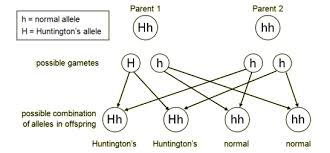
- Huntindons is a dominant allele so if one parent has is, the is 50% chance
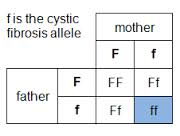
- Punnett sqaures
- The combination of alleles determines its phenotype
- Sex chromosomes
- 23rd pair is labled XY
- This determines your sex
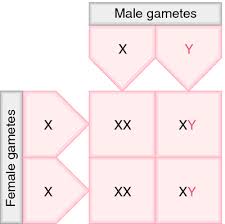
- All men have an X and a Y chromosome
- All women have 2 X chromosomes
- The gene that makes you male produces a certain protein
- Produces testes (instead of overies)
- Produces testes (instead of overies)
- All men have an X and a Y chromosome
- This determines your sex
- 23rd pair is labled XY
- Genetic disorders
- Genetic disorders are caused by one faulty allele
- Cystic fibrosis is caused by recessive alleles
- Symptoms
- Breathing difficulty
- Chest infections
- Difficulty digesting food
- Breathing difficulty
- Symptoms
- Huntindons is dominant allele
- Tremors, clumsiness, memory loss, poor concentration
- Tremors, clumsiness, memory loss, poor concentration
- Genetic disorders are caused by one faulty allele
- Genetic testing
- Embryos, adult and children
- Embroys can be tested using iVF
- Healthy eggs are placed back in womb
- Healthy eggs are placed back in womb
- Adult and children can be tested to see if they are carriers
- Can also be tesred before drug presciption to see any affects
- Can also be tesred before drug presciption to see any affects
- Embroys can be tested using iVF
- Issues
- Not 100% accurate
- Not 100% safe
- Right to terminate a pregnancy?
- Discrimination
- Not 100% accurate
- Embryos, adult and children
- Clones
- Clones are genetically identical organisms
- Nature makes clones
- Embroys split
- Identical twins
- Identical twins
- Asexual reproduction
- Only one parent
- Bateria divides into 2
- Plants produce clones
- Produce horizontal stems and form clones
- Bulbs copy themselves
- Produce horizontal stems and form clones
- Bateria divides into 2
- Only one parent
- Embroys split
- Scientists make clones
- The nucleus of an egg is removed
- The nucleus of an adult donor is incerted in its place
- The cell is stimulated so it acts as a normal embryo
- The embryo is identical to the donor cell
- The embryo is identical to the donor cell
- The cell is stimulated so it acts as a normal embryo
- The nucleus of an adult donor is incerted in its place
- The nucleus of an egg is removed
- Nature makes clones
- Clones are genetically identical organisms
- Stem cells
- Stem cells become othr types of cells
- Embroyonic stem cells
- Found in early embryos
- Stem cell is removed from the embro then embryo is destroyed
- Can be made into ANY cell at all
- Can be made into ANY cell at all
- Stem cell is removed from the embro then embryo is destroyed
- Found in early embryos
- Adult dtem cells
- Found in adult animals
- Involved in maintaining and repairing tissues and can turn to MANY cels
- Removed safely by removing bone marrow, no embryos destroyed
- Removed safely by removing bone marrow, no embryos destroyed
- Involved in maintaining and repairing tissues and can turn to MANY cels
- Found in adult animals
- treat many illnesses
- Medicine is using stem cells
- Bone marrow transplants
- Heart muscle cells for people with heart disease
- Heart muscle cells for people with heart disease
- Bone marrow transplants
- Medicine is using stem cells
- Embroyonic stem cells
- Stem cells become othr types of cells
Medienanhänge
Möchten Sie kostenlos Ihre eigenen Mindmaps mit GoConqr erstellen? Mehr erfahren.