
Mindmap
Atomic structure
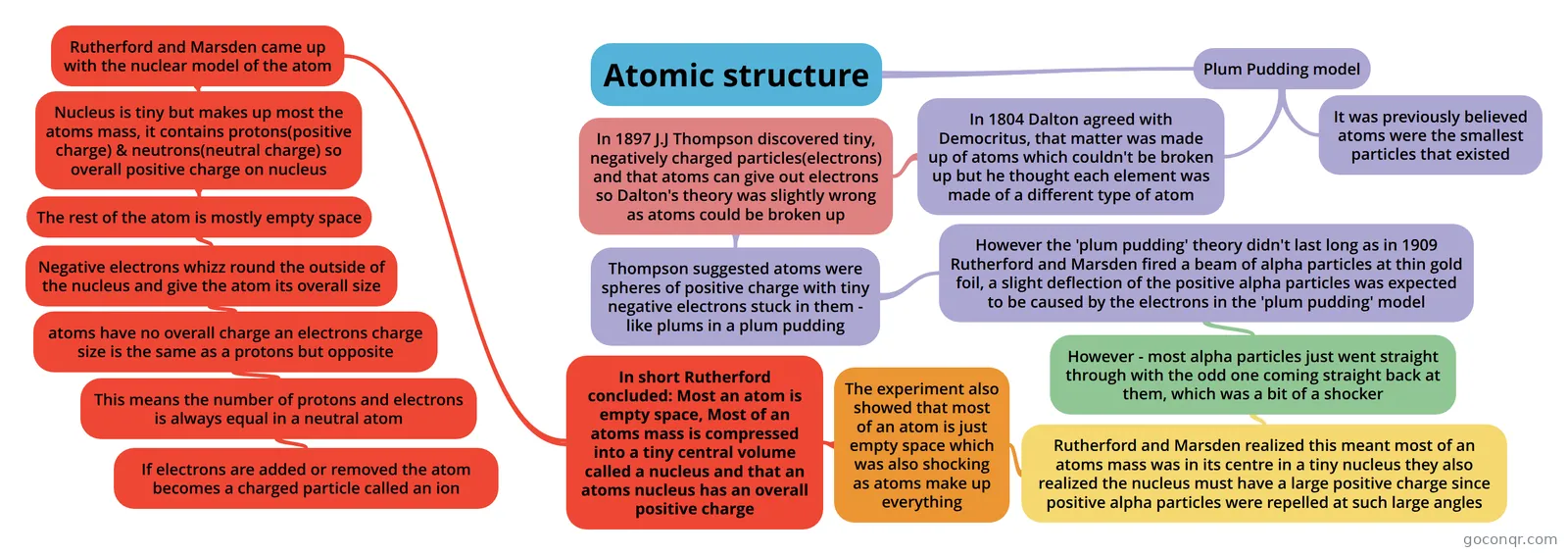
Mind map: Atomic structure
Inhalt der Mindmap
Atomic structure
Plum Pudding model
- It was previously believed atoms were the smallest particles that existed
- In 1804 Dalton agreed with Democritus, that matter was made up of atoms which couldn't be broken up but he thought each element was made of a different type of atom
- In 1897 J.J Thompson discovered tiny, negatively charged particles(electrons) and that atoms can give out electrons so Dalton's theory was slightly wrong as atoms could be broken up
- Thompson suggested atoms were spheres of positive charge with tiny negative electrons stuck in them - like plums in a plum pudding
- However the 'plum pudding' theory didn't last long as in 1909 Rutherford and Marsden fired a beam of alpha particles at thin gold foil, a slight deflection of the positive alpha particles was expected to be caused by the electrons in the 'plum pudding' model
- However - most alpha particles just went straight through with the odd one coming straight back at them, which was a bit of a shocker
- Rutherford and Marsden realized this meant most of an atoms mass was in its centre in a tiny nucleus they also realized the nucleus must have a large positive charge since positive alpha particles were repelled at such large angles
- The experiment also showed that most of an atom is just empty space which was also shocking as atoms make up everything
- In short Rutherford concluded: Most an atom is empty space, Most of an atoms mass is compressed into a tiny central volume called a nucleus and that an atoms nucleus has an overall positive charge
- Rutherford and Marsden came up with the nuclear model of the atom
- Nucleus is tiny but makes up most the atoms mass, it contains protons(positive charge) & neutrons(neutral charge) so overall positive charge on nucleus
- The rest of the atom is mostly empty space
- Negative electrons whizz round the outside of the nucleus and give the atom its overall size
- atoms have no overall charge an electrons charge size is the same as a protons but opposite
- This means the number of protons and electrons is always equal in a neutral atom
- If electrons are added or removed the atom becomes a charged particle called an ion
- This means the number of protons and electrons is always equal in a neutral atom
- atoms have no overall charge an electrons charge size is the same as a protons but opposite
- Negative electrons whizz round the outside of the nucleus and give the atom its overall size
- The rest of the atom is mostly empty space
- Nucleus is tiny but makes up most the atoms mass, it contains protons(positive charge) & neutrons(neutral charge) so overall positive charge on nucleus
- Rutherford and Marsden came up with the nuclear model of the atom
- In short Rutherford concluded: Most an atom is empty space, Most of an atoms mass is compressed into a tiny central volume called a nucleus and that an atoms nucleus has an overall positive charge
- The experiment also showed that most of an atom is just empty space which was also shocking as atoms make up everything
- Rutherford and Marsden realized this meant most of an atoms mass was in its centre in a tiny nucleus they also realized the nucleus must have a large positive charge since positive alpha particles were repelled at such large angles
- However - most alpha particles just went straight through with the odd one coming straight back at them, which was a bit of a shocker
- However the 'plum pudding' theory didn't last long as in 1909 Rutherford and Marsden fired a beam of alpha particles at thin gold foil, a slight deflection of the positive alpha particles was expected to be caused by the electrons in the 'plum pudding' model
- Thompson suggested atoms were spheres of positive charge with tiny negative electrons stuck in them - like plums in a plum pudding
- In 1897 J.J Thompson discovered tiny, negatively charged particles(electrons) and that atoms can give out electrons so Dalton's theory was slightly wrong as atoms could be broken up
Informationen
- Beschreibung
- Mindmap am Atomic structure, erstellt von Jack Willepotte am 20/03/2016.
- Erstellt von
- Jack Willepotte
- Aufrufe
- 48
- Bewertung