
5430423
Beschreibung

Mindmap von César Pineda, aktualisiert more than 1 year ago

|
Erstellt von César Pineda
vor mehr als 9 Jahre
|
|
Finite Element Method
- General procedure
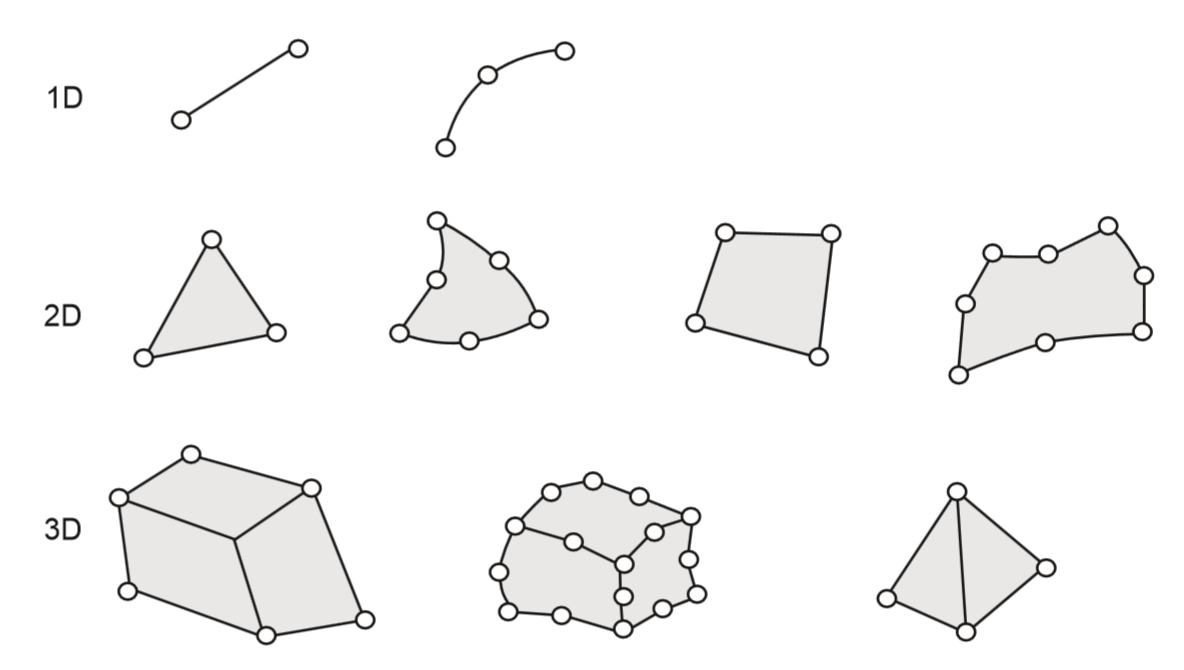
- Discretise the structure or continuum into finite elements.
- Specify the approximation equation.
- Determine the shape functions for each element.
- Formulate the properties of each element.
- Determine stiffness matrices and equivalent load vectors for all elements.
- Assemble elements to obtain the finite element model of the structure or continuum.
- Apply the known loads
- Apply boundary conditions.
- Solve simultaneous linear algebraic equations
- DOF
- nodal displacements in stress analysis
- nodal temperatures in heat transfer analysis
- nodal displacements in stress analysis
- stress analysis
- Compute stress
- Compute stress
- heat transfer analysis
- compute temperature
- Interpret results
- Interpret results
- compute temperature
- DOF
- Solve simultaneous linear algebraic equations
- Apply boundary conditions.
- Apply the known loads
- Assemble elements to obtain the finite element model of the structure or continuum.
- Determine stiffness matrices and equivalent load vectors for all elements.
- Formulate the properties of each element.
- Determine the shape functions for each element.
- Specify the approximation equation.
- Discretise the structure or continuum into finite elements.
- Advantages of FEM
- Model complex shaped bodies quite easily.
- Handle several load conditions without difficulty.
- Handle different kinds of boundary conditions.
- Include dynamic effects.
- Vary the size of the elements to make it possible to use small elements where necessary.
- Handle time-dependent and time-independent heat transfer problems.
- Handle time-dependent and time-independent heat transfer problems.
- Vary the size of the elements to make it possible to use small elements where necessary.
- Include dynamic effects.
- Handle different kinds of boundary conditions.
- Handle several load conditions without difficulty.
- Model complex shaped bodies quite easily.
- Engineering Applications
- Mechanical Desing
- Stress concentration problems
- Stress analysis of pressure vessels
- Composite materials
- Linkages and gears
- Stress concentration problems
- Electrical machines and
electromagnetics
- Steady state analysis
of synchronous and
induction machines
- eddy current and core losses
in electric machines
- magnetostics
- Steady state analysis
of synchronous and
induction machines
- Biomedical engineering
- Stress analysis of eyeballs
- bones and teeth
- load-bearing capacity in plant and prosthetic systems
- mechanics of heart values
- Stress analysis of eyeballs
- Nuclear engineering
- Analysis of nuclear
pressure vessels and
containment structures
- Steady state
temperature distribution
in reactor components
- Analysis of nuclear
pressure vessels and
containment structures
- Mechanical Desing
- Degrees of freedom(DOF)
- Specify the state of the element. They also
function as ‘handles’ through which adjacent
elements are connected. DOF are defined as
the values (and possibly derivatives) of a
primary field variable at nodal points
- Specify the state of the element. They also
function as ‘handles’ through which adjacent
elements are connected. DOF are defined as
the values (and possibly derivatives) of a
primary field variable at nodal points
- What is FEM?
- FEM is a powerful tool for
the numerical solution of a
wide range of engineering
problems.
- The basic concept in the physical
interpretation of the FEM is the sub-division
of the mathematical model into disjoint
(non-overlapping) components of simple
geometry called finite elements
- The basic concept in the physical
interpretation of the FEM is the sub-division
of the mathematical model into disjoint
(non-overlapping) components of simple
geometry called finite elements
- FEM is a powerful tool for
the numerical solution of a
wide range of engineering
problems.
- Boundary conditions
- Avoid the possibility of the structure moving as a rigid
body. Two approaches are used for handling specified
displacement boundary conditions.
- Elimination approach
- Penalty approach
- Elimination approach
- Avoid the possibility of the structure moving as a rigid
body. Two approaches are used for handling specified
displacement boundary conditions.
- Variational Formulation
- The Total Potential Energy Functional (TPE)
- Relation between strain energy density and external energy
- Relation between strain energy density and external energy
- The Minimum Potential Energy Principle (MPEP)
- states that the actual displacement solution u(x) is that which renders Pi stationary
- states that the actual displacement solution u(x) is that which renders Pi stationary
- The Total Potential Energy Functional (TPE)
- ANSYS
- It is one of the finite element analysis
computer programming software.
- ANSYS-Mechanical product is
designed for analysing
- static
- structural and thermal
- linear and non-linear
- buckling
- sub-structure
- acoustics
- dynamic/transient
- static
- ANSYS-Mechanical product is
designed for analysing
- It enables users to solve a wide variety of
analyses in mechanical engineering
applications
- It is one of the finite element analysis
computer programming software.
- Finite Element Discretisation
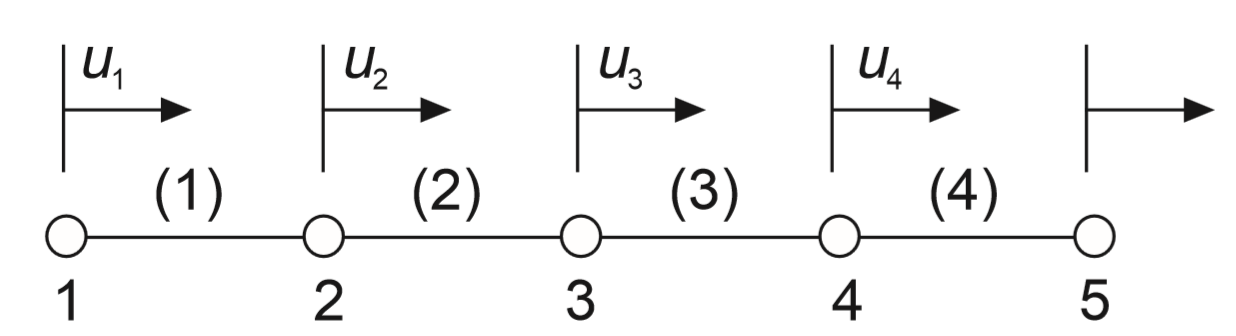
- Decompose the TPE functional into a sum of
contributions of individual elements.
- The same decomposition applies to the internal and external energies, as
well as to the condition of MPEP
- Using the fundamental lemma of variational calculus, it can be
shown that implies that for a generic element
(e) we may write:
- This variational equation is the basis for the derivation of
element stiffness equations once the displacement field has
been discretised over a bar element.
- This variational equation is the basis for the derivation of
element stiffness equations once the displacement field has
been discretised over a bar element.
- Using the fundamental lemma of variational calculus, it can be
shown that implies that for a generic element
(e) we may write:
- The same decomposition applies to the internal and external energies, as
well as to the condition of MPEP
- Decompose the TPE functional into a sum of
contributions of individual elements.
- By César Pineda Leonardo
Medienanhänge




Möchten Sie kostenlos Ihre eigenen Mindmaps mit GoConqr erstellen? Mehr erfahren.