
5714273
Beschreibung

Mindmap von Mohd Iddeen Shah, aktualisiert more than 1 year ago

|
Erstellt von Mohd Iddeen Shah
vor mehr als 9 Jahre
|
|
Logical Reasoning
- Proof
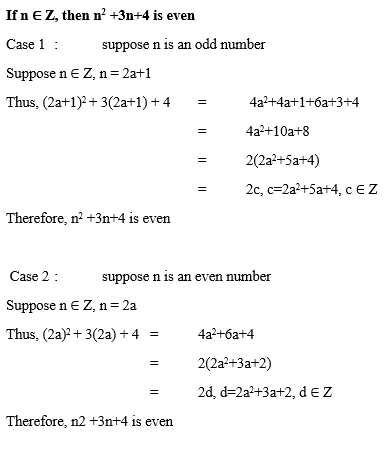
- Direct Proof
- outline
- Reason to use
- Its a straightforward method, suitable
for proving easier statement
- Its a straightforward method, suitable
for proving easier statement
- outline
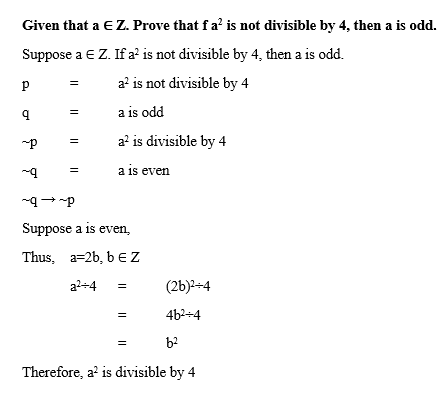
- Contrapositive Proof
- Reason to use
- Certain cases can be both
proved using contrapositive
proof and direct proof, however,
for more complex proving
statement, its preferable to use
this method as it is easier
- Certain cases can be both
proved using contrapositive
proof and direct proof, however,
for more complex proving
statement, its preferable to use
this method as it is easier
- Outline
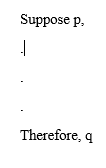
- If p, then q
- Suppose ~q
- Therefore ~p
- If p, then q
- Reason to use
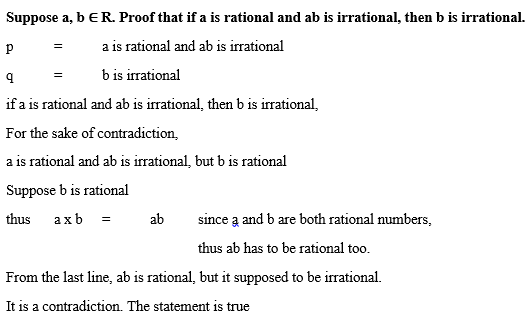
- Contradiction Proof
- Reason to use
- used in when the statement
cannot be proven using both
direct proof and contrapositive
proof method
- used in when the statement
cannot be proven using both
direct proof and contrapositive
proof method
- The proof by contradiction is grounded
in the fact that any proposition must be
either true or false, but not both true
or false at the same time.
- Outline depends on the
statement since
contradiction method
can both be used to
prove a statement or a
conditional statement
- Reason to use
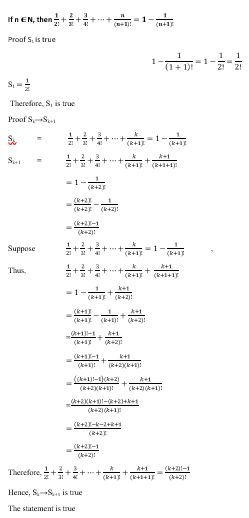
- Mathematical Induction
- Reason to use
- Used whenever the statement
requires proving a certain
sequence such as Fibonacci's
sequence
- Used whenever the statement
requires proving a certain
sequence such as Fibonacci's
sequence
- Outline
- Prove that first statement is true
- assume that n=k is true
- prove than n=k+1 is true
- conclude every S is true
- Prove that first statement is true
- Reason to use
- Direct Proof
- Logic
- Systematic way of thinking that allows us to deduce new
information and to examine the meaning of sentence
- Systematic way of thinking that allows us to deduce new
information and to examine the meaning of sentence
- Statement
- Sentence or a
mathematical expression
that is either definitely true
(T) or false (F), but not both
- Biconditional statement
- Conditional statement
- If p then q
- Direct proof
- Indirect proof
- Contrapositive
- Contradiction
- Contrapositive
- Mathematical induction
- Direct proof
- If p then q
- Types of statement
- Known to be true ( theorem & preposition)
- Truth unknown (conjectures)
- Known to be false
- Known to be true ( theorem & preposition)
- Sentence or a
mathematical expression
that is either definitely true
(T) or false (F), but not both
- Real Number
- Rational Number
- Integer
- Negative Integer
- Zero
- Positive Integer
- Prime Number
- Composite Number
- Prime Number
- Symbol - Z
- Negative Integer
- Non Integer
- Symbol - Q
- Integer
- Irrational Number
- Symbol - R
- Rational Number
- Complex Number
- Natural Number
- Not include number '0'
- Not include number '0'
- Whole Number
- Include number '0'
- Include number '0'
- Truth Table
- Display relationship between truth values of statements
- Logical possibilities = 2^n
- Example : 2^2=4
- Example : 2^2=4
- Connective
- Negation
- not
- not
- Conjuction
- and
- and
- Disjunction
- or
- or
- Implication
- if p, then q
- if p, then q
- Equivalence
- if and only if
- if and only if
- Negation
- Display relationship between truth values of statements
- Theorem
- statement that is true and has been true
- statement that is true and has been true
- Known facts and rules
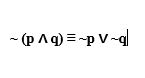
- De Morgan's law
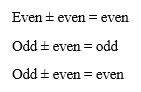
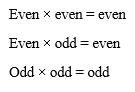
- Parity
- Two integers have same parity if both even or both odd. otherwise, they have opposite parity
- Addition and substraction
- Multiplication
- Addition and substraction
- Two integers have same parity if both even or both odd. otherwise, they have opposite parity
- n = Odd number
- n = Even number
- De Morgan's law
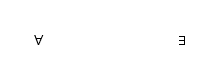
- Quantifiers
- Universal
- For all
- For every
- For all
- Existential
- There exist a
- There is a
- There is at least 1
- There exist a
- Universal
Medienanhänge








Möchten Sie kostenlos Ihre eigenen Mindmaps mit GoConqr erstellen? Mehr erfahren.