
619604


Meta-igneous rocks
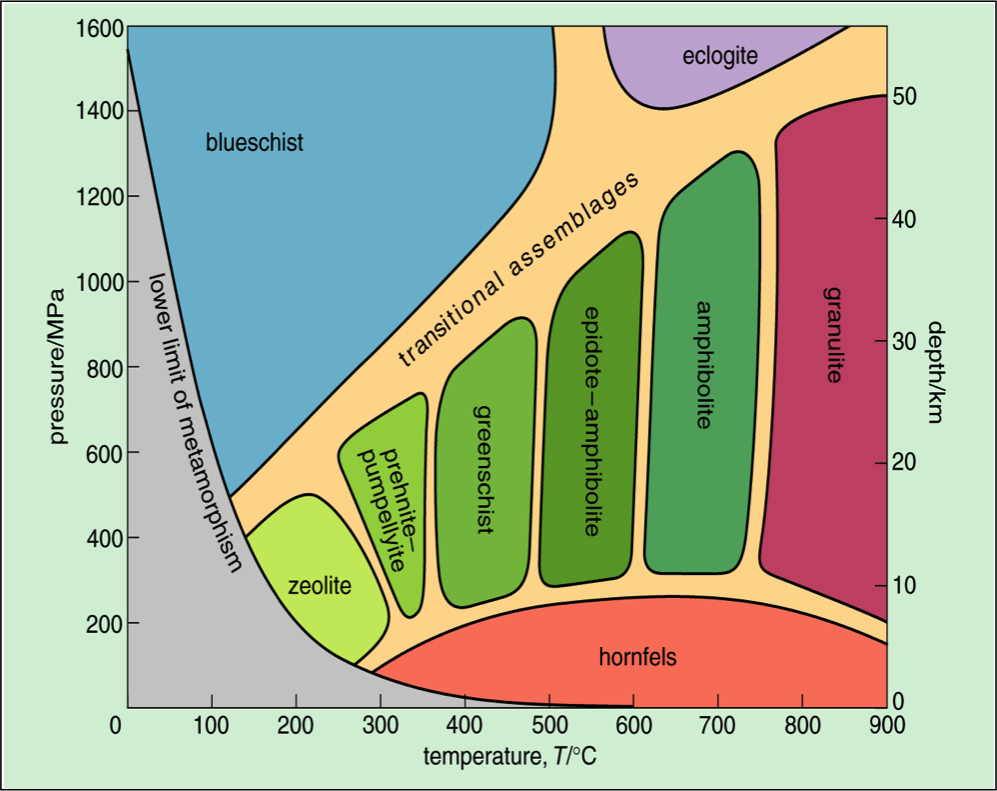
- Metamorphic facies
- Greenschist
- chlorite, albite, actionlite,
epidote, quartz
- chlorite + green amphibole
- chlorite, albite, actionlite,
epidote, quartz
- Amphibolite
- green amphibole
(hornblende = dark
green/black
amphibole),
garnet, plag
- green amphibole
(hornblende = dark
green/black
amphibole),
garnet, plag
- Hornfels
- Sanidinite
- Eclogite
- high density -
transformation of blue
schist into something
denser and loss of
hydrous minerals.
- green/red colours
diagnostic - green
pyroxene (jadeite)
and garnet
- high density -
transformation of blue
schist into something
denser and loss of
hydrous minerals.
- Granulite
- with increasing T,
amphibole breaks down
to produce pyroxenes:
clino and ortho
- represent unusually hot conditions - greater T
than associated with their depth of formation so
thought to be formed with crustal thickening and
excess heating
- no hydrous mineral
phases - represents
deep burial and
dehydrated roots of
continental crust
- pyx, garnet/plag
- with increasing T,
amphibole breaks down
to produce pyroxenes:
clino and ortho
- Epidote-amphibolite
- epidote + green amphibole
- epidote + green amphibole
- Blueschist
- Grown under v high pressures
- subduction zones
- characterised by sonic
blue amphibole =
glaucophane
- Grown under v high pressures
- subduction zones
- Greenschist --> amphibolite
--> granulite corresponds to
typical continental geotherm
- most common facies dries of regional
metamorphism - equivalent to classical
Barrovian series
- most common facies dries of regional
metamorphism - equivalent to classical
Barrovian series
- Greenschist
- Hydration of original mafic
minerals needed to generate
mm mineral assemblages for
most facies
- w/o H2O most igneous
rocks will be unaffected
whilst surrounding
sediments will be
metamorphosed
- coarse-grained intrusions
of gabbro are most
resistant - low H2O content
whilst basalts are most
susceptible
- w/o H2O most igneous
rocks will be unaffected
whilst surrounding
sediments will be
metamorphosed
- not much difference
between low-P
metabolites and med-P
- distinguish between contact mm
facies and medium-pressure regional
mm facies if 1) metapelites are
present (regional) 2) textures etc
- distinguish between contact mm
facies and medium-pressure regional
mm facies if 1) metapelites are
present (regional) 2) textures etc
- metasediments (and
barrow zones) tend to
give more information
that metamorphic
facies
Medienanhänge
Möchten Sie kostenlos Ihre eigenen Mindmaps mit GoConqr erstellen? Mehr erfahren.