
708131
Beschreibung

Mindmap von 06watkinse, aktualisiert more than 1 year ago

|
Erstellt von 06watkinse
vor mehr als 12 Jahre
|
|
1213 Week 19 T
- Enzyme Catalysed Reactions
- E + S <-> ES <-> E + P
- the relationship between time and product formed is exponential
- as time goes on the rate of reaction slows
- concentration of the substrate decreases over time so there are less collisions
- velocity of the back reaction increases
- product may inhibit the enzyme
- enzyme may be labile
- concentration of the substrate decreases over time so there are less collisions
- concentration against initial reaction rate is hyperbolic
- Vmax = maximum reaction rate
- Km = concentration of substrate where half of the enzyme active sites are occupied (half Vmax) (conc units)
- Michaelis-Menten equation is velocity=Vmax[S] / ([S] + Km)
- if the substrate dissociates quicker than the rate of product formation Km becomes the substrate dissociation constant
- if this occurs then the smaller Km the higher the affinity of the substrate to the enzyme
- if this occurs then the smaller Km the higher the affinity of the substrate to the enzyme
- it is difficult to measure Vmax because there is poor solubility of substrate at high concentrations
- the Lineweaver-Burk plot removes the issue of insolubility
- on the plot
- y axis = 1/v
- x axis = 1/[S]
- the slope = Km/Vmax
- the intercept = 1/Vmax
- y axis = 1/v
- on the plot
- E + S <-> ES <-> E + P
- Allosteric Enzymes
- allosteric - the binding site for the effector molecule is not the active site of the substrate
- co-operative binding = occurs if the number of binding sites of a molecule that are occupied by a specific
type of ligand is a non-linear function of this ligand's concentration
- cooperative binding produces a sigmoidal graph of initital reaction rate against substrate concentration
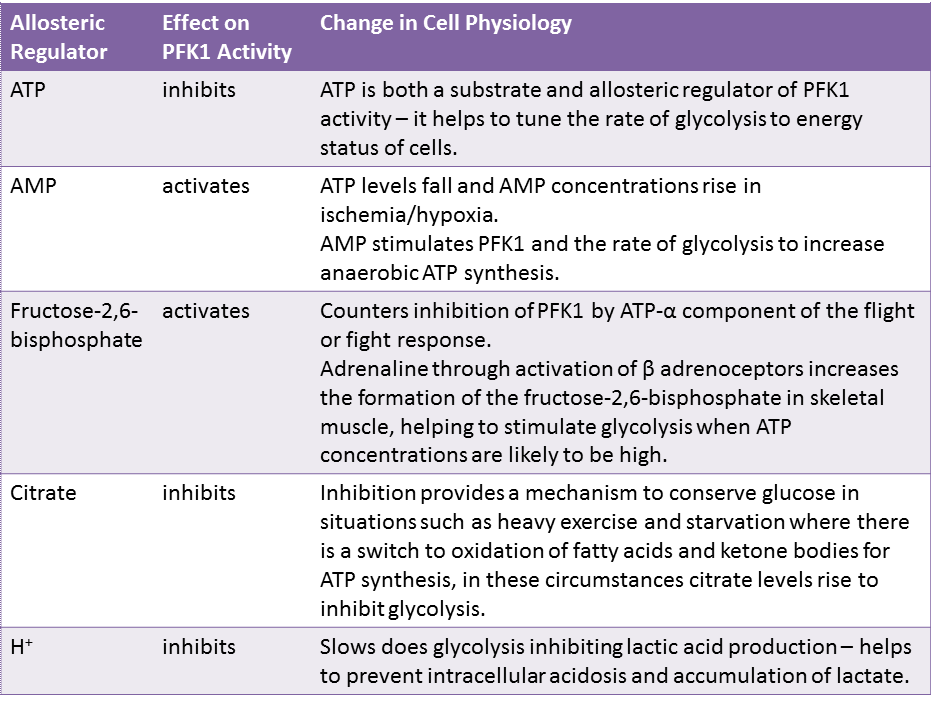
- mechanisms that control enzyme activity
- feedback inhibition by a product
- gene expression - amount of enzyme altered
- phosphorylation/dephosphorylation
- proteolysis - irreversible activation and altering life span through changes in rate of enzyme degradation
- feedback inhibition by a product
- allosteric - the binding site for the effector molecule is not the active site of the substrate
- Inhibition of Enzyme Activity
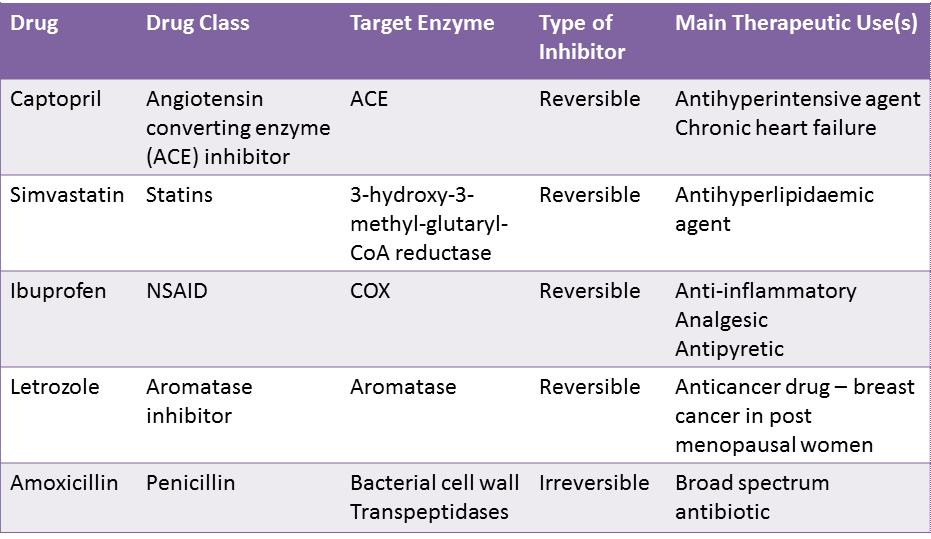
- irreversible inhibitors
- form a covalent or they bind too tightly so dissociation is extremely slow
- enzyme activity can only be restored by synthesis of new enzymes
- form a covalent or they bind too tightly so dissociation is extremely slow
- reversible inhibitors
- competitive
- have a similar shape too the substrate
- bind to the active site
- can be overcome by increasing the substrate concentration
- alter the slope of the Lineweaver-Burk plot but not the y axis intercept
- Vmax remains the same
- Km changes
- have a similar shape too the substrate
- non-competitive
- bind to a site different to the active site of the substrate
- can not be overcome by increasing substrate concentration
- decrease the efficiency of the enzyme rather than stopping the reaction
- Vmax changes
- Km doesn't change
- alter the slope of the Lineweaver-Burk plot but not the x axis intercept
- bind to a site different to the active site of the substrate
- competitive
- organophosphates
- target enzyme - acetylcholinesterase
- uses - chemical warfare, insecticides
- physiological effects
- nerve agents
- produce a cholinergic toxidrome as a result of excessive activation of the PSNS
- DUMBBELS
- D - diarrhoea
- U - urination
- M - miosis
- B - bronchorrhoea
- B - bronchospasm
- E - emesis
- L - lacrimation
- S - salivation
- D - diarrhoea
- nerve agents
- target enzyme - acetylcholinesterase
- irreversible inhibitors
Medienanhänge
Möchten Sie kostenlos Ihre eigenen Mindmaps mit GoConqr erstellen? Mehr erfahren.