
780310
Beschreibung

Mindmap von Sophie.J.E, aktualisiert more than 1 year ago

|
Erstellt von Sophie.J.E
vor mehr als 12 Jahre
|
|
The Marketing
Environment
- Demand, supply, price
- Demand: the amount
consumers desire to
purchase at various prices
- If enough people want something
and are willing to pay a high price
for it, an organisation will be likely
to supply more of it to increase
profits
- The higher the price the lower
the demand, and vice verca
- High demands leads to: high
levels of employment, good
profits, good wages, inflation
- Lower demand leads to:
reduced production, reduced
profits, unemployment, wage
restraints, lower national income
- High demands leads to: high
levels of employment, good
profits, good wages, inflation
- Factors influencing demand:
Quality, branding, reputation,
costs of raw materials, business
ethics
- Elastic: a change in price leads
to a large change in quantity sold
- In-elastic: a change in price leads to
very little change in quantity sold
- Price fixing: artificially high
pricing due to 'gentlemans
agreements' (illegal) -
customers lose out.
- Predatory pricing: Companies
lower prices more than local
businesses in the short term to
gain/steal customers because local
businesses cannot afford to do the
same
- If enough people want something
and are willing to pay a high price
for it, an organisation will be likely
to supply more of it to increase
profits
- Demand: the amount
consumers desire to
purchase at various prices
- S.W.O.T
- Strengths
- Weaknesses
- Opportunities
- Threats
- Strengths
- Marketing Strategies
- S Hammond: 'marketing
strategy is the organisation of
all the resources available to
the marketing function to
achieve given objectives. The
term may also be used to
describe the plan drawn up by
the marketing function in order
to achieve those objectives'.
- Aims of a marketing strategy
include: getting the best returns
for business and getting the
business to identify the right mix
of function, image or service.
- Aims of a marketing strategy
include: getting the best returns
for business and getting the
business to identify the right mix
of function, image or service.
- Market orientated firm: adapts its products to changing trends
- Asset-led firm: uses an asset to make products that vary by demand
- Product-orientated firm: make the same product and rely on it being in trend
- Market segmentation
- Can divide a market by: age, gender, income,
interests, etc. This is demographic
segmentation. It can also be divided by lifestyle
groups, psychological groups and specific
mixed profiles
- An alternative is to segment by customer needs and
expectations, such as speed of service, value of products,
range of products, quality of products and in-store services
- An alternative is to segment by customer needs and
expectations, such as speed of service, value of products,
range of products, quality of products and in-store services
- Advantages: improved
marketing effectiveness,
improved customer
satisfaction
- Drawbacks: reaching the
chosen segment with marketing,
difficult to identify the most
appropriate segmentation
method, meeting needs of
customers in the chosen
segment can cause other
customers to be ignored
- Can divide a market by: age, gender, income,
interests, etc. This is demographic
segmentation. It can also be divided by lifestyle
groups, psychological groups and specific
mixed profiles
- S Hammond: 'marketing
strategy is the organisation of
all the resources available to
the marketing function to
achieve given objectives. The
term may also be used to
describe the plan drawn up by
the marketing function in order
to achieve those objectives'.
- Growth Strategies
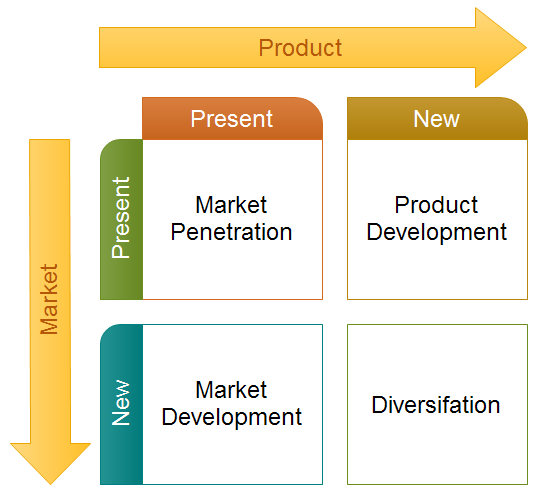
- Ansoff:
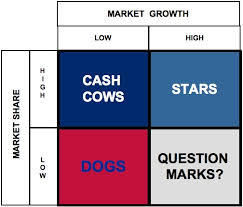
- Boston:
- Boston:
- Organic growth: internal growth; arises from the sale of existing products and the development of new products
- Advantages: less risk, lower investment
- Advantages: less risk, lower investment
- External growth: in-organic growth; arises from the firm buying another business
- Advantages: quicker more instant/visible growth, business not too
over-reliant on one business venture
- Advantages: quicker more instant/visible growth, business not too
over-reliant on one business venture
- Acquisition: the purchase of one business by another
- Joint venture: two or more business agree to run a separate business or project together
- Integrated growth
- Vertical integration: when two businesses in the same industry but
at different stages in the production process join together
- Horizontal integration: When two businesses at the same
stage of production process in the same industry are
brought together
- Business size can be measured by: Sales figures, business value,
capital employed, workforce, output, no. of outlets and its market share
- Vertical integration: when two businesses in the same industry but
at different stages in the production process join together
- Ansoff:
- Competitive position strategies
- Market Leaders
- Market challengers
- Market followers
- Market nichers
- Market Leaders
- P.E.S.T
- Market Research
- Analysing market data
Medienanhänge
Möchten Sie kostenlos Ihre eigenen Mindmaps mit GoConqr erstellen? Mehr erfahren.