
973115


P1.4.2 The National Grid
- Overhead power lines
- +
- lower set up cost
- easy to access
- easy to set up
- minimal disturbance to land
- lower set up cost
- -
- lots of maintenance needed
- looks ugly
- affected by weather
- less reliable
- lots of maintenance needed
- +
- Underground cables
- -
- higher setup cost
- hard to access
- hard to set up
- large disturbance to land
- higher setup cost
- +
- minimal maintenance
- not unsightly as they are hidden
- not affected by weather
- more reliable
- minimal maintenance
- -
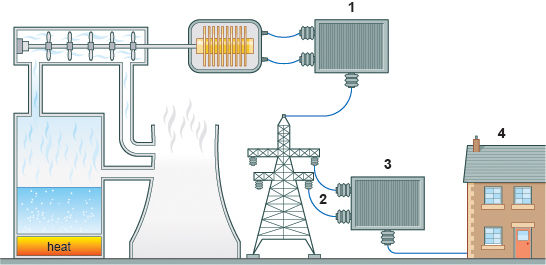
- Is a network of cables and transformers that distributes power to our homes from distant power stations and renewable energy generators
- 1) Step-up transformers (used at power stations)
- 2) High voltage (132 kV or more) transmission lines
- 3) Step-down transformers (at sub-stations)
- 4) Consumers, homes and factories- 230 V
- Step the grid voltage down for use in our homes
- 4) Consumers, homes and factories- 230 V
- 3) Step-down transformers (at sub-stations)
- Power station (up to 25 kV)
- Step up power station voltages to the grid voltage
- 2) High voltage (132 kV or more) transmission lines
- For a given power, increasing the voltage reduces the current required and this reduces the energy losses in the cable
- 1) a step-up transformer raises the voltage, so less current is needed to transfer the same amount of power
- 2) a lower current passes through the grid cables
- 3) so energy losses due to the heating effect of the current are reduced to almost zero
- 4) But we need to lower the voltage at the end of the grid cables before we can use mains electricity at home
- 4) But we need to lower the voltage at the end of the grid cables before we can use mains electricity at home
- 3) so energy losses due to the heating effect of the current are reduced to almost zero
- 2) a lower current passes through the grid cables
- 1) a step-up transformer raises the voltage, so less current is needed to transfer the same amount of power
Medienanhänge
Möchten Sie kostenlos Ihre eigenen Mindmaps mit GoConqr erstellen? Mehr erfahren.