
Beschreibung


|
Erstellt von Natalia Lehnhoff Faillace
vor mehr als 5 Jahre
|
|
Seite 1
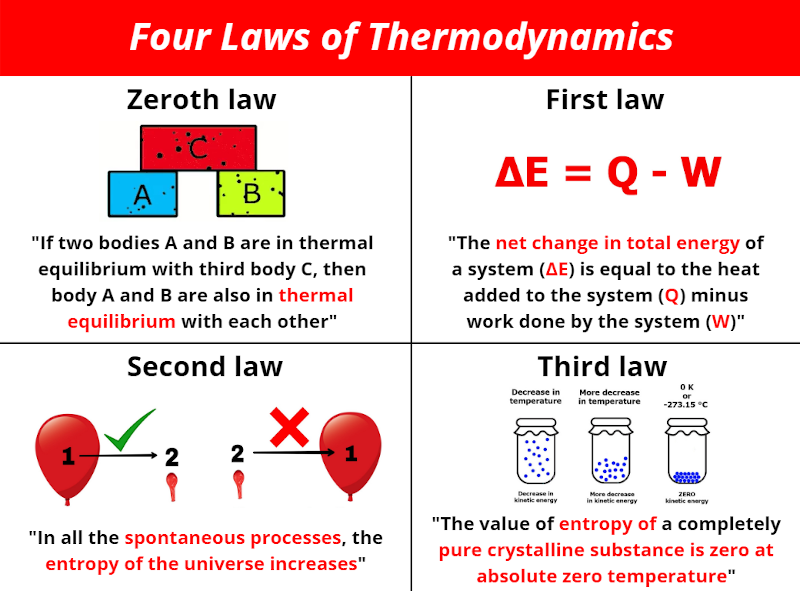
Laws of Thermodynamics An infrared camera is measuring infrared heat. It captures the heat release, and it gives you the shape. Thermodynamics is a branch of science that studies heat. Thermo (heat) and dynamics (moving or changing) Movement of thermal energy Heat is energy on the move. Heat (Thermal energy): The transfer of energy from a warmer object to a cooler object and never reverse. Heat is the movement or transfer of thermal energy. Joule: The standard unit of measure of energy is the joule, which is abbreviated as J. Temperature is a measurement of the average kinetic energy of molecular movement in an object or system. The more they move the higher the temperature and the lower the move the lesser the temperature. Higher kinetic energy and lower kinetic energy until they reach a balance. Thermal energy is used to generate steam. The First Law: Conservation of energy: The amount of energy in the universe is a constant. Energy can be transferred from one substance to another or transformed into other forms of energy, but it cannot be created or destroyed. Describe the behavior of a system. A chemical reaction is an open system. Second Law of Thermodynamics: Energy always disperses from a more usable form of energy to a less usable form. Heat cannot transfer from a cool object to a warmer object: The energy disperses. Entropy: The measurement of energy dispersal. Heat cannot transfer from a cool object to a warmer object. Disperse energy is useless to us. Entropy is always increasing. Entropy depends on the temperature. A lot of heat a lot of entropy. The lower the heat the lower the entropy. Entropy is a measurement of dispersal. Absolute Zero: The temperature at which all molecular motion stops and entropy is zero. Third Law of Thermodynamics: The entropy of a system at absolute zero is zero. James Prescott Joule (1818-1889): English physicist who studied the nature of heat.
Möchten Sie kostenlos Ihre eigenen Notizen mit GoConqr erstellen? Mehr erfahren.