

Schließen
Learning goals for Lecture 37
Need to know the following key points
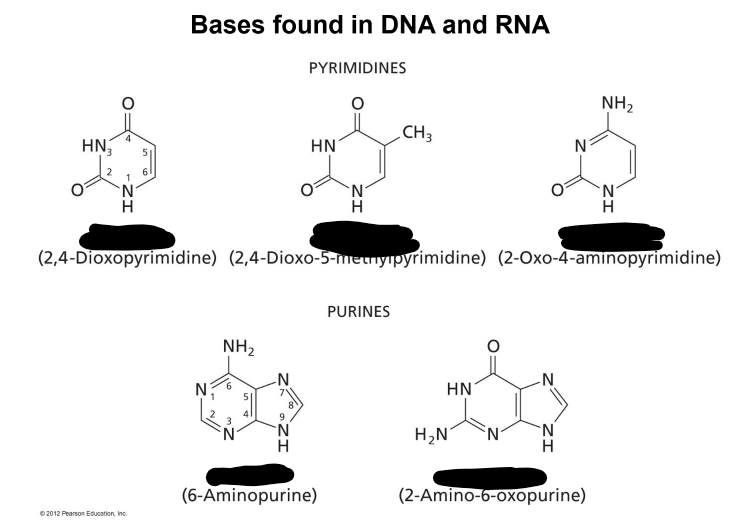
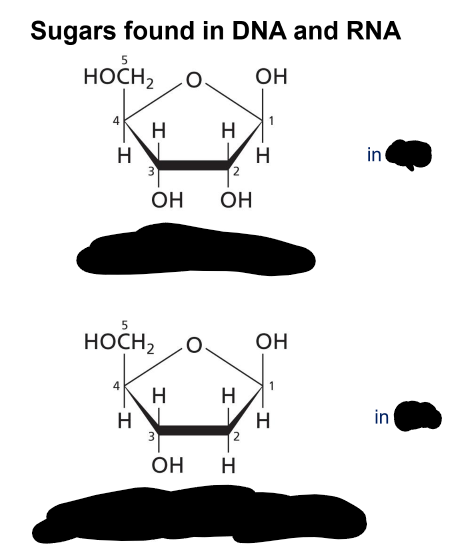
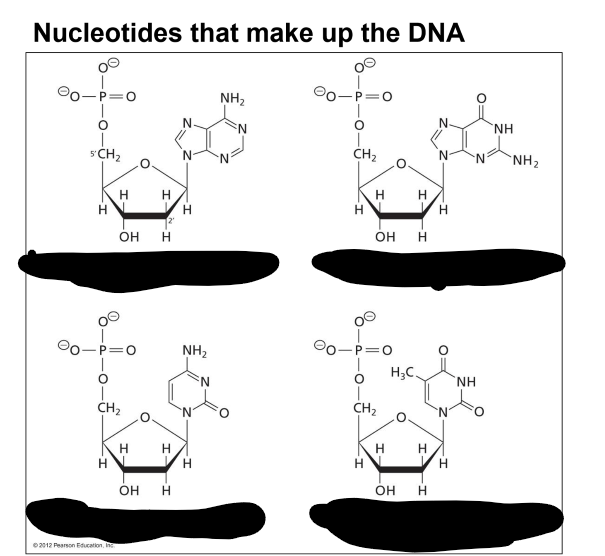
Figure 19.6 Hydrogen bonding sites of bases.
While A has ___, T G, and C have ___ donor or acceptor sites each.
C & T have __ donor and __ acceptors
G has ___ donors and ___ acceptor
A has __ donor and ___ acceptor
Primary structure of DNA
Nucleotides are joined by ___ phospho-diester linkages.
The backbone of the polynucleotide chain consists of phosphoryl groups, 5' 4' and 3' carbon atoms, and 3' oxygen of the deoxyribose
So backbone = ___ + ___
DNA double strand formation
Two anti-parallel strands form the DNA double helix through ____ bonding between the bases of complementary strands.
Note that the backbone of the two
strands formed by the deoxyribose-
phosphate phospho-diester linkages
are ___-____
G-C = ___ H bonds
A-T = ___ H bonds
Complementary base pairing and
stacking in double-stranded DNA
Base pairing produces a regular structure in which one strand is complementary to the other.
Base-pair ___ lead to the formation of a double helix with stacked base pairs.
Weak interactions stabilize the double helix:
1. ___ bonds between bases in the double helix.
2. Stacking interactions: stacked bases form __ __ ___ interactions.
3. ____ effects: burying of bases in the interior of the double helix.
Some terms used to describe
double helix DNA
Major and minor groove of the helix with unequal width induced by ___-___
mechanism.
Diameter of the double helix (2.37 nm in B
DNA)
• Rise of the helix (0.33 nm in B DNA).
Rise = distance b/w two neighboring DNA ___ ___
• Pitch of the helix (3.4 nm in B DNA, -10.4
bases).
Pitch = one ____ of the helical structure
A slide with a space-filling model of __ DNA, the most common form in cells.
• bases (light shades) project ___ from
the sugar-phosphate backbones (dark
red and blue) of each strand
• the major and minor grooves are lined
by potential hydrogen bond donors and
acceptors (yellow), which can interact
with proteins and other molecules
without ___ the helix.
Note: electrostatic repulsion due to the
negatively charged phosphate groups
is a destabilizing force, but mitigated by
cations such as ___ and positively
charged proteins (e.g. ____).
Stacking interactions for the 10
possible combinations in double-stranded DNA
The stacking energy of two base pairs depends on the nature of the base pair (G/C or A/T) and the orientation of each base pair. Within the hydrophobic core of the stacked double helix, the hydrogen bonds between the base pairs have -27 kJ/mol each.
However, if the stacking interactions are ___, the hydrogen bonds in the base pairs become exposed to competition with water and the overall contribution to keeping the strands together diminishes greatly.
Under physiological conditions, double-stranded DNA is thermodynamically much more ____ than separated strands and that is why the double-stranded form predominates in vivo.
The complete separation of strands of a double helix DNA is called ____. The temperature at which half of the double-stranded DNA is separated is the ___ ___
The _ form of the double helix is the most common form in cells. However, two other forms of the DNA double helix have been discovered.
The _ DNA with tighter stacking but wider diameter that forms when DNA is dehydrated, and the _ DNA with left-handed helix.
Z DNA is formed by __ rich regions with alternating purine and pyrimidine bases in the primary structure.
B & A DNA = ___ handed
Z DNA = ___ handed
UV absorbance of DNA is maximum at ___ nm.
Single-stranded DNA absorbs 12-40%
___ light than double-stranded DNA since the bases are more exposed in ssDNA than dsDNA.
A plot of change in absorbance of a DNA solution versus temperature is called a ___ ___
Generally, absorbance increases sharply at the melting point and ____ occurs in a narrow range after that.
The sigmoidal nature of the curve indicates ____ between base pairing and stacking.
Note that GC-rich DNA has a ___ melting point due to the increased energy conferred by G-C base pairing. For instance, the melting point of poly-AT, poly-AT/GC and poly-GC in the figure below are 69°C, 88°C, and 109°C, respectively.
Primary structure of RNA
Like DNA, each RNA strand has the same basic structure composed of nitrogenous bases ___ bound to a sugar-phosphate backbone.
However, unlike DNA, RNA is usually a ___-____ molecule.
RNA molecules can form
secondary and tertiary structures:
Unlike DNA which exists primarily
as a long double helix, most cellular RNAs are ___ stranded and exhibit a variety of conformations. Differences in size and conformations permit them carry out specific functions.
a) Secondary structures:
___ : complementary sequences
5-10 ntds from each other.
___-___ : by complementary strands 10 to several hundred ntds from each other.
b) Tertiary structure: combination
of ___ and ___
Cells contain several types of RNA
1. ___ ___ (__): Integral part of ribosomes and the most abundant
RNA in cells.
2. ___ ___ (__): they carry activated amino acids to ribosomes for incorporation into proteins.
3. ___ ___ (__): carry the genetic information (encode the
sequence of amino acids) for the synthesis of proteins by the ribosomes.
4. ___ ___ molecules (miRNA, IncRNAs, primer RNAs, etc)
Alkaline hydrolysis of RNA:
DNA is more stable than RNA and therefore a better carrier of genetic information.
RNA is less stable because the _-___ group can act as a nucleophile and attack the phosphodiester bond and break the strand when activated by proton withdrawal.
First, 2',3' cyclic monophosphate product is formed and then hydrolyzed to a mixture of 2' and 3' monophosphates. This can happen in 0.1 M NaOH at room temperature in which DNA is stable.
RNA is a very UNSTABLE molecule due to the presence of the __ group on the 2' carbon on the sugar (ribose) and can be degraded very ___
Mechanism of RNA cleavage by RNase A.
Three ionic residues in the active site of RNase A (His-12, Lys-41, and His-119) cooperate to ___ RNA.
The process is similar to alkaline hydrolysis in that His-12 acts as a __ to abstract H from the 2'-hydroxyl group, leading to activation of the 2'-oxygen to act as a nucleophile.
His-119 then acts as an __ and donates H to the 5'oxygen atom of the next nucleotide residue to produce an alcohol leaving group (Product 1 or PI).
The end of the truncated RNA molecule now has a 2',3'-cyclic nucleoside, which is
attached by an activated water molecule.
Note this His-119 after donating H now acts as a __ to activate water. The role of Lys-41 is to ___ the transition state. Finally, His-12 which was converted to an acid donates H to produce P2 and ____the enzyme.


