
12465870
Beschreibung

Quiz von Rachel O' Flynn, aktualisiert more than 1 year ago

|
Erstellt von Rachel O' Flynn
vor mehr als 8 Jahre
|
|
Frage 1
Frage
Shortening of the muscle occurs by the [blank_start]sliding filament[blank_end] mechanism
- [blank_start]actin[blank_end] filaments slide along adjacent [blank_start]myosin[blank_end] filaments by cycling of cross-bridges with myosin
• The [blank_start]Z[blank_end] lines come closer together and the muscle cell shortens
• The cardiac muscle thus produces [blank_start]force[blank_end] or tension
Antworten
-
sliding filament
-
actin
-
myosin
-
Z
-
force
Frage 2
Antworten
-
Total
-
Active
-
Passive
Frage 3
Frage
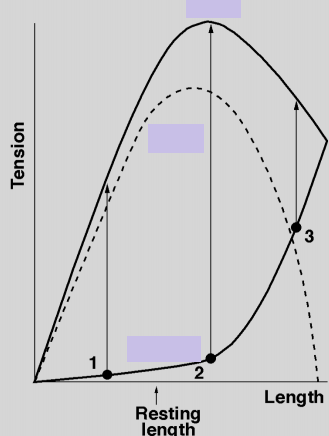
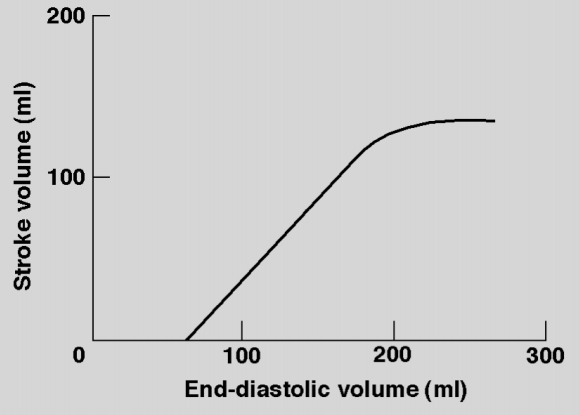
This ability of cardiac muscle to increase its [blank_start]contractile[blank_end] force with a slight increase in its [blank_start]length[blank_end] underlies its ability to control [blank_start]stroke volume[blank_end] (the volume of blood ejected from the heart during a single beat)
Antworten
-
contractile
-
length
-
stroke volume
Frage 4
Frage
If the muscle is overstretched (ie, during dilation of the heart), its ability to produce an active tension is reduced
Antworten
- True
- False
Frage 5
Antworten
-
ejection
-
filling
-
stroke volume
-
isovolumetric relaxation
-
isovolumetric contraction
Frage 6
Antworten
-
Starling curve
Frage 7
Frage
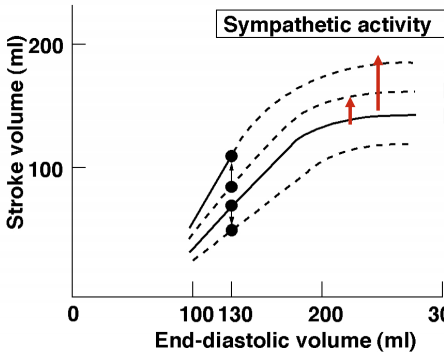
Label the graph with the following; increased, normal, decreased
Antworten
-
increased
-
increased
-
normal
-
decreased
Frage 8
Frage
Increased contractility means
Antworten
-
higher stroke volume for the same end diastolic volume
-
lower stroke volume for the same end diastolic volume
-
higher stroke volume for the higer end diastolic volume
-
higher stroke volume for the lower end diastolic volume
Frage 9
Frage
A rise to a higher starling curve means decreased contractility
Antworten
- True
- False
Frage 10
Frage
dP/dtmax is a good measure of
Antworten
-
myocardial contractility
-
myocardial reponse
-
myocardial dilation
-
myocardial pressure
Frage 11
Frage
Label the following curves A, B and C
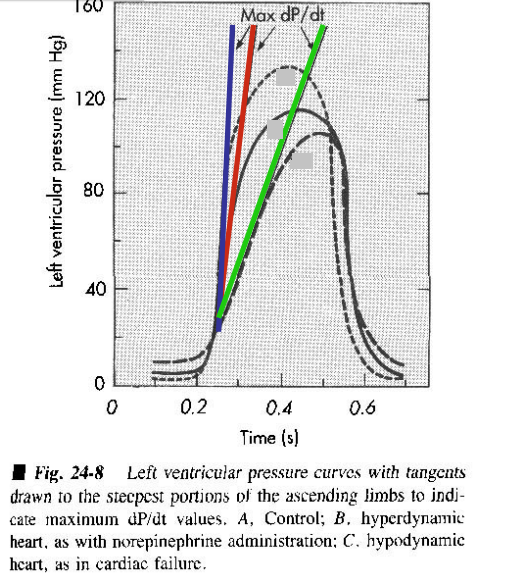
Antworten
-
control
-
B
-
C
Frage 12
Frage
Agents that cause an increase in contractility are said to have a positive [blank_start]inotropic[blank_end] effect
Antworten
-
inotropic
Frage 13
Frage
Which of the following are examples of positive inotropic agents?
Antworten
-
noradrenaline
-
adrenaline
-
digoxin
-
verapamil
Frage 14
Frage
Positive inotropic agents have the general effect of increasing
Antworten
-
Ca^2+
-
K^+
-
Cl^-
-
Na^+
Frage 15
Frage
Which of the following are negative inotropic agents?
Antworten
-
calcium channel blockers
-
beta adrenergic blockers
-
hypoxia
-
epinephrine
Frage 16
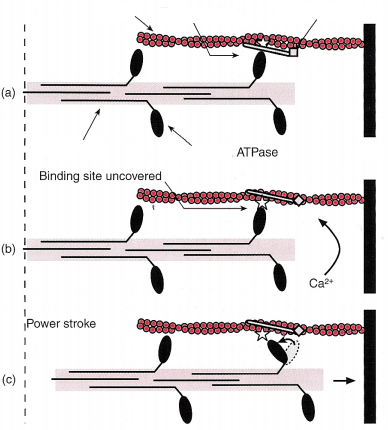
Antworten
-
actin
-
tropomyosin
-
troponin complex
-
myosin body
-
myosin head
-
z line
Frage 17
Frage
CICR stands for [blank_start]calcium induced calcium release[blank_end]
Antworten
-
calcium induced calcium release
Frage 18
Frage
SERCA stands for [blank_start]sarcoplasmic endoplasmic reticulum[blank_end] calcium ATPase
Antworten
-
sarcoplasmic endoplasmic reticulum
Frage 19
Frage
Which of the following statements are true?
Antworten
-
Junctional SR is studded with Ca2+ release channels
-
RYR is a giant protein with a terminal foot with a T-shaped tube in its centre through which Ca2+ ions are releases
-
The density of RYR is low near L-type Ca channels
-
The distance between the Ca channels and the RYR is very short (nm)
Frage 20
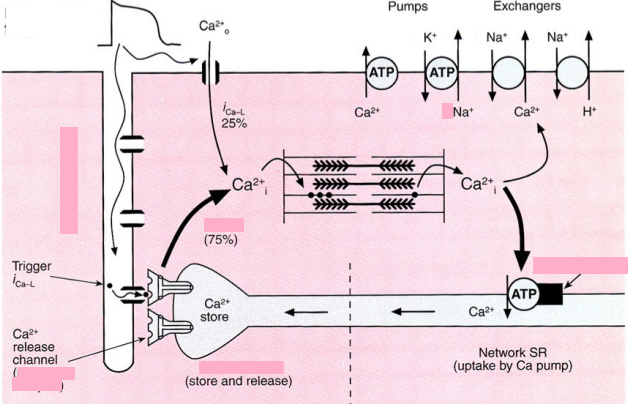
Antworten
-
2
-
3
-
3
-
phospholamban
-
junctional SR
-
ryanodine receptor
-
transverse tubule
-
CICR
-
extracellular fluid
Frage 21
Frage
What is SERCA regulated by?
Antworten
-
phospholamban
-
ryanodine
-
CICR
-
noradrenaline
Frage 22
Frage
What happens at the end of contraction?
Antworten
-
Ca2+ influx ceases and the SR is no longer stimulated to release Ca2+
-
the intracellular concentration of Ca2+ must be rapidly reduced
-
most of the cytoplasmic Ca2+ is pumped back into the SR by SERCA
-
a small amount of calcium is pumped out of the cell by the cell membrane Ca pump
Frage 23
Frage
What does sympathetic stimulation of the cardiac muscle produce?
Antworten
-
Increase in active tension
-
Increase in the rate of active tension development
-
Increase in the rate of tension relaxation
-
Increase in passive tension
-
Increase in the rate of passive relaxation
-
decrease in active tension
-
decrease in passive tension
Frage 24
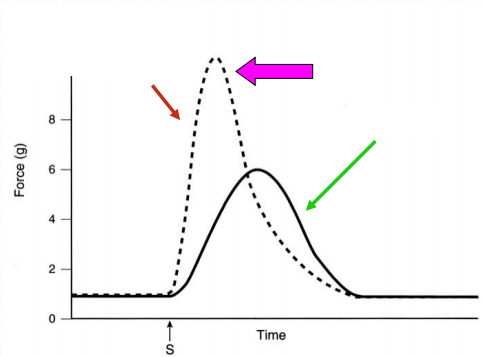
Antworten
-
beta adrenergic stimulation
-
control
Frage 25
Frage
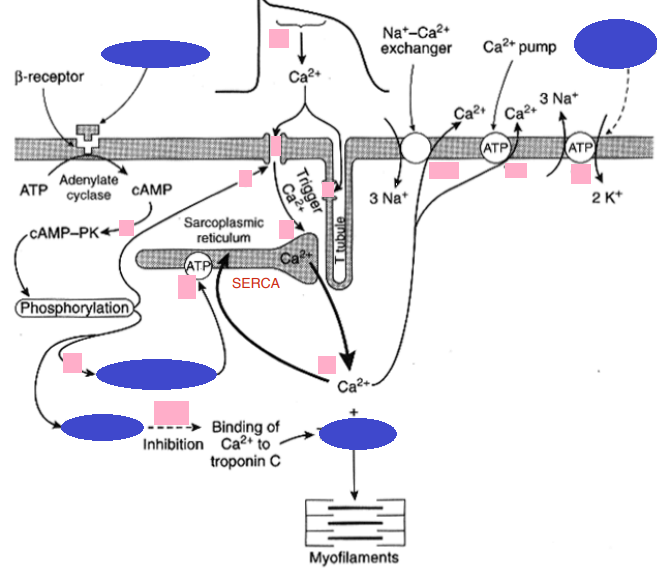
Label the pink rectangles 1-12( step 2 is there twice). Label the blue ovals cardiac glycosides, catecholamine, troponin I, troponin C and phospolamban
Antworten
-
1
-
2
-
2
-
3
-
4
-
5
-
6
-
7
-
8
-
9
-
10
-
11
-
12
-
troponin c
-
troponin I
-
phospholamban
-
catecholamine
-
cardiac glycosides
Frage 26
Frage
cAMP activates [blank_start]protein kinase A[blank_end]
Antworten
-
protein kinase A
Frage 27
Frage
Protein Kinase A [blank_start]phosphorylates[blank_end] the L-type calcium channel
Antworten
-
phosphorylates
Frage 28
Frage
Which of the following are true?
Antworten
-
Increased intracellular Ca2+ concentration increases the force of contraction (positive inotropic effect)
-
Protein kinase A phosphorylates Phospholamban and Troponin I
-
phosphorylation of troponin I leads to inhibition of binding of calcium to troponin C and relaxation occurs
-
phosphorylation of phospholamban leads to reduced inhibition of SERCA which leads to increased uptake of calcium into the SR and relaxation occurs
-
Phospholamban phosphorylation promotes the rate of contraction
Möchten Sie mit GoConqr kostenlos Ihre eigenen Quiz erstellen? eigenen Mehr erfahren.