
13535617


| Frage | Antworten |
| What are Ethics? | Broadly applied social standards for what is right and wrong in a particular situation, or a process for setting those standards |
| How/why does ethics apply to leadership? | "Ethics is central to leadership because of the process of influence, the need to engage followers to accomplish mutual goals, and the impact leaders have on establishing organizational values." |
| Ethics v Morals | Ethics are different from morals, which are individual and personal beliefs about what is right and wrong |
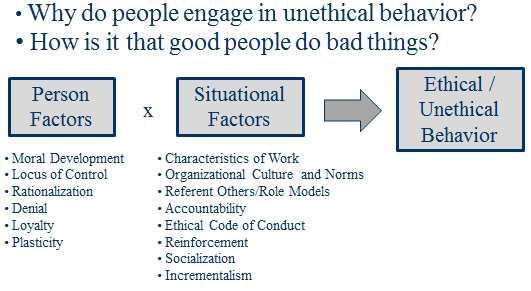
| Interactionist Model of Ethics | |
| Organizational Culture | -Norms influencing employees (beliefs, values, cognitions, behaviors) -The shared assumptions of the org members and the shared history that created the assumptions that guide the behavior in the org -A type of social control system |
| Strong v Weak Cultures | Best impact on behavior, values, cognitions, and behavior is strong Strong = widely and intensely shared |
| Effects of Culture | -Provides a sense of identity & encourages commitment -Helps individuals make sense of organizational events -Reinforces organizational values -Guides and shapes individual behavior |
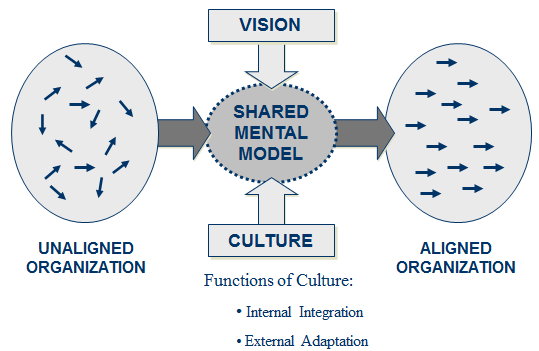
| Aligning the Organization | |
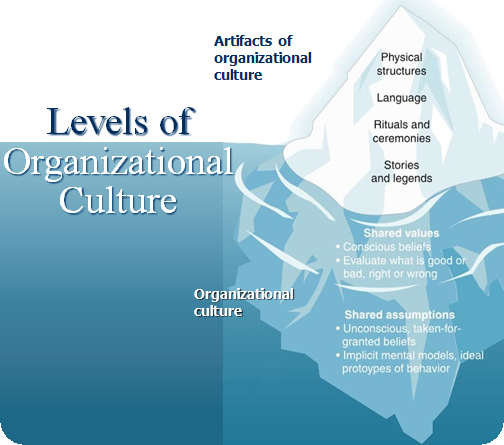
| Levels of Organizational Culture | |
| Characteristics of Org. Culture | Innovation and Risk Taking Attention to Detail Outcome Orientation People Orientation Team Orientation Aggressiveness |
| Ethics and Organization Cultures | Culture that develops inside org with an ethical component -Agency: managerial egoism -Corporate Egoist: short term profit -Instrumentalist: strategic morality due to financial benefit -Moralist: concern for all stakeholders -Altruist: moral standard trump all |
| Four Components of an Ethical Culture | Ethical Leadership Supervisor Reinforcement of Ethical Values Peer Commitment to Ethics Embedded Ethical Values |
| Characteristics of Ethical Leaders | Respect Others Serve Others Are Just Are Honest Act as Ethical Role Models |
| Culture Strength and Subcultures | Most orgs have more than one culture Dominant Culture: expresses the core values that are shared by a majority of the orgs members Subcultures: mini-cultures within an org, typically defined by dept and geographical location |
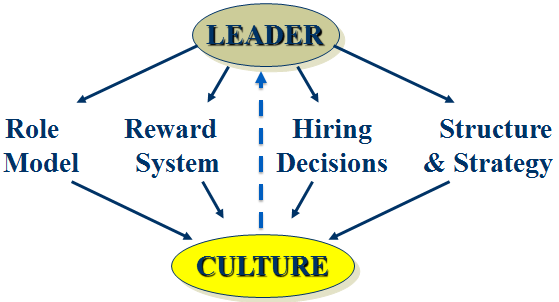
| Leader's Function in Shaping Organizational Culture | |
| Sustaining a Strong Culture | Selection Management Socialization Other Methods |
| Management | -What leaders pay attention to, measure, and control on a regular basis -How leaders react to critical incidents -How leaders allocate scarce resources, rewards, and status/recognition -How leaders recruit, select, promote, retire, and remove org members |
| Other Methods | Stories Rituals Symbols Language |
| What's a "Good" Culture? | Strong Compatible Adaptable |
| Strong Culture | -Intense consensus about org values -Facilitation of effective performance -Extremely difficult to change -May lead to lack of diversity -May become barrier to success of merger/acquisition |
| Compatible Culture | -Fit with industry requirements or firm strategy -Long-term performance costs when environment changes faster than culture |
| Adaptable Culture | -Encourages risk taking to respond to external change -Promote long-term performance through attention to needs of owners, customers, & employees -May have short-term performance costs |
| International Leadership | |
| Four Dimensions of Cultural Intelligence (CQ) | Cognitive Meta-cognitive Motivational Behavioral |
| Cognitive (CQ) | Knowledge of other cultures, such as language |
| Metacognitive (CQ) | One's awareness, monitoring, and control of culture-based assumptions and inferences |
| Motivational (CQ) | One's confidence (self-efficacy) and motivation to adjust to a new culture |
| Behavioral (CQ) | One's ability to change behaviors to match cultural needs e.g. I change my verbal behavior (accent/tone) when a cross-cultural interaction requires it |
| GLOBE Database | 17,000 middle managers in 62 countries and 951 organizations (80% male) Financial, Food, and Telecom Industries |
| GLOBE Project Goals | -Identify manager behaviors, attributes, and org practices that are: -universally accepted and effective -accepted and effective only in particular cultures -determine whether org cultures are reflective of society |
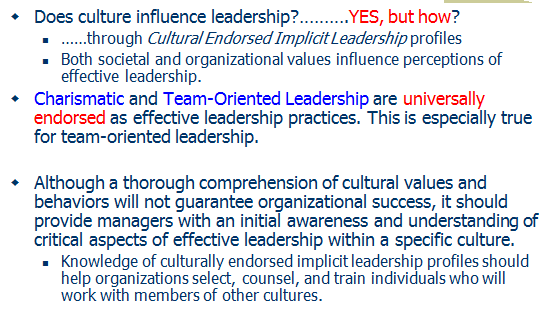
| Implicit Leadership Theory | Individuals have implicit theories about the attributes and behaviors that distinguish leader from others, effective leaders from ineffective ones, and moral leaders from evil ones. |
| Why are implicit theories of leadership & leadership prototypes important? | -Indicate styles and behavior to will be exhibited in that culture -Suggests styles expected by followers -Specify what leaders may or may not do -Indicate level of status & influence on leaders |
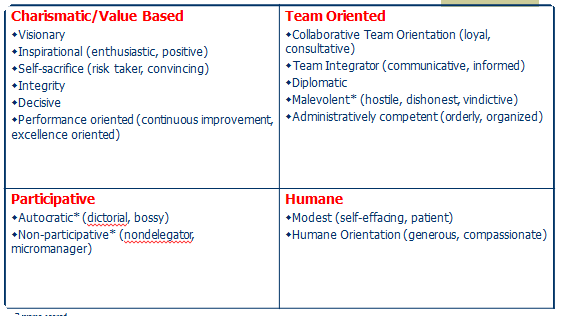
| GLOBE Leader Dimensions | |
| Criticisms of GLOBE | -Sampling Problems -Cannot assume leadership style will fit across entire population of country (ie Shanghai v other parts of China) -Bases results on national stereotypes and results in socially desirable responses |
| Key Takeaways |
Möchten Sie mit GoConqr kostenlos Ihre eigenen Karteikarten erstellen? Mehr erfahren.