

Close
GOALS
TUTORIAL SLIDES
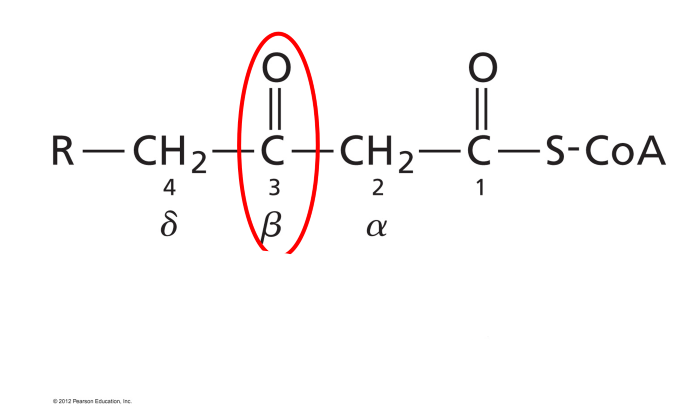
β oxidation:
Degradation of fatty acid removing _ carbons at a time
Proceeds from the ___ __ end of the fatty acid
2 carbons released as I molecule of ___ ___
Fatty acids must be removed from the lipid (break ___)
Fatty acids must be activated (form ____ with COA)
β oxidation occurs in ____ (mostly)
Must get fatty acids into mitochondria first
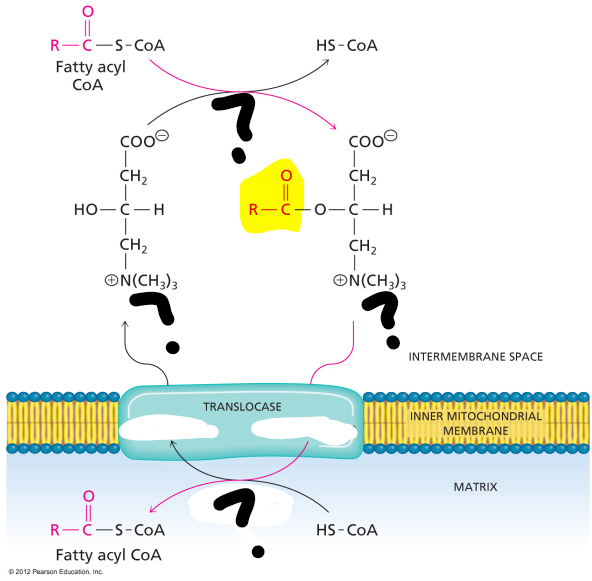
___ is a carrier for transport
Carnitine acyltransferase I (in CYTOPLASM) transfers acyl group from acyl COA to ____
_____ is translocated into mitochondria, while carnitine is translocated out
Carnitine ____ __
(in mitochondria) transfers acyl group
from acylcarnitine to COA
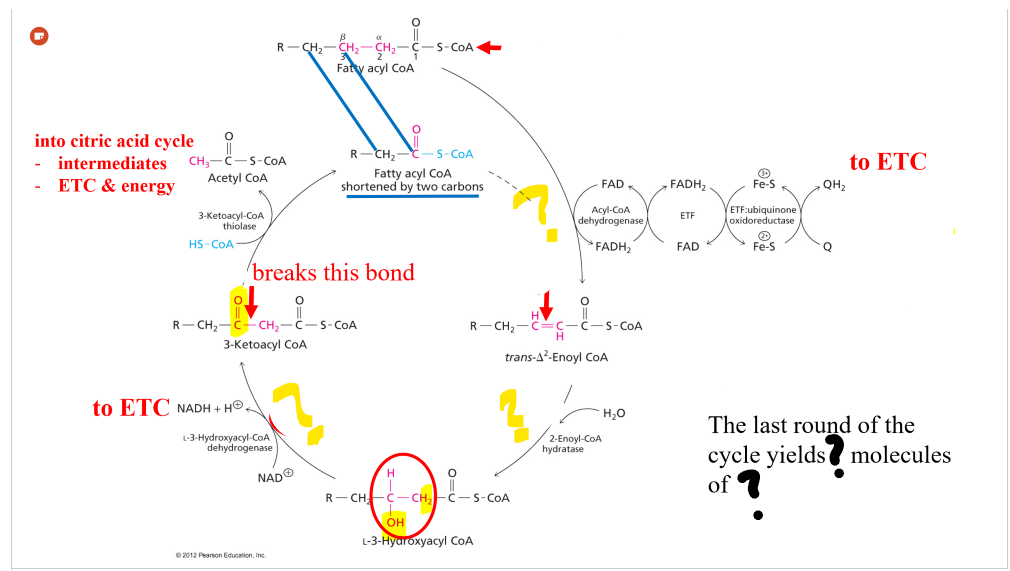
β oxidation:
Four steps
l. _____
2. _____
3. _____
4. _____
1st oxidation generates ___
2nd oxidation generates ___
FADH2 and NADH go to the __ __ __
acetyl COA goes into the __ ___ ___
Fatty acids are synthesized and degraded by adding or removing _ carbons at a time.
For fatty acid oxidation
Four repeating steps — ___, ___, ____, ___, then repeat
FA's built and degraded at the same carbon! (at the __ carbon)
Why are fatty acids degraded?
->Turnover of membrane lipids
->Yields ___
->Yield carbons for ___ __ synthesis
Fatty acid oxidation
Primarily occurs in ____.
There are two steps:
1.) ____
2.) ____- Four repeating steps — oxidation, hydration, oxidation and thiolysis, then repeat
Ester linkage between fatty acid and carbon backbone of lipid must be hydrolyzed to yield __ ___
Free fatty acids must be ____ before they can be degraded.
Forms a ___ with COA.
This is the same reaction we discussed in lipid synthesis — ___ of fatty acids
Fatty acid oxidation also occurs in
peroxisomes
Very long-chain fatty acids (>C26) are oxidized in _____
When shorter, fatty acids are transported to ___ for further oxidation
__ oxidation also occurs in peroxisomes
Mitochondrial vs peroxisomal oxidation
In mitochondria — first oxidation is catalyzed by acyl-COA ____— FAD is ___
In peroxisomes — first oxidation is catalyzed by acyl-COA ___— electrons transferred to 02 to generate ___
β oxidation and energy
Consider this example — stearate = C18 fatty acid
How many ATP could be made?
___ cycles of β oxidation generate:
8 QH2
12 ATP
8 NADH yields 20 ATP
9 acetyl COA yields 90 ATP
Activation of stearate cost _ ATP equivalents
I molecule of stearate can
yield ___ ATP
Oxidation of stearate = ___ ATP; oxidation of 3 glucose (CI8) = 96 ATP
SHORTCUT??? (for both gross and net ATP)
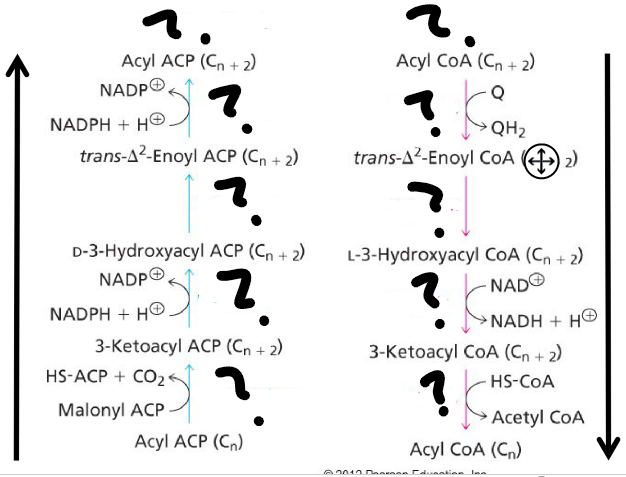
Comparison of fatty acid synthesis and β
oxidation
Opposite processes but different:
Different cofactors (COA vs ACP)
Oxidation — _ carbon products
Synthesis — __ carbon substrate
Different compartments:
cytoplasm vs mitochondria
Problem — how to get fatty acids into
mitochondria?
Little ones (<C12) = ___
BIGGER ones need transport
Transported with ___ as a carrier
Problem — how to get fatty acids into mitochondria?
1. ___ ___ _ covalently links acyl group from fatty acyl COA to carnitine — occurs at outer membrane of mitochondria
2. ____ is translocated INTO the
mitochondrial matrix as carnitine is translocated OUT of the matrix
3. ___ ____ __ in matrix
of the mitochondria, transfers acyl group to COA, generating acyl COA and free
carnitine
What happens to odd chain fatty acids?
Most ANIMAL fatty acids have ___ number of carbons
Odd chain fatty acids are made by other species
These can be degraded by __ ___
The last step produces 1 molecule of acetyl COA (C2) and I molecule of ___ __ (C3)
__ __ is converted to ___ CoA, which is used in the citric acid cycle
What happens to unsaturated fatty acids?
• β oxidation occurs as normal until double bond gets in the way — occurs because l) double bond may be ___ and may be in the __ __, e.g. Δ3
position, or 2) might be a Δ2'4 diene
l) If an isomerase converts to ___ and moves the double bond to the Δ2
position yielding a ___-___-___ ___ (product of first oxidation step of β
oxidation — remember) and β oxidation resumes
•2) If reductase reduces a double bond, generating a double bond in the wrong
place:
->___ moves the double bond to the Δ2 position yielding a trans-Δ2-Enoyl COA and β oxidation resumes
Fatty acid oxidation via other mechanisms
If β carbon is methylated, e.g. in phytanic acid, β oxidation ___ occur
-> Can be modified by __ oxidation
Resulting product can be degraded by __ oxidation
α oxidation occurs in ____
Recap
•Fatty acids are transported as ___ into the mitochondria, where _ oxidation occurs (transport is KEY regulatory step)
•Oxidation involves 4 repeated steps of: oxidation, hydration, oxidation and
thiolysis to generate __ __ (shorter by 2 C's) and __ ___
•Oxidation steps generate ___ and ___ — connect to electron transport
chain — also generates __ __ which enters citric acid cycle
•UNsaturated fatty acids required additional steps for degradation — either
isomerization or ___/___ to generate a substrate for oxidation enzymes
•BRANCHED (i.e. methylated) fatty acids must undergo _ oxidation (in peroxisome) prior to β oxidation


