

Close
GOALS
TUTORIAL SLIDES
Nitrogen
Atmospheric nitrogen is non-reactive
and must be ___ prior to use.
Nitrogen fixation is the ___ of N2 to
NH3 (ammonia). This is catalyzed by ___.
Ammonia (NH3) is inorganic and must be incorporated into an organic molecule.
This is called nitrogen ____.
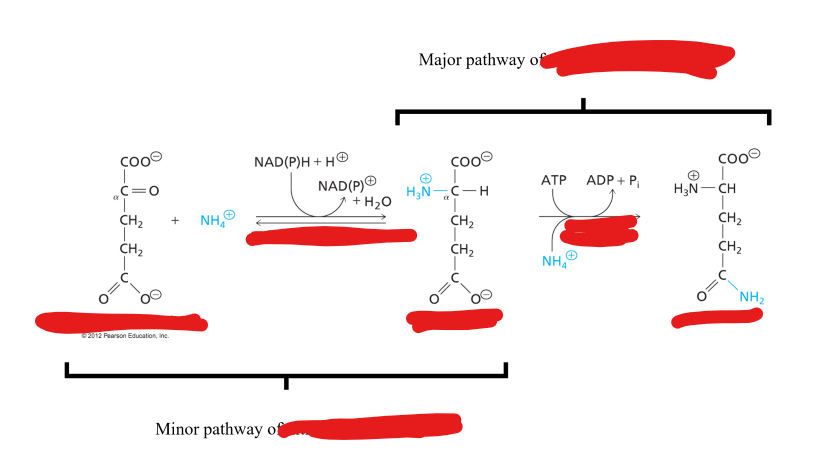
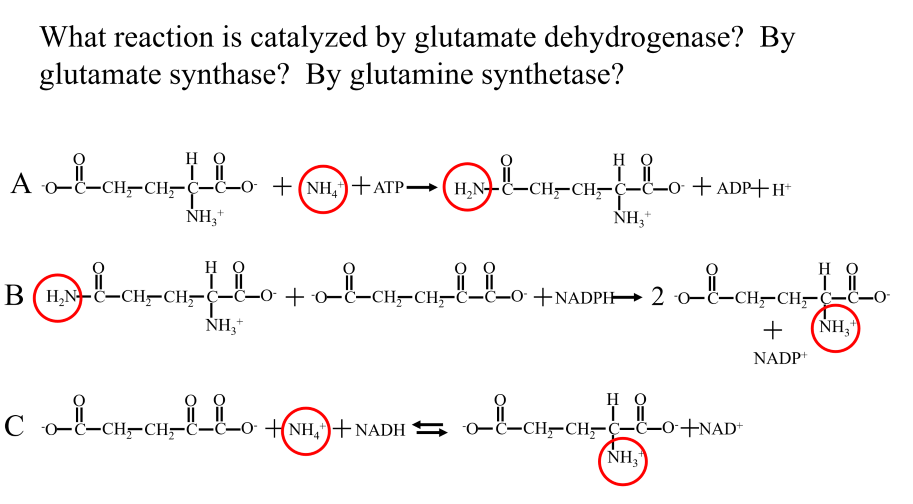
Major mechanism of nitrogen assimilation - Ammonium (NH4+) reacts with glutamate to form ____. Catalyzed by glutamine ____.
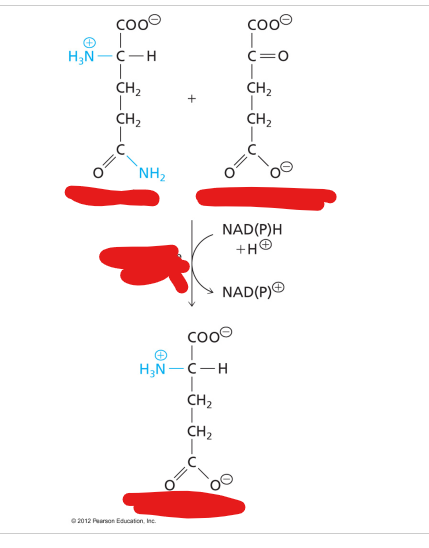
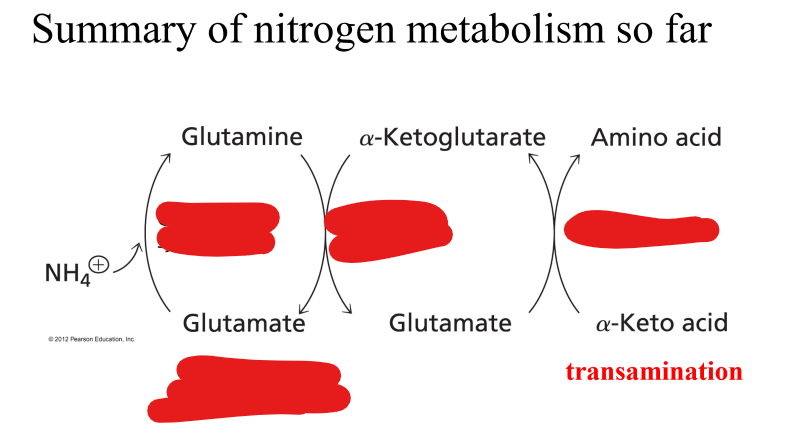
Glutamate synthase transfers the side chain amino group from glutamine to α-ketoglutarate to generate 2 molecules of _____.
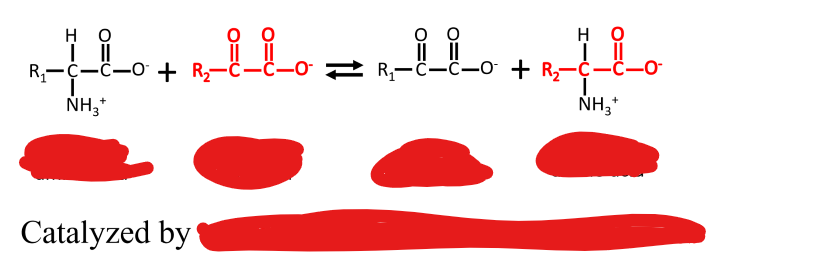
Amino groups from amino acids can be transferred to an α keto acid to generate a new amino acid. These ____ reactions are catalyzed by aminotransferases/ transaminases.
Animals can make some amino acids (called nonessential amino acids) and must acquire other amino acids from the diet (____ AAs).
Transamination reactions are catalyzed by ____ or _____
Aminotransferases require the co-enzyme ___
Nitrogen gas
Air is __% N2
N2 is ___ (stable/nonreactive) and we can't use
Atmospheric N2 must be ___ to a useful form
Nitrogen ____ = reduction of atmospheric N2 - can only be done by some prokaryotes
-reaction is very SLOW and requires a lot of ____
Nitrogen fixation is catalyzed by ______
_____ is a protein complex and reduction occurs in the ___ center.
(electrons are transferred from NADH)
Nitrogen assimilation
Nitrogen assimilation — incorporation of ___ ___ (e.g. NH4+ or N03-) into organic molecules
___ ___ is incorporated into amino acids
Organic nitrogen moves through the ecosystem primarily as amino acids
____ ___ — catalyzes this reaction
Glutamate + NH4(+) --> Glutamine
This reaction is __ dependent
To incorporate nitrogen from N03-, the nitrate must be reduced to ____ first
Glutamate Synthase
•Glutamine acts as nitrogen donor for reductive amination of __-____
Catalyzed by __ ____ (only in prokaryotes and plants)
**Requires ____
•Enzyme is NOT present in animals
a-ketoglutarate + glutamine + NADPH + H(+) --> 2 glutamate + NADP(+)
Amino group from glutamate can be transferred in the synthesis of other
molecules
Direct amination of α-ketoglutarate
____ ____ catalyzes this reaction
Reaction is REVERSIBLE
Reaction primarily runs in reverse in eukaryotes to generate ___ for nitrogen excretion
Very MINOR mechanism to ____ nitrogen
Amino Acid Biosynthesis
Plants and prokaryotes can make ALL of their amino acids
Animals can only make some amino acids (____ amino acids) and must get the other amino acids from their diet (____ amino acids)
Amino Acid Metabolism
Principle source of ____ for biosynthetic reactions
Source of amino acids is the ___
Metabolic mechanisms are required since dietary amino acids may not be in the proportions that we need
Recall gluconeogenesis
BCAA (branched-chain amino acids): transport of nitrogen from the ___ to other tissues
Amino acids cross cell membranes using specific transport ___
Overview of reactions in amino acid and
nucleotide biosynthesis
Three major types of reactions we will discuss:
1) ____ reactions catalyzed by pyridoxal phosphate-containing enzymes — aminotransferases or transaminases
2) Transfer of one-carbon groups using ___ or ___ cofactors
3) Transfer of amino groups from ____
Transamination reactions
____ reactions
Function in synthesis and degradation of amino acids
**Aminotransferases — many in eukaryotes:
•Cytoplasmic and mitochondrial enzymes
•Specifically recognize the donor amino acid and acceptor keto acid
•____ is most often DONOR amino acid — α-ketoglutarate/____ pair is important
•Oxaloacetate/___pair — important for urea cycle (___ of nitrogen)
•Pyruvate/___ pair important in the glucose-alanine cycle (gluconeogenesis)
Mechanism for transamination
PLP is covalently bound to ____
____— PLP now covalently bound to amino acid substrate in active site
Hydrolysis of bond leaving
the amino group bound to PMP and freeing the __ ___
Reaction then runs in ____ to transfer amino group to a different keto acid to make a new amino acid
Recap
Nitrogen ___- the reduction of atmospheric nitrogen (catalyzed by
nitrogenase)
Nitrogen ____— the incorporation of ammonia into organic molecules (catalyzed by ____ synthetase)
_____— transfer of amino group from amino acid to keto acid to generate new amino acid (catalyzed by transaminases /aminotransferases)
Pyridoxal-5'-phosphate (PLP) coenzyme required for ______
Some amino acids are essential (come only from the ___) and some are non-essential


