


Learning goals for Lecture 38
Need to know the following key points
DNA packaging in cells
In a normal resting eukaryotic cell, ____ exists as a long slender fiber with an approximate diameter of 30 nm.
In humans, the nucleus must accommodate 46 such fibers which are now called ____. The largest human chromosome is —2.4 x 10⁸ bp; it would be —8 cm long if it were stretched in the B conformation.
But, during metaphase, when chromosomes are most ____, the largest chromosome is —10 pm long. The difference in length between the metaphase chromosome and the corresponding B form is about 8000-fold, the packing ratio.
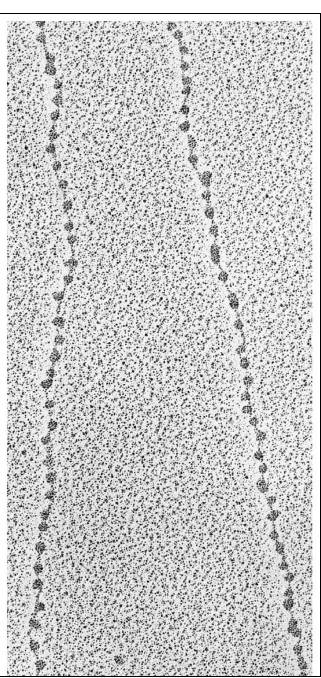
Chromatin unfolds when treated with a solution of low ionic strength (<5 mM), and the extended chromatin looks like beads-on-string under an electron microscope (EM). The beads are DNA-histone complexes known as ____.
Histones are small basic proteins with numerous ___ & ___ residues whose positive charge allow the proteins to bind to the negatively charged (___-___) backbone of DNA.
Prokaryotic DNA also associates with ____ for condensation, but it is not often referred to as chromatin.
In eukaryotic cells, there are five known histone molecules with varying proportion of basic residues, but with a net __ charge.
Histones have more ___ residues than neutral or acidic and therefore have an overall ___ charge which allows them to interact w/negatively charged DNA.
What are the five types of nucleosomes (or histones)?
Nucleosome and higher-order chromatin assembly
• Two subunits each of H2A, H2B, H3, and H4 form the core ___.
• -200 bp of DNA wraps around the core octamer.
• H1 binds to the ___ region of the successive nucleosomes. As such, H1 is
considered as a ___ of higher-order DNA packing.
• The N-terminus of the core histones are rich in __ & __ residues and
project outward from the core to allow further interaction with DNA in other
nucleosomes, leading to the formation of ___-___ packing.
Second level of packing:
_____: H1 histones aggregate
causing 6 nucleosomes to coil together
-30 nm in diameter
-stack on top of each other forming the chromatin fiber
Steps of DNA packaging into chromosomes
1.) Histones (H4, H3, H2A, & H2B) form histone core (octamer) and interact with helical DNA to form the ____ structure.
2.) __ histones aggregate by binding to the linker region to form the nucleosome superhelix.
3.) DNA gets condensed and packaged even further to become chromatin fibers and finally ___.
Histones are rich in BASIC amino acids
• Particularly N-terminus of histones are rich in __ & __ residues
**Leads to net ___ charge of Histones
Both (Lys & Arg) are positively charged under physiological conditions and can interact with DNA which is ___ charged (due to the phosphate groups).
Histone modifications regulate interaction with DNA
Happens by methylation (__ compaction), demethylation (___ compaction) acetylation (___ compaction), and deacetylation (restore compaction)
Specific __ (_) residues in the N-terminal end of histones can be acetylated by enzymes known as ___ ____ (___) leading to a decrease in net positive charge, WEAKENING interaction with DNA.
Acetylation is associated with gene transcription, and HATS are recruited to sites where chromatin has to be ____ in order to transcribe a gene.
Histone deacetylases (___) are responsible for removing acetyl groups from K residues. This restores the ___ charge and chromatin ____.
Further detail on acetylation & deacetylation
Enzymatic transfer of an acetyl group from Acetyl-CoA to the N-terminal amino group of a polypeptide, catalyzed by __-___ ____ (___). The reaction is considered to be IRREVERSIBLE.
REVERSIBLE acetylation of the ε-amino group of a lysine residue by ___ ____ (___)
The deacetylation of lysine residues is catalyzed by ___ ____ (___)
Effect of histone modification on gene
Active genes are usually located in ____ chromatin while inactive genes are found in ____ chromatin.
Furthermore, transcription which stimulates transcription from various genes have been shown to recruit
___ activity to the promoters of these genes while other factors which are
known to inhibit or repress transcription have been shown to recruit ___ activity
to these promoters which results in hypoacetylation of surrounding histones.
In this context, it is important to note that active genes have a more __ structure while inactive genes are more ___ & are ___ packed structures.
Methylation ___ histone-DNA interaction
PRMT: Protein ___ Methyltransferase
PKMT: Protein ___ Methyltransferase
PKDM: Protein Lys _____
Methylation of Arg and Lys residues in histones by S-adenosyl-L-methionine (AdoMet)-dependent histone _____.
Demethylation reactions — Histone demethylation ___ histone-DNA interaction
Therefore, the DNA compaction is ___
Histone phosphorylation reduces the net positive charge on histones, leading to ___ histone-DNA interaction.
Protein phosphorylation is catalyzed by protein ___, which transfer
phosphate groups from ATP to the hydroxyl groups of the side chains
of ___, ___, or ___ residues.
Protein phosphorylation is reversed by protein ____, which catalyzes the hydrolysis of phosphorylated amino acid residues.
Phosphorylation (kinases) of proteins = ___ DNA compaction
Dephosphorylation (phosphatases) = ___ DNA compaction


