
17740289
Description

Quiz by Brage Haavik, updated more than 1 year ago

|
Created by Brage Haavik
over 7 years ago
|
|
Question 1
Question
In a repeated measures ANOVA, the within-participant variability is divided into two components, what are they?
Answer
-
Variability between conditions and total variability
-
Variability between conditions and random variability
-
Total variability and random variability
-
Variability between participants and random variability
Question 2
Question
Which of the following is an important advantage of a repeated-measures ANOVA?
Answer
-
A different sample of participants serves in each condition, making it possible to compare different populations
-
Individual differences do not contribute to unsystematic variance
-
A large number of participants is generally required, which provides a greater glimpse of the population
-
All of the above
Question 3
Question
A researcher reports ANOVA as F (2, 40) = 5.18, p = .01, how many conditions were involved in this study?
Answer
-
2
-
3
-
4
-
41
Question 4
Question
How many participants were there in the experiment reported in question 3?
Answer
-
21
-
63
-
41
-
44
Question 5
Question
Sphericity is an assumption in a repeated measures ANOVA. How is sphericity calculated?
Answer
-
By looking at the variability within each condition
-
By looking at the size of the differences in each condition
-
By looking at the difference between the first and last condition
-
By looking at the variability in difference scores between conditions
Question 6
Question
The following table shows the results of a repeated-measures ANOVA, but the F-value is missing. what is the F-Value?

Answer
-
11.10
-
12.13
-
0.91
-
0.08
Question 7
Question
Which of the following statements about the assumption of sphericity is NOT true?
Answer
-
It is tested using Levene's Test in SPSS
-
It is tested using Mauchley's Test in SPSS
-
It is automatically met when an IV has only two levels
-
It is the repeated measures equivalent of homogeneity of variance
Question 8
Question
If the assumption of sphericity is violated, which correction is available in SPSS?
Answer
-
Mauchly
-
Levene
-
Greenhouse-geisser
-
Kolmogorov-smirnov
Question 9
Question
The larger the F statistic is in a repeated measures ANOVA, the larger the ___________, compared to the ____________
Answer
-
Variation within individuals; variation between individuals
-
Random variation; variation between conditions
-
Variation between conditions; random variation
-
Variation between individuals; variation within individuals
Question 10
Question
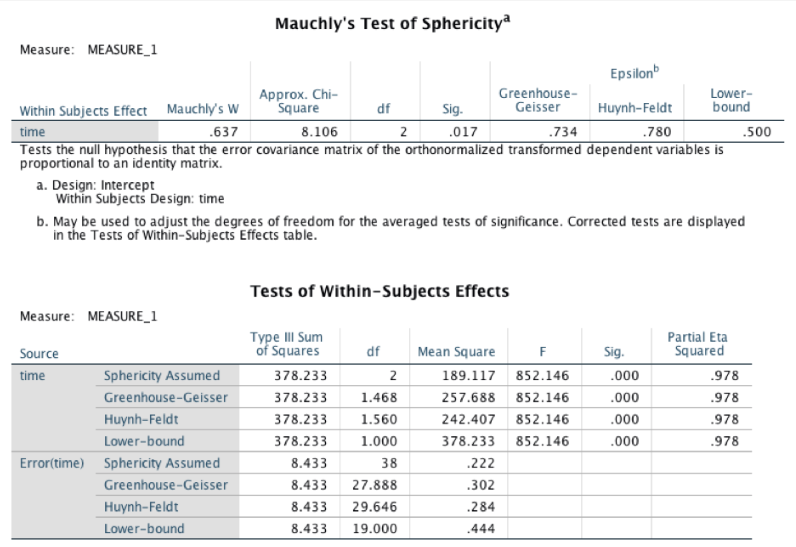
A researcher wanted to see whether desensitization therapy was an effective treatment for hylophobia (fear of forests). She recorded levels of hylophobia in 20 participants at three points; before therapy, after therapy, and at a six-month follow up. The SPSS output from her data analysis is shown below. Which of the following statements is true?
Answer
-
The data meets the assumption of normality
-
The data violates the assumption of sphericity
-
There was a significant reduction in hylophobia following desensitisation therapy
-
Desensitisation therapy did not affect hylophobia levels
Want to create your own Quizzes for free with GoConqr? Learn more.