
Descripción


|
Creado por Luca Campopiano
hace alrededor de 11 años
|
|
Página 1
Resistance and current - potential difference graphs
Resistance is measured in Ohms and is an indication of how easily electrons can travel through a material. Current–potential difference graphs are used to show how the current through a component varies with the potential difference across it. Current is Current is the "rate of flow of coulombs" in a circuit. A coulomb is a unit of charge so an electrical current is a flow of charge. Charge is measured in Q.Current is measured in Amps. 1 Amp = 1 coulomb per second.Current has a heating effect so a large current must be contained by a thick insulated wire.Calculate current, potential difference or resistance using the equation: V = I X R
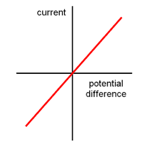
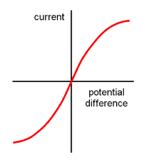
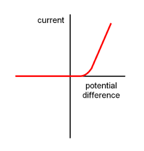
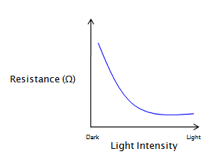
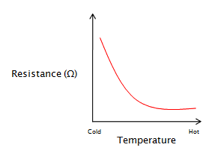
The current flowing through a resistor at a constant temperature is directly proportional to the potential difference across it - following Ohm's Law.The resistance of a long wire is greater than the resistance of a short wire because electrons collide with ions more often. The resistance of a thin wire is greater than the resistance of a thick wire because a thin wire has fewer electrons to carry the current.A bulb containing a filament heats up when an electric current passes through it. This is because the moving electrons collide with the ions in the metal. This makes it more difficult for the current to flow, and causes resistance. As the temperature increases, the metal ions vibrate more. There are more collisions with the electrons and so the resistance increases. This is why the filament's resistance increases as the temperature increases.A diode has a very high resistance in one direction, meaning that the current can only flow in one direction.An LED emits light when a current flows through it i the forward direction. They are being used more often as they are more efficient and require a smaller current.LDR resistance decreases as light intensity increases.Thermistor resistance decreases as temperature increases. It decreases so that the current can flow easier and therefore less heat is generated.EXTRA NOTE: The current through a component depends on its resistance. The greater the resistance the smaller the current for a given potential difference across the component.
¿Quieres crear tus propios Apuntes gratis con GoConqr? Más información.