
Test
Atom structure
Este test tiene tipos de pregunta que se abren en el reproductor de siempre.
Preguntas del test (13)
1When was the first idea of atom found?
- AIn the 6th century BC
- BIn the 5th century BC
- CIn the 5th century
- DIn Roman era
2The nucleus of an atom is located at the centre.
- AVerdadero
- BFalso
3Choose the correct answers about the electron cloud:
- AIt is the internal part of the atom
- BIt has got the negative charge of the atom
- CIt has got protons spinnng in orbits
- DIt is the external part of the atom
- EIt has got electrons turning in orbits
4All atoms have the same [blank_start]internal[blank_end] structure made up of: the [blank_start]nucleus[blank_end], very [blank_start]smalll[blank_end] compared to the size of the atom and the [blank_start]electron[blank_end] [blank_start]cloud[blank_end], the external area of the atom which is much larger than the [blank_start]nucleus[blank_end].
- Ainternal
- Bnucleus
- Csmalll
- Delectron
- Ecloud
- Fnucleus
5The Atomic Theory was admitted in 1904.
- AVerdadero
- BFalso
6Dalton in [blank_start]1808[blank_end] said that atoms of the same [blank_start]elements[blank_end] had identical properties and those of [blank_start]different[blank_end] elements are different. [blank_start]Thomson[blank_end] in 1904, designed an atomic model where [blank_start]electrons[blank_end] were incrusted in a [blank_start]positive[blank_end] sphere. Rutherford in [blank_start]1911[blank_end] drew an atomic model were the nucleus had got almost all the [blank_start]mass[blank_end] of the atom and all the [blank_start]positive[blank_end] charge, and he added [blank_start]electrons[blank_end] in an electron cloud where it was located the [blank_start]negative[blank_end] charge. In 1913 [blank_start]Bohr[blank_end] specified the [blank_start]orbits[blank_end] in the electron cloud and he detailed how [blank_start]electrons[blank_end] moved in them.
- A1808
- B1904
- C1911
- D1540
- Ecompounds
- Felements
- Gsystems
- Hprotons
- Isimilar
- Jthe same
- Kmetallic
- Ldifferent
- MDalton
- NRutherford
- OThomson
- PBohr
- Qelectrons
- Rneutrons
- Sprotons
- Tnucleus
- Uneutral
- Vnegative
- Wcircular
- Xpositive
- Y1904
- Z1911
- AA1915
- AB1880
- ACcharge
- ADclouds
- AEelectrons
- AFmass
- AGpositive
- AHnegative
- AIneutral
- AJespherical
- AKprotons
- ALelectrons
- AMneutrons
- ANelements
- AOpositive
- APneutral
- AQwhole
- ARnegative
- ASRutherford
- ATBohr
- AUThomson
- AVDalton
- AWorbits
- AXroads
- AYdroplets
- AZthickness
- BAprotons
- BBthings
- BCelectrons
- BDneutrons
7Marie Curie was born in Russia
- AVerdadero
- BFalso
8At the beginning of the 19th century 75 chemical elements were known.
- AVerdadero
- BFalso
9What is represented by every letter?
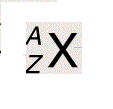
- ASymbol of the element
- BName of the element
- CGroup of the element
- DAtomic representation
- EMass number
- Felectron cloud
- GPosition number
- HMetalization
- IAtomic Number
10Choose the correct staments about atoms and numbers:
- AThe mass number is determined by the number of protons and electrons.
- BThe atomic number is the number of protons.
- CThe charge of an atom is calculated with protons and electrons.
- DThe number of neutrons is the number of protons plus the number of electrons
- EThe mass number is the addition of protons and neutrons
- FIn the Periodic system of elements, they are ordered by their mass numbers
- GIf an atom has got the same number of electrons and protons, this atom is neutral.
11Choose the correct option
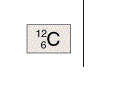
- AThe element is calcium
- BThe element is carbon
- CThe element is Chlorine
- DThe mass number is 6
- EThe elemental number is 6
- FThe element has got 6 protons
- GThe mass number is twelve
- HThe atomic number is twelve
- IIt has got twelve electrons
12Describe correctly this atom
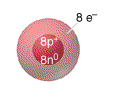
- AHydrogen
- BOxygen
- CNitrogen
- DMass number 8
- EMass number 0
- FMass number 16
- GAtomic number 8
- HAtomic number 16
- IAtomic number 0
- JIt has got negative charge
- KIt is neutral
- LIt has got positive charge
13The periodic table contains [blank_start]118[blank_end] elements ordered by their [blank_start]atomic[blank_end] number. The system is divided into:
- [blank_start]seven[blank_end] rows called [blank_start]periods[blank_end]
- [blank_start]eighteen[blank_end] columns, called [blank_start]groups[blank_end] or families. Elements which belong to the same group have got [blank_start]similar[blank_end] chemical properties.
We can distinguish four general types of elements:
- [blank_start]Metals[blank_end]: They are electricity and heat conducted. They are in [blank_start]solid[blank_end] state except Mercury.
- Semimetals: Their behaviour is [blank_start]metallic[blank_end] or [blank_start]non metallic[blank_end] depending on the conditions.
- [blank_start]Non-metals[blank_end]: They are heat and electricity bad conducted. They are in solid, gas and liquid state.
- [blank_start]Noble gases[blank_end]: They do not combine with other chemical elements.- A119
- B117
- C118
- Datomic
- Emass
- Felectronical
- Geight
- Hseven
- Inine
- Jperiods
- Kgroups
- Lfamilies
- Meighty
- Nseventeen
- Oeighteen
- Pperiods
- Qgroups
- Rplaces
- Sdifferent
- Telectrical
- Usimilar
- VMetals
- WNon metals
- XSemimetals
- Yliquid
- Zgas
- AAsolid
- ABmetallic
- ACbright
- ADimportant
- AEnon bright
- AFspecial
- AGnon metallic
- AHNon-metals
- AINoble gases
- AJSemimetals
- AKEspecial gases
- ALNoble gases
- AMKing gases
Información
- Descripción
- Physics and Chemistry Test sobre Atom structure, creado por Rocío Aguirre el 07/02/2019.
- Autor
- Rocío Aguirre
- Idioma
- Español
- Visitas
- 747
- Historial
- Creado el 7 feb 2019 · actualizado el 7 feb 2019
- Etiquetas
- Valoración
- Aún sin valoraciones Valora este test