
7597103


Pregunta 1
Pregunta
Which of the following statements is true about campus networks? Pg. 34
Respuesta
-
The campus network describes the interconnections of servers in a data center
-
The campus network describes the WAN inter-connectivity between two remote sites and head office
-
The campus network describes the network devices that interconnect end users to applications such as e-mail, the intranet, or the internet over wire or wireless connections.
Pregunta 2
Pregunta
Which of the following is a disadvantage to using flat Layer 2 networks? Pg. 35
Respuesta
-
Broadcast packets are flooded to every device in the network.
-
No IP boundary to administer IP-based access control.
-
A host flooding traffic onto the network effects every device.
-
Scalability is limited.
-
All of the above.
Pregunta 3
Pregunta
Why are network designed with layers? Pg. 36
Respuesta
-
Allow focus within specific layers due to grouping, segmentation, and compartmentalization.
-
Simplification of network design.
-
Optimizes use of physical interconnects (links).
-
Optimizes application of policies and access control.
-
Eases network management.
-
All of the above.
Pregunta 4
Pregunta
Identify the three layers of hierarchical model for designing networks. Pg. 36
Respuesta
-
Core
-
Access
-
Distribution
-
Enterprise edge
-
WAN
-
Wireless
Pregunta 5
Pregunta
What is another common name for the core layer? Pg. 36
Respuesta
-
Backbone
-
Campus
-
Data center
-
Routing layer
Pregunta 6
Pregunta
In newer terminology, what layers are referred to as the spine layer and the leaf layer? Pg. None
Respuesta
-
The spine layer is the equivalent to the core layer, and the leaf layer is equivalent to the distribution layer.
-
The spine layer is equivalent to the access layer, and the leaf layer is equivalent to the distribution layer.
-
The spine layer is equivalent to the distribution layer, and the leaf layer is equivalent to the access layer.
-
The spine layer is equivalent to the core layer, and the leaf layer is equivalent to the access layer.
Pregunta 7
Pregunta
Match each layer to its definition.
[blank_start]Access[blank_end] - Connects PCs, wireless access points, and IP phones.
[blank_start]Core[blank_end] - High-speed interconnectivity layer that generally supports routing capability.
[blank_start]Distribution[blank_end] - Aggregates access layer switches and provides for policy control.
Respuesta
-
Access
-
Distribution
-
Core
-
Access
-
Distribution
-
Core
-
Access
-
Distribution
-
Core
Pregunta 8
Pregunta
Which of the following are generally true about recommended core layer designs? Pg. 39
Respuesta
-
Requires high-availability and resiliency
-
Connects critical application servers directly for optimal latency and bandwidth
-
Leverages fixed form factor switches in large enterprises
Pregunta 9
Pregunta
In which layer are you most likely to find fixed Catalyst switches?
Respuesta
-
Access Layer
-
Distribution Layer
-
Core Layer
Pregunta 10
Pregunta
In which layer are you most likely to find modular Catalyst switches? Pg. 41
Respuesta
-
Access layer
-
Distribution layer
-
Core layer
Pregunta 11
Pregunta
Which of the following are benefits to using Layer 3 in the access layer? (Choose two.) Pg. 42
Respuesta
-
Reduced cost
-
Reduce Layer 2 domain
-
Reduce spanning-tree domain
-
Mobility
Pregunta 12
Pregunta
Which of the following is the biggest disadvantage with using Layer 3 in the access layer using current technologies? Pg. 42
Respuesta
-
More difficult troubleshooting
-
Lack of broadcast forwarding
-
Native mobility without additional features
-
Lack of high availability
Pregunta 13
Pregunta
A Layer 2-only switch makes forwarding decisions based on what? Pg. 47
Respuesta
-
Source MAC address
-
Destination MAC address
-
Source IP address
-
Destination IP address
Pregunta 14
Pregunta
What does a switch do when it does no know how to forward a frame? Pg. 47
Respuesta
-
Drops the frame
-
Floods the frames on all ports in the same Layer 2 domain except the source port
-
Stores the frame for later transmission
-
Re-sends the frame out the port where it was recieved
Pregunta 15
Pregunta
The layer 2 forwarding table of Cisco switches is also referred to as which of the following? Pg 47
Respuesta
-
CAM table
-
Routing table
-
MAC address table
-
FIB table
Pregunta 16
Pregunta
Which of the following look-ups does a Layer 2-only Cisco Catalyst switch perform on an ingress frame? Pg. 49
Respuesta
-
Layer 2 forwarding for destination port
-
ACL for access control
-
NetFlow for statistics monitoring
-
QoS for classification, marking, or policing
Pregunta 17
Pregunta
Which of the following are true about CAM and/or TCAM (Choose three.) Pg. 49
Respuesta
-
TCAM stands for ternary content-addressable memory
-
CAM provides three results: 0, 1, and don't care
-
Leveraging CAM and TCAM ensures line-rate performance of the switch
-
CAM and TCAM are software-based tables
-
TCAM is leveraged by QoS and ACL tables
Pregunta 18
Pregunta
Why is TCAM necessary for IP routing tables over CAM? Pg. 49
Respuesta
-
TCAM supports longest matching instead of match or not matched
-
TCAM is faster than CAM
-
TCAM memory is cheaper than CAM
Pregunta 19
Pregunta
Cisco Catalyst switches leverage which of the following technologies for Layer 3 forwarding? Pg. 52
Respuesta
-
Route caching
-
Processor/CPU switching
-
NetFlow
-
CEF
Pregunta 20
Pregunta
Cisco Catalyst switches relay routing information to hardware components for additional performance and scalability (line-rate forwarding). What are the two common hardware types that receive routing information? Pg. 55
Respuesta
-
Centralized
-
Distributed
-
Aggregated
-
Core-based
Pregunta 21
Pregunta
With regard to load balancing, what term describes the situation where less than optimal use of all links occurs? Pg. 54
Respuesta
-
Reverse path forwarding (RPF)
-
Polarization
-
Inverse routing
-
Unicast flooding
Pregunta 22
Pregunta
What is the default load-balancing mechanism found on Cisco Catalyst switches? Pg. 54
Respuesta
-
Per-flow
-
Per-destination IP address
-
Per-packet
-
Per-destination MAC address
Pregunta 23
Pregunta
It is important to have the same native VLAN on both switch link partners for ISL trunking. Pg. 67
Respuesta
- True
- False
Pregunta 24
Pregunta
The Cisco Catalyst 6500 supports up to 1024 VLANs in the most recent software releases. Pg. 72
Respuesta
- True
- False
Pregunta 25
Pregunta
When removing the native VLAN from a trunk port, CDP, PAgP, and DTP, use the lowest-numbered VLAN to send traffic.
Respuesta
- True
- False
Pregunta 26
Pregunta
In VTP client mode, switches can add and delete VLANs. Pg. 88-91
Respuesta
- True
- False
Pregunta 27
Pregunta
Token Ring support is available in VTY version 1. pg. 88
Respuesta
- True
- False
Pregunta 28
Pregunta
If the interface in the example negotiates trunking, what would be the native VLAN?
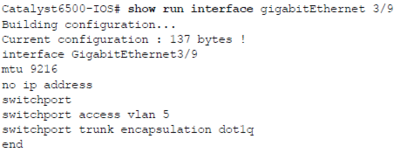
Respuesta
-
VLAN 1
-
VLAN 5
-
VLAN 9216
-
No native VLAN if the port negotiated trunking
Pregunta 29
Pregunta
Under what condition can the interface in the example negotiate ISL trunking?
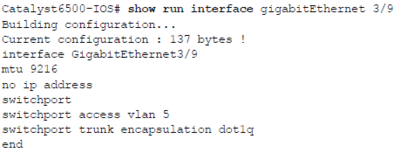
Respuesta
-
If the port is a member of an EtherChannel
-
If the link partner defaults to ISL trunking or negotiated ports
-
If the link partner is configured for trunking in the on mode
-
The interface cannot negotiate trunking because it is configured statically for 802.1Q trunking
Pregunta 30
Pregunta
Which statement is true for the configuration of the interface in the example?
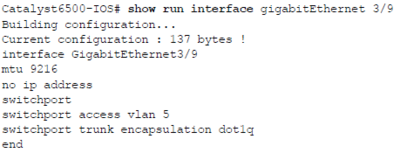
Respuesta
-
The interface is a member of VLAN 5 and may negotiate to a trunk port
-
The interface may negotiate to an ISL trunk with a native VLAN of 5
-
The interface may negotiate to an 802.1Q trunk and operate with a native VLAN of 1
-
The interface will not negotiate to a trunk port because it is configured in access VLAN 5
-
If a host workstation is connected to the interface, it must be configured for trunking
Pregunta 31
Pregunta
What is the trunk native VLAN based on the example?
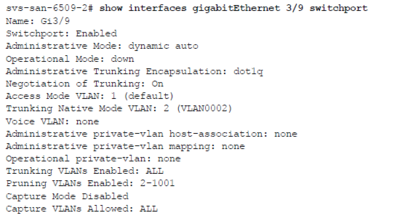
Respuesta
-
VLAN 1
-
VLAN 2
-
VLAN 5
-
No Native VLAN if the port negotiated trunking
Pregunta 32
Pregunta
Based on the example, what statement is true if the link partner (peer switch) is configured for the dynamic trunking mode?
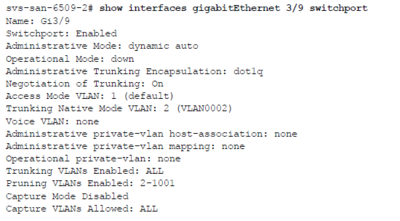
Respuesta
-
The interface cannot negotiate to a trunk port because it is configured for dot1Q encapsulation
-
The interface cannot negotiate a trunk port because the native VLAN and access VLANs are mismatched
-
The interface can negotiate to a trunk port if the peer is configured for the dynamic desirable trunking mode
-
The interface can negotiate to a trunk port if access VLAN is the same on both sides
Pregunta 33
Pregunta
What is the interface's access mode VLAN in the example?
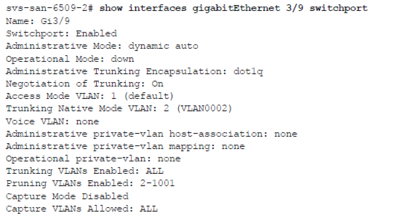
Respuesta
-
VLAN 1
-
VLAN 2
-
VLAN 5
-
VLAN 1001
Pregunta 34
Pregunta
How does implementing VLANs help improve the overall performance of the network? Pg 89
Respuesta
-
by isolating problem employees
-
By constraining broadcast traffic
-
By grouping switch ports into logical communities
-
By forcing the Layer 3 routing process to occur between VLANs
Pregunta 35
Pregunta
What are the advantages of using local VLANs over end-to-end VLANs? (Choose two.)
Respuesta
-
Eases management
-
Eliminates the need for Layer 3 devices
-
Groups users by logical commonality
-
Keeps users and resources on the same VLAN
-
Allows for a more deterministic network
Pregunta 36
Pregunta
Which prompt indicates that you are in VLAN configuration mode of Cisco IOS?
Respuesta
-
Switch#
-
Switch(vlan)#
-
Switch(config)#
-
Switch(config-vlan)#
Pregunta 37
Pregunta
Which switch port mode unconditionally sets the switch port to access mode regardless of any other DTP configurations?
Respuesta
-
Access
-
Nonegotiate
-
Dynamic auto
-
Dynamic desireable
Pregunta 38
Pregunta
What information is contained in the FCS of the ISL-encapsulated frame?
Respuesta
-
CRC calculation
-
Header encalsulation
-
ASIC implementaion
-
Protocol-independence
Pregunta 39
Pregunta
802.1Q uses an internal tagging mechanism, where a tag is inserted after the ____ field.
Respuesta
-
Type
-
SA
-
Data
-
CRC
Pregunta 40
Pregunta
Which command correctly configures a port with the ISL encapsulation in Cisco IOS?
Respuesta
-
Switch(config-if)# switchport mode trunk isl
-
Switch(config-if)# switchport mode encapsulation isl
-
Switch(config-if)# switchport trunk encapsulation isl
-
Switch(config-if)# switchport mode trunk encapsultation isl
Pregunta 41
Pregunta
Which command correctly sets the native VLAN to VLAN 5
Respuesta
-
switchport native vlan 5
-
switchport trunk vlan 5
-
switchport native trunk vlan 5
-
switchport trunk native vlan 5
Pregunta 42
Pregunta
If the Layer 2 interface mode on one link partner is set to dynamic auto, a trunk will be established if the link partner is configured for which types of interface modes in Cisco IOS? (Choose two.)
Respuesta
-
Trunk
-
Access
-
Nonegotiate
-
Dynamic auto
-
Dynamic desireable
Pregunta 43
Pregunta
What is the default VTP mode for a Catalyst switch?
Respuesta
-
Client
-
Access
-
Server
-
Transparent
Pregunta 44
Pregunta
When is a consistency check performed with VTP Version 2?
Respuesta
-
When information is read from NVRAM
-
When the digest on a received VTP message is correct
-
When new information is obtained from a VTP message
-
When you enter new information through CLI or SNMP
Pregunta 45
Pregunta
Which command correctly sets the VTP version to Version 1 in Cisco ISO global configuration mode?
Respuesta
-
vtp v1-mode
-
vtp v2-mode
-
no vtp version
-
no vtp version 2
Pregunta 46
Pregunta
Which of the following are valid VTP Version 1 and 2 modes? (Choose all that apply.)
Respuesta
-
Primary server mode
-
Server mode
-
Client mode
-
Transparent mode
Pregunta 47
Pregunta
After you complete the VTP configuration, which command should you use to verify your configuration?
Respuesta
-
show vtp status
-
show vtp counters
-
show vtp statistics
-
show vtp status counters
Pregunta 48
Pregunta
What command might correct a problem with incorrect VTP passwords?
Respuesta
-
password vtp 0
-
clear vtp password
-
clear password vtp
-
vtp password password_string
Pregunta 49
Pregunta
The EtherChannel would come up if one side of the EtherChannel mode is set to auto and the other to on.
Respuesta
- True
- False
Pregunta 50
Pregunta
Which of the following solutions are provided by EtherChannel (Choose two.)
Respuesta
-
Provide redundancy
-
Help to overcome bandwidth limitation
-
Because of EtherChannel, can transmit more than one VLAN over links between switches
-
Can limit the broadcast to the local switches
Pregunta 51
Pregunta
Which statement about transparent VTP mode is true?
Respuesta
-
Creates, modifies, and deletes VLANs on all switches in VTP domain
-
Creates, modifies, and deletes local VLANs only
-
Does not forward advertisements to other switches in VTP domain
-
Synchronizes VLAN configurations from other switches in VTP domain
¿Quieres crear tus propios Tests gratis con GoConqr? Más información.