
869416
Descripción

Test por michelle_simms_w, actualizado hace más de 1 año

|
Creado por michelle_simms_w
hace más de 11 años
|
|
Pregunta 1
Pregunta
DNA is associates itself around protein histones bundles called nucleosomes. Which function as...
Respuesta
-
support
-
extra genetic information
-
for stablity
Pregunta 2
Pregunta
Guanie and cytosine have 2 bonds
Respuesta
- True
- False
Pregunta 3
Pregunta
Orgin of replication is where there the DNA strand are cut up into segments and begin repeating themseleves
Respuesta
- True
- False
Pregunta 4
Pregunta
Why are there multiple sites of origin on a strand of DNA
Respuesta
-
Genetic malfunction
-
It allows the DNA to be replicated as fast as possible
-
There are different enzymes require fore each of the bubbles
Pregunta 5
Pregunta
Replication proceeds in one direction from each origin, until the entire molecule is copied
Respuesta
- True
- False
Pregunta 6
Pregunta
Which way does DNA only flow
Respuesta
-
3' to 5'
-
5' to 3'
Pregunta 7
Pregunta
What are the given names for the template and its new strand
Respuesta
-
Mother and daughter strand
-
Parent and Daughter strand
-
Father and son strand
-
Orginal and twin strand
Pregunta 8
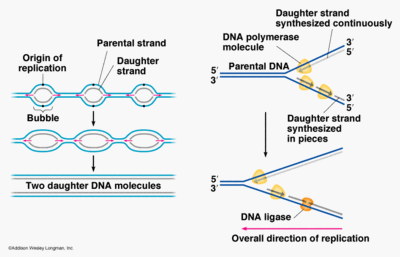
Respuesta
- True
- False
Pregunta 9
Pregunta
Single strand binding protiens allow DNA to wind back up on itself during replication
Respuesta
- True
- False
Pregunta 10
Pregunta
What is the ratio for rate of of elongation between bacteria and human cells is.. nucleotides per second
Respuesta
-
350: 35
-
6000:600
-
500:50
Pregunta 11
Pregunta
At which position does DNA replication begin
Respuesta
-
the left side of the bubble
-
the middle of the bubble
-
the right of the bubble
Pregunta 12
Pregunta
Lagging strand flow in the oppostie direction from the point origin towards the replication fork.
Respuesta
- True
- False
Pregunta 13
Pregunta
What is the name of the model DNA replication follows
Respuesta
-
Conservative
-
Semiconservative
-
Dispersive
Pregunta 14
Pregunta
If DNA is replicated disperively , and you did the same type of 15N/14N bacterial experiment, what type of band pattern would you see after the density spin
Respuesta
-
the same pattern as Meselson and stahl
-
the first generation tube will have 14N and 15N bands; the second generation will also have bands but the 14N band would be darker
-
The 1st generation tube will have one intermediate band; the second generation tube will have 1 intermediate band and another slightly higher
-
instead of bands, the first generation and second generation tubes will have a smear between 14N and 15N positions
Pregunta 15
Pregunta
What imporant function doe DNA polymerase do
Respuesta
-
synthesizes new DNA
-
Proof reads the newly made DNA
-
removes RNA Primer
Pregunta 16
Pregunta
state which of the following features that multicellular organisms don't require cell division
Respuesta
-
Developement from a fertilized cell
-
Destorying mutated DNA
-
Growth
-
Repair
Pregunta 17
Pregunta
All the DNA in a cell constitutes is called a
Respuesta
-
Genus
-
somatic cells
-
genome
Pregunta 18
Pregunta
Forming chromosomes
DNA strands condense along histones bundle to form a chromatid, two are duplicated in the in the nucleus through DNA replication and a pinched together 2/3s of the was up this is called the centrmere. They are known as sister chromatids which are when separated 2 new chromosomes.
Respuesta
- True
- False
Pregunta 19
Pregunta
In Mitosis there are 3 major phases
Respuesta
- True
- False
Pregunta 20
Pregunta
which percentage of time is spent where
Respuesta
-
Interphase 30% Mitosis phase 70%
-
Interphase 90% Mitosis phase 10%
-
Interphase 50 % Mitosis phase 50%
-
Interphase 10% Mitosis phase 90%
Pregunta 21
Pregunta
what happens in the interphase section mitosis
Respuesta
-
G1- the cell grows
-
G2- grows more as it completes preperation for cell division
-
S- the cell continues to grow as it copies its chromosomes
-
E-enzymes in the cell wall break down as cells get ready to split
Pregunta 22
Pregunta
All of the following are included in phases of mitosis
Prophase
Prometaphase
Metaphase
Anaphase
Telophase
Celophase
Respuesta
- True
- False
Pregunta 23
Pregunta
The mitotic spindle is made up of 2 microtubules...... called..... and are duplicated during interphase
Respuesta
-
Centrioles and centrosme
-
codon and anti codon
-
Fillament and intermediate fillaments
Pregunta 24
Pregunta
During the G2 phase of mitosis a nuclear envelope encloses the nucleus, the centrosomes have been duplicated and chromosome have been duplicated during the S phase however is not yet condensed
Respuesta
- True
- False
Pregunta 25
Pregunta
which of the following does not occur during prophase
Respuesta
-
Chromatid becomes condensed
-
centrosomes are on opposite sides of the cell and kinetochores are formed between spindles and chromosomes
-
nucleoi disappears
-
centrosomes start to move to opposite sides of the cell and form spindles radial arrays. Shorter spindle called aster appear
-
Each duplicated chromosome appears as two sister chromatids
Pregunta 26
Pregunta
Which of the following are missing from prometaphase
Nuclear envelope fragments
Chromosmes are now even more condensed
Each chromatid have a kinetiochore attached to centromere
Nonkinetochore microtubles interact with each other
Respuesta
-
Microtubels extending from the each centrosome no invade the nuclear area
-
The cell elongates as the nonkinetochore microtubles lenghten
-
A cleavage furrow is formed
Pregunta 27
Pregunta
In metaphase the chromosomes convene at the metaphase plate which are a similar distance from the spindle poles
Respuesta
- True
- False
Pregunta 28
Pregunta
Anaphase is considered the shortest phase what else can be said about this phase
Respuesta
-
The two daughter cell are liberated and begin moving to opposites of the cell as the kinetochore microtubles shorten as they are draw to the poles at a rate of 1 micrometer per minute
-
By the end of the of the phase these is a complete and equivalent set of chromosomes on either side of the cell
-
chromosomes become less condesed
-
nonkinetochores help the cell elongate
Pregunta 29
Pregunta
During telophase and cytokenisis, 3 daughter nuclei form in the cell, and nuclear envelope is forms around the fragments of the parent cells. The Nucloli doesn't reappear. The chromosomes become less condense and the microtubles are depolymerized. In cytokensis there is a division in the cytoplasm continues as the a cleavage furrow is formed and the cell pinches into two
Respuesta
- True
- False
Pregunta 30
Pregunta
Which of the following phases of mitosis is not include in the division of plant cells
Respuesta
-
Prophase
-
Prometaphase
-
Metaphase
-
Anaphase
-
Telophase
-
Cytokenisis
Pregunta 31
Pregunta
How are microtubles shortened in anaphase?
They are brought back toward the pole via motor proteins which help the microtubles depolymerizes . The protein pulls the filament at the kinetochore as more is pulled though the microtuble is broken up into tublin subunits.
Respuesta
- True
- False
Pregunta 32
Pregunta
how many chromosomes are in a prokaryote
Respuesta
-
1
-
2
-
5
-
10
Pregunta 33
Pregunta
like eukaryotes ,prokayotic cells have a a leading and lagging strand are produced
Respuesta
- True
- False
Pregunta 34
Pregunta
What is the name of the type of reproduction carried out by prokaryotes
Respuesta
-
asexual reproduction
-
Binary fission
-
sexual reproduction
Pregunta 35
Pregunta
which aspects are inolved in binary fission
Respuesta
-
Replication begins at two origins on the bacterial chromosome
-
There is a division into two daughter cells
-
Replication finishes and the cells enlongate
-
All of them
-
Copies of the chromosome begin to seperate
Pregunta 36
Pregunta
Protists are said to exhibit types of cell division between binary fission an mitosis
Respuesta
- True
- False
Pregunta 37
Pregunta
Once a layer of cells are forms in a dish they will stop growing, however when some cells are removed cell division will continue until the space is filled. This is known as...Density-dependent inhibition
Respuesta
- True
- False
Pregunta 38
Pregunta
Once a layer of cells are forms in a dish they will stop growing, however when some cells are removed cell division will continue until the space is filled. This is known as...Density-dependent inhibition
Respuesta
- True
- False
Pregunta 39
Pregunta
Cancerous cell are not density dependant because they...
Respuesta
-
Continue to divide well beyond a single layer as as a result forms clumps of cells
-
Don't divide at all and don't produce a layer of cells
Pregunta 40
Pregunta
cells know to stop dividing according to scientists who say that the binding of a cell surface protein to its counterpart on the adjoiinng cells sends a growing inhibiting signal to both cells preventing them from moving forward in the cell cycle or even the presence of growth factors
Respuesta
- True
- False
Pregunta 41
Pregunta
Only some animal cells also exhibit anchorage dependence, in which they must be attached to a solid structure in order to divide. The process is linked back to the use of cytoskelton and proteins in the plasma membrane
Respuesta
- True
- False
Pregunta 42
Pregunta
how many growth factors are currently known in eukayotes
Respuesta
-
10
-
20
-
50
-
150
Pregunta 43
Pregunta
growth factor like platelet derived growth factor do what
Respuesta
-
tell the cells to keep growing
-
give the go ahead when a cell cycle is stopped at check point
-
stimulates further growth
Pregunta 44
Pregunta
Where are the check points in mitosis
Respuesta
-
S phase
-
G2 phase
-
Mitsosis phase
-
G1 phase
Pregunta 45
Pregunta
A capsid is the protein shell that encloses the viral genome. Capsids are built from protein subunits called capsomeres
Respuesta
- True
- False
Pregunta 46
Pregunta
viruses that infect bacteria are know as
Respuesta
-
phagocytosis
-
Bacteriophages,
Pregunta 47
Pregunta
Obligate intracellular parasites like viruses can replicate only within a host cell
Respuesta
- True
- False
Pregunta 48
Pregunta
what are prions
Respuesta
-
virtually indestructible infectious proteins
-
convert normal proteins
¿Quieres crear tus propios Tests gratis con GoConqr? Más información.