
2073425
Descripción

Fichas por howlader.i, actualizado hace más de 1 año

|
Creado por howlader.i
hace más de 11 años
|
|
| Pregunta | Respuesta |
| evidence for microbial life can be found in rocks that are ______ old | 3.5 billion years old |
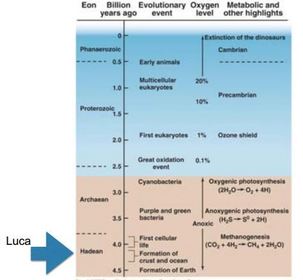
| Earth formed ___ | 4.5 billions years ago |
| oceans formed | 4.3 billions years ago |
| Stromatolites | fossilized microbial mats consisting of layers of filamentous prokaryotes and trapped sediment (fossilized stromatolite vs. modern stromatolite) |
| Alexander Oparin & JBS Haldane | 1920s, were precursors of modern ideas of origin of life |
| planetary science | -clues for organic synthesis environment conditions (uv radiation, electric discharges, c present in inorganic, highly reducing environments) |
| Primordial soup | -hot and diluted soup proteins and other organic compounds form colloidal systems: coacervates. one theory was that origin of life arose out of this soup- surface conditions were hostile so this is not possible |
| Harold Urey 1950's | -primitive earth had reducing atmosphere, molecules saturated with hydrogen atoms that can reduce other molecules -planets in solar system have this kind of atmosphere. their atmosphere contained methane, ammonia, hydrogen and water |
| stanley miller | first experiments designed to clarify chemical reactions in the primitive earth |
| what did miller's experiment find? | conclusion: the organic building blocks of life are generated in the probable atmosphere of early Earth. by reducing atmosphere with gases in prebiotic earth |
| what is still revealing secrets of early solar system? | meteorite that fell in 1969 |
| microfossils from apex chert, australia are how old? | 1 billion years old. |
| surface origin hypothesis | -the first membrane-enclosed, self replicating cells arose out of primordial soup rich in organic and inorganic compounds in ponds on earth's surface. -dramatic temp fluctuations, uv radiation, mixing of metor, dust cloud, storms argue against this hypothesis |
| subsurface origin hypothesis | life originated in hydrothermal vents deep in the ocean -steady and abundant supply of required molecules and energy may have been available at these sites -protected from UV and from temperature fluctuations |
| Marine hydrothermal vents | has been proposed that amino-acid synthesis could have occurred deep in the Earth's crust and that these amino-acids were subsequently shot up along with hydrothermal fluids into cooler waters (and the presence of clay minerals would have fostered the formation of peptides etc |
| Montmorillonite | -supply of reduced compounds H2 and H2S for energy. Montmorillonite clays catalyzer for the formation of key organic molecules nucleotides, lipids and proteins the bricks of life. |
| RNA world | -The RNA world hypothesis proposes that self-replicating ribonucleic acid (RNA) molecules were precursors to all current life on Earth. It is generally accepted that current life on Earth descends from an RNA world, although RNA-based life may not have been the first life to exist. |
| RNA has the ability to act as both _____ and ______ | 1) genes 2) enzymes |
| RNA can be transcribed into ____ in reverse of the normal process of ______ | 1) dna 2) transcription (reasons why rna world would be considered) |
| early life may be based on RNA to: | store and replicate genetic information & catalyze chemical reactions |
| What are the RNA properties in support of RNA-based protocell | 1) RNA like DNA can store and genetic information 2) RNA like proteins can catalyze chemical reactions 3) RNA can direct RNA synthesis, in the lab (rna polymerase) |
| significance of replicase | -scientists hypothesize that a ribozyme that was capable of making copies of other RNAs called replicase evolved early in life's history. (true replicase has not been found) |
| montmorillonite & rna | -montmorillonite-catalyzed formation of RNA oligomers; the possible role of catalysis in the origins of life. -montm..promote RNA synthesis at a faster rate than its degradtion |
| Lipid membrane | -fatty acids can form inside thermal vents and geysers -montmorillonite can induce de formation of fatty acid vesicles that can growth and divided (ph |
| Fatty acids vs. phospholipids | 1) phospholipids compose modern cell membranes 2) fatty acids proposed for protocells (small carboxylate head group that is easily neutralized, allows fatty acids to rapidly flip across bilayer generating high permeability. fatty acids membranes are in equilibrium with micelles and single free fatty acids transfer in b/w these structures in second to minute time scale |
| red tagged rna molecule bound to _____ in a lipid vesicle | montmorillonte |
| first organism | Probiont/protocell (rna enclosed by lipid membrane) |
| when does competition emerge? | when protocells containing replicating genomes steal membrane from protocells containing inactive molecules |
| eventually rna could have given rise to structurally similar double stranded ____ | Dna in cellular life form. |
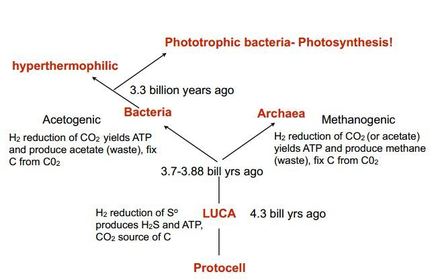
| LUCA | Last universal common ancestor (primordial to RNA to this) - population of early prokaryotic hyperthermophilic (cell grown in deep sea hypoterhmal vent sulfur rich 150-300C) anaerobic cells form which cellular life may have diverged into ancestors of modern day Bacteria and Archae |
| what happens when o2 becomes freely available? | protects sun from uv lights - mutation rates slow down (happens around 2.5-3.0 billion years ago) |
| evolution of luca | |
| what kind of metabolism could LUCA have had? | |
| environment? | -reducing atmosphere -high temperature -UV radiation |
| menu-of luca | 1) anaerobic 2) inorganic sources of carbon 3) reduced inorganic compoints 4) H2 |
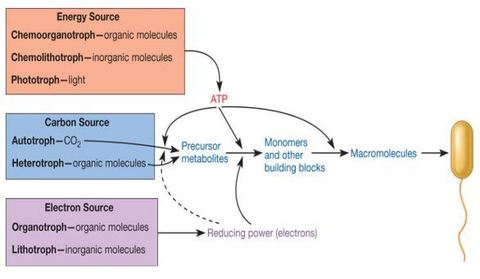
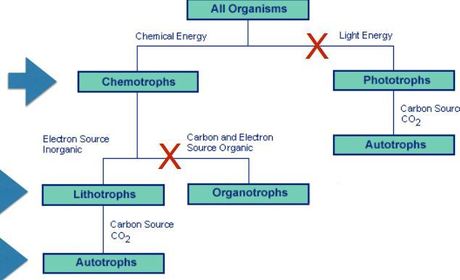
| metabolisms in modern microorganism | luca could be Chemolithotrophic autroph or chemolitoautroph (remember absence of O2) |
| gram positives have ___ membrane | 1 mebrane -gram negatives have more than one membrane |
| to obtain energy organisms ____ molecules or use light | OXIDIZE |
| we are ______ that mainly oxidase organic compounds like glucose to obtain CO2 and H2O to C, reducing power and energy | glucose -> glycolysis ->pyruvate ->acetylcoa-> TCA krebs cycle oxidation -> electrons go to etc (membrane of mitochondria) |
| oxidative phosphorylation: | harvest the energy from the proton motive force to make ATP |
| glycolysis | breakdown of glucose to pyruvate (occurs in cytoplasm of prokaryotes and eykaryotes) |
| tricarboxulic acid/krebs/citric acid cycle | -widely distributed among microorganisms -fuels the electron transport chain -generates precursers for anabolic reactions -in prokaryotes: CYTOPLASM -in eukaryotes: MITOCHONDRIAL MATRIX |
| electron transport chain (aerobic resp) | -series of electron carriers arranged in 4 complexes, operate together to transfer electrons from reduced NADH and FAD to a terminal electron acceptor -Prokaryotes: Located in PLASMA membrane eukaryotes: inner mitochondrial membrane |
| gram positive bacteria when | 1) no outer membrane 2) cell wall super thick (peptidoglycan) |
| redox tower | -better electron donors (co2, glucose,methanol, nadh,fadh,pyruvate)...better at accepting (h20,02,fe, n03) -the larger the jump, the larger the amount of energy released by the reaction |
| oxidation process | -electrons reduce carriers of increasing positive redox potential to ultimately reduce O2 to produce h20 |
| what happens as electrons are transferred? | energy is released and utilized for synthesis of ATP -> oxidative phosphotylation 1/2 O2 +2H + 2e => H2O |
| Substrate-level phosphorylation | -uses the chemical energy from an exergonic reaction to produce ATP by phosphorylation of ADP (atp produced in glycolysis and krebs cycle. enzyme directly produces it) |
| oxidative phosphorylation | 1) when electrons are transported through etc protons are extruded to the outside membrane 2) charge separation across the membrane generates the proton motive force 3) proton motive force generates ATP by oxidative phoshorylation |
| anaerobic respiration | -carried out by bacteria and archaea -exogenous terminal electron acceptor, different from O2 which are used for etc **final electron acceptors as NO3, SO4, CO2, Fe, SeO4 - or organic acceptors -yields LESS energy because e'o of electron acceptor is less positive than o2 ones -glycolysis and TCA cycle may function the same during both aerobic and anaerobic respiration but fuelling electrons to different carriers |
| luca environment and menu | -anaerobic and strong uv radiation -reduced inorganic compounds -feS, H2, H2S available in these sites as a source of energy and electrons -source of carbon- co2 |
| luca's metabolism | based in: H2, source of energy and electrons donor S: electron acceptor, reduced to produce H2S (waste-gassy smell) CO2 is fixed (reduced) to produce organic compounds with e- and ATP coming from H2 oxidation |
| hyperthermophiles can live in | 65-110 C temperatures -modern deep ocean thermal vents which present such conditions are populated by hyperthermophillic, H2 oxidizers, chemolithotrophic procaryotes |
| Pyrolobus fumarii can live at ____ in submarine hydrothermal vents Aquifex aeolicus grows near volcanoes or hot springs at temperatures up to _____ degrees | 113, 95 degrees |
| modern chemolithotrophs | -oxidation of H2 -H2-> 2H +2e -requires hydrogenase -H2 can donate to e- directly to ETC or first to reduce NAD+ that will subsequently donate etc |
| terminal acceptors may be | O2, Fe, S, or CO |
| if organic sources of carbon are available for energy | they will switch from chemolithotrophic to chemoorganotrophic metabolism |
| H2 based metabolism produces | energy atp for the fixation of CO2 to form cellular organic material. the accumulated organic material served as nutrients that allowed the appearance of different metabolism |
| first cell.. | |
| phototrophic organisms | -convert light energy into chemical energy for growth. photosynthetic organisms are phototrophic but not the other way around. red microbial...phototrophic |
| photosynthesis | the reduction (fixation) of CO2 into organisms using energy derived form light. Co2 reduction requires both atp and electrons. conseuquence - synthesis of carbohydrates and other molecular products to form biomass. the electron source can be H2O, H2S, H2 or other reduced inorganic compounds |
| electron source of photosynthesis | -H2O, H2S, H2 |
| oxygenic photosynthesis | -eucaryotes and cyanobacteria |
| anoxygenic photosynthesis | all other bacteria, and archae |
| stromatolites | -fossilized microbial mats consisting of layers of filamentous prokaryotes and trapped sediment -found in rocks 3.5 billions years old or younger |
| chloroflexus | been proposed that modern cholorflexus may be a early form of phototroph that first evolved a photosynthetic reaction centre and cholorosomes |
| anoxygenic photosynthesis | 1)carried out by phototrophic green bacteria, purple bacteria and heliobacteria 2) take place in cholorosomes attatched to inner membrane 3) mainly strict anaerobes 4) H2) is not used as an electron source => O2 is not produced 5) Pigment bacteriocholrophylls absorbs at a larger wavelength than cholorophylls 6) only one photosystem involved |
| chlorobi | green sulfur bacteria -obligately anaerobic photoautotroph electron source: H2S, elemental sulfur and H2 -carbon source: CO2 -some have gas vesicles to adjust depth of cell for adequate light and H2S |
| chlorosomes: | -ellipsoidal vesicles attached to plasma membrane |
| chlorosome | -large antennae complex in the form of membranous vesicles that contain bacteriocholophyll molecules and accessory pigments -most efficient light harvesting complexes found in nature -transfer energy to bacteriocholophyll reaction centres located in the plasma membrane. (insect eye so can capture as much light as it can) |
| cyanobacteria (oxidative phosphorylation) | before the rise of eukaryotes, 2.7 billion years ago. cyanbacterial lineages developed oxygenic photosynthesis |
¿Quieres crear tus propias Fichas gratiscon GoConqr? Más información.