
71200


| Pregunta | Respuesta |
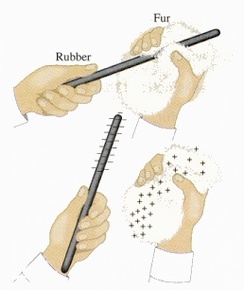
| Certain insulating materials become charged when rubbed together. Electrons are transferred when objects become charged. Like charges repel; unlike charges attract. | |
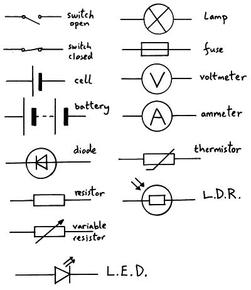
| Every component has its own agreed symbol. I = Q / T | |
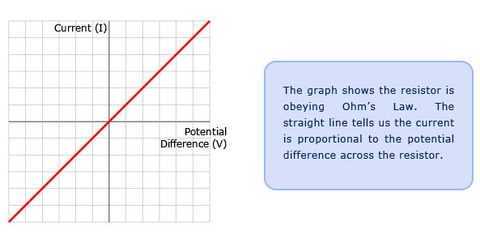
| V = W / Q = E / Q R = V / I Ohm's law states that the current through a resistor at constant temperature is directly proportional to the potential difference across the resistor. Reversing the current through a component reverses the potential difference across it. |
Image:
resistance (image/jpg)
|
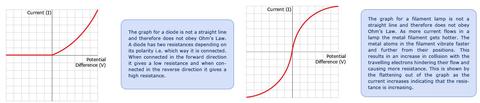
| Filament bulb: resistance increases with increase of the filament temperature. Diode: 'forward' resistance low; 'reverse' resistance high. Thermistor: resistance decreases if its temperature increases. LDR: resistance decreases if the light intensity on it increases. | |
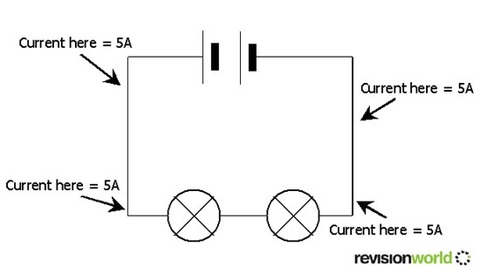
| For components in series: -the current is the same in each component. -adding the potential differences gives the total potential difference. -adding the resistances gives the total resistance. |
Image:
series_circuit (image/jpg)
|
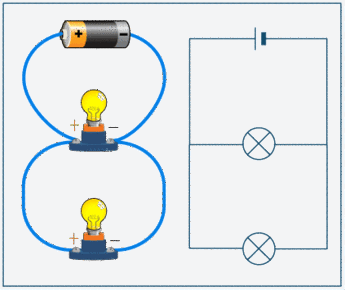
| For components in parallel: -the total current is the sum of the currents through the separate components. -the bigger the resistance of a component the smaller the current is. In a parallel circuit the potential difference is the same across each component. To calculate the current through a resistor in a parallel circuit use I = V / R. |
¿Quieres crear tus propias Fichas gratiscon GoConqr? Más información.