
18079231
Descripción

Mapa Mental por Isla Carpenter, actualizado hace más de 1 año

|
Creado por Isla Carpenter
hace más de 6 años
|
|
P5 - Forces
- Independent variable - What is changed
- Control variable - What you keep the same
- Dependent variable - What you measure
- Variables
- Control variable - What you keep the same
- A non-contact force is a force that has
no contact with anything.
- A contact force is a force that has contact
with something else. Some examples would
be: Pushing or pulling something and air
resistance
- Air resistance is a contact force because if something
was gliding through the air, it would be in contact
with the air particles, meaning it is in contact wityh
something
- Air resistance is a contact force because if something
was gliding through the air, it would be in contact
with the air particles, meaning it is in contact wityh
something
- Non-contact forces: Magnetism, static
electricity, and gravity
- Contact forces: Pushing or pulling
something and air resistance
- Different forces
- Different forces
- Contact forces: Pushing or pulling
something and air resistance
- A contact force is a force that has contact
with something else. Some examples would
be: Pushing or pulling something and air
resistance
- Scalar - Something that only has size
- Vector - Something that has size as well as direcion
- Vector and
Scalar
- Vector - Something that has size as well as direcion
- Newtons 1st law - Every object will remain
at rest or in a uniform motion in a straight
line unless an external force chenges its
state.
- Newton's 2nd law (simplified) - If an object with a
bigger mass pushes an object with a much smaller
mass, the object with the smaller mass will have more
acceleration.
- Newton's 3rd law - For every action in nature
there is an equal and opposite force.
- Newton's laws
- Newton's laws
- Newton's 3rd law - For every action in nature
there is an equal and opposite force.
- Distance is how far you have gone
- Displacement is how far you are from
a certain point, it can be positive or
negative
- how to measure displacement:
- (10 will be an example)
- a² = b² + c²
- 10² + 10² = 200
- a = √200
- =14.1km
- =14.1km
- a = √200
- 10² + 10² = 200
- a² = b² + c²
- (10 will be an example)
- how to measure displacement:
- Distance
and Velocity
- Displacement is how far you are from
a certain point, it can be positive or
negative
- Newton's 2nd law (simplified) - If an object with a
bigger mass pushes an object with a much smaller
mass, the object with the smaller mass will have more
acceleration.
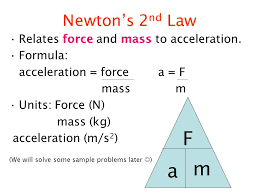
- Force = Mass x acceleration
- Inertial mass = Force ÷ Acceleration
- The bigger the mass of something,
the less the acceleration will be
- The bigger the force, the
greater the acceleration will be
- The bigger the mass of something,
the less the acceleration will be
- Weight = Mass x Gravity
- Work Done = Force x Distance
- Speed = Distance ÷ Time
- Force of a spring = Spring Constant x extension
- Acceleration = (Final Velocity - Initial Velocity) ÷ Time
- Equations
- Equations
- Inertial mass = Force ÷ Acceleration
Recursos multimedia adjuntos
¿Quieres crear tus propios Mapas Mentales gratis con GoConqr? Más información.