
Mapa mental
Risk, Return and Historical Record
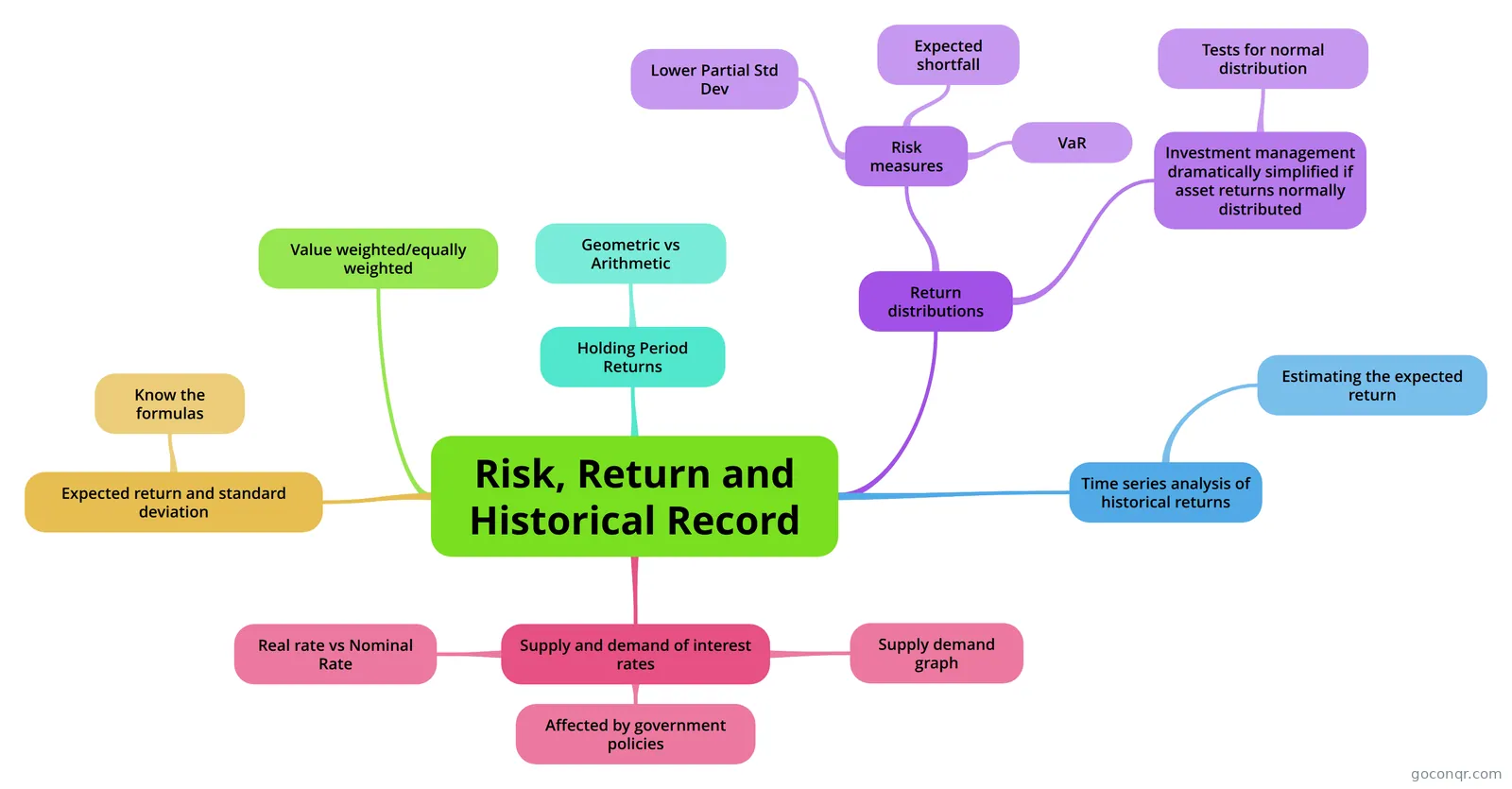
Mind map: Risk, Return and Historical Record
Contenido del mapa
Risk, Return and Historical Record
Supply and demand of interest rates
- Supply of funds from those with more than they wish to consume today-usually households Demand for funds from those who have less than they wish to consume or invest today- usually businesses
- Affected by government policies
- Fiscal policies refer to governments expenditure and revenue. Monetary policies directly influence by buying and selling bonds
- Supply demand graph
- The reason why supply (demand) curve of real interest rate upward (downward) sloping is because as interest rate increase and demand moves down. Also if I lend money, I prefer higher interest
- Real rate vs Nominal Rate
- The rate your money grows at when invested (the nominal rate, R) is not necessarily the same as the rate your purchasing power grows at over the investment period (the real rate, or r). This is a result of inflation, i, or changes in the purchasing power of money (1+r) = (1+R)/(1+i) The approximation is r ~ R-i
Holding Period Returns
- Measure of the return earned over a given investment period (P1 + income - P0)/ P0
- Geometric vs Arithmetic
- Geometric return is more consistent with the actual return received. Arithmetic mean return: provides a good indication of the expected rate of return for an investment during a future individual year. Geometric mean return: assumes you reinvest all profits back into the stock. Reinvested funds earn the rate of return the stock earns in subsequent periods. IF rates of return are the same for all years the geometric mean will equal the arithmetic mean. If returns vary, geometric mean is lower than arithmetic mean.
Expected return and standard deviation
- Given uncertainty about future assets values, investors cannot be certain about the HPR they will ultimately enjoy so they assign probabilities to possible outcomes and arrive at a weighted average or expected return
- Know the formulas
Time series analysis of historical returns
- Historical data analysis forms the basis of expected return and risk estimation but it only reveals the HPRs realised over specific periods and not what investors expected they would be. Therefore we must use historical data sets to make inferences regarding the probability distributions the observed HPRs were drawn from.
- Estimating the expected return
- You can estimate expected return by assigning identical probabilities to each historical outcome before calculating the arithmetic average of the sample HPRs. Although the arithmetic average is an unbiased estimate of expected return, the geometric average return is often preferred when measuring past performance.
Return distributions
- Investment management dramatically simplified if asset returns normally distributed
- Distribution is completely described by its mean and standard deviation. Sharpe ration is a complete measure of portfolio performance
- Tests for normal distribution
- We calculate the dsitribution's higher moments Skewness- measures symmetry of distribution Kurtosis-measures the fatness of the distributions tails
- If the return distribution is positively skewed, standard deviation will overestimate risk Conversely, and of even greater concern, if the return distribution is negatively skewed, standard deviation will underestimate risk When return distributions exhibit 'fat tails' standard deviation will underestimate the likelihood of large gains and more concerning, large losses occurring
- Risk measures
- VaR
- Value at risk is the quantile of a distribution or the level below which q% of the distributions values lie. The 5% VaR commonly estimated in practice is the value at the 5th percentile when returns have been shorted in descending oder. The value which will be lower than the values of 95% of the distribution. CAn be derived using the mean and standard deviation if returns are normall distributed VaR= Mean + (-1.65)Std Dev
- Expected shortfall
- Tells us the expected loss given that one of the worst-case scenarios eventuates and involves averaging across the lowest 5% of observations.
- Lower Partial Std Dev
- LPSD can be thought of as a 'left tail standard deviation' Further it focuses solely on negative deviations form the risk-free rate (return - risk free rate) and is calculated as the square root of total squared negative deviations from the risk free rate
- VaR
- Investment management dramatically simplified if asset returns normally distributed
Value weighted/equally weighted
- Value weighted portfolios weight large companies returns more heavily than small companies and the value weighted index is a better reflection of what happened in the market. Value weighted measures are more accurate
Información
- Descripción
- University (Intro to Risk, Return & Historical Record) Investments Mapa Mental sobre Risk, Return and Historical Record, creado por Nafisa Zahra el 07/10/2013.
- Creado por
- Nafisa Zahra
- Visitas
- 47
- Etiquetas
- Valoración