
3579651
Descripción

Mapa Mental por Robyn Oelofse, actualizado hace más de 1 año

|
Creado por Robyn Oelofse
hace más de 10 años
|
|
Basic concepts, relationships and issues
- what economics is all about
- Macroeconomic theory
- aka a model
- how
- simplification and abstraction
- systematic attempt to understand complex issues
- identify most nb elements and relationships, ignore the rest
- systematic attempt to understand complex issues
- simplification and abstraction
- why
- explain complex phenomenon
- predict
- formulate decisions (economic policy)
- explain complex phenomenon
- aka a model
- 5 objectives of Macroeconomic policy
- ECONOMIC GROWTH
- aim to match production to population living
stds needs and employment
- aim to match production to population living
stds needs and employment
- FULL EMPLOYMENT
- unemployment is threat to society and is costly
- increased production doesn't always equal
increased employment, but is needed if going to
raise
- increased production doesn't always equal
increased employment, but is needed if going to
raise
- unemployment is threat to society and is costly
- PRICE STABILITY
- inflation
- keep low
- keep low
- responds to changes in supply and demand
- CPI
- inflation
- BALANCE OF PAYMENT STABILITY
- aka external stability
- imports and exports
- aim to earn foreign currency through exports
- balance of payments and exchange rates should be stable
- balance of payments and exchange rates should be stable
- aim to earn foreign currency through exports
- aka external stability
- EQUITABLE DISTRIBUTION OF INCOME
- socially acceptable
- reduce social and political unrest
- reduce social and political unrest
- socially acceptable
- HOW?
- monetary policy
- fiscal policy
- monetary policy
- ECONOMIC GROWTH
- Definition of economics:
- wants are unlimited but means to satisfy are
limited. Scarcity necessitates choice
- Definition opportunity cost: value of alternate decision
- Definition opportunity cost: value of alternate decision
- seeks to explain, analyse and predict eg
economic growth, inflation, unemployment
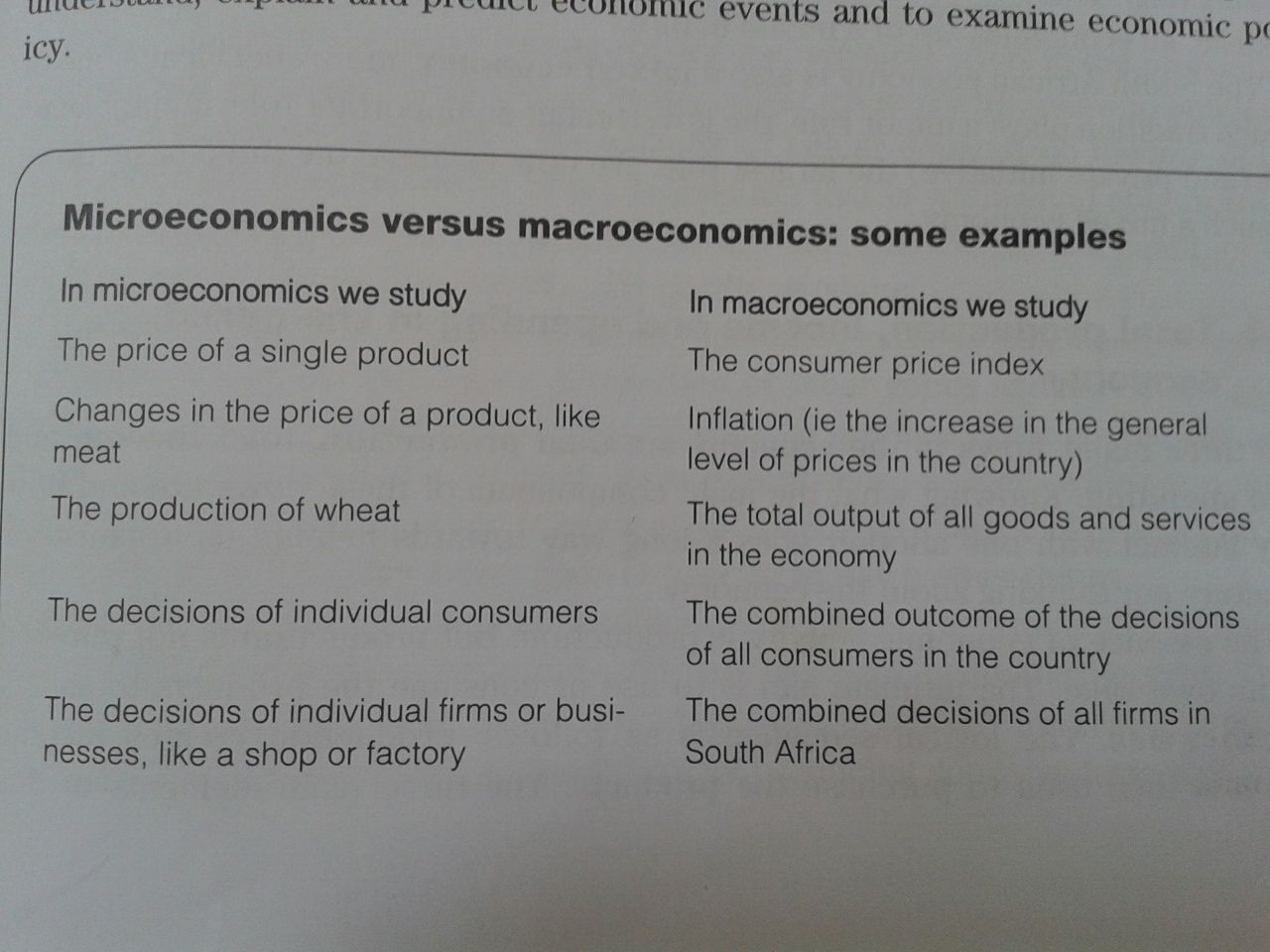
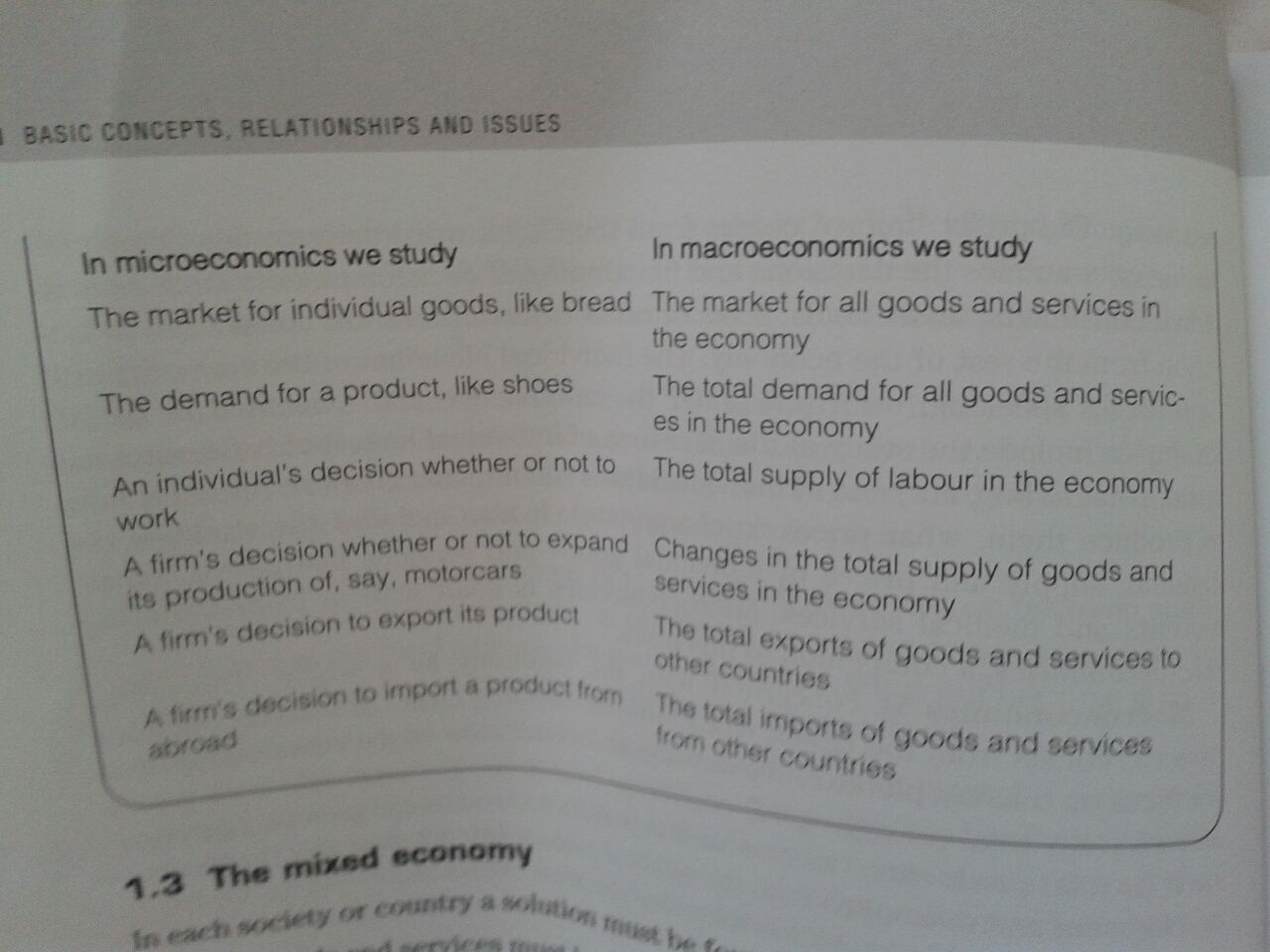
- micro vs macro
- micro isolated from rest of
economy - households, firms study
of decisions, demand/supply and
prices.
- macro whole economy. Aggregate (total eg
total production, income and expenditure,
economic growth, emplyment)
- micro isolated from rest of
economy - households, firms study
of decisions, demand/supply and
prices.
- wants are unlimited but means to satisfy are
limited. Scarcity necessitates choice
- Macroeconomic theory
- The mixed economy
- Total production, income and spending in the mixed economy
- 3 major flows
- PRODUCTION
- aim: consume. satisfy wants
- generated by factors of production
- land
- quality and quantity nb
- labour
- income as reward
- human capital
- income as reward
- capital
- entrepeneurs
- land
- aim: consume. satisfy wants
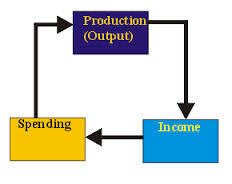
- sequence:
production >
creates
income> used
to purchase
products
- all steps simultaneous
- all steps simultaneous
- INCOME
- created in production process
- TOTAL REMUNERATION EARNED
BY FACTORS OF PRODUCTION.
TOTAL INCOME = TOTAL
PRODUCTION
- TOTAL REMUNERATION EARNED
BY FACTORS OF PRODUCTION.
TOTAL INCOME = TOTAL
PRODUCTION
- TYPES
- rent
- wages and salaries
- interest
- profit
- rent
- created in production process
- SPENDING
- households C
- govt G
- Firms I
- Foreign sector X-Z
- households C
- PRODUCTION
- 3 major flows
- The relationships between households, firms, govt and foreign sector in the mixed
economy
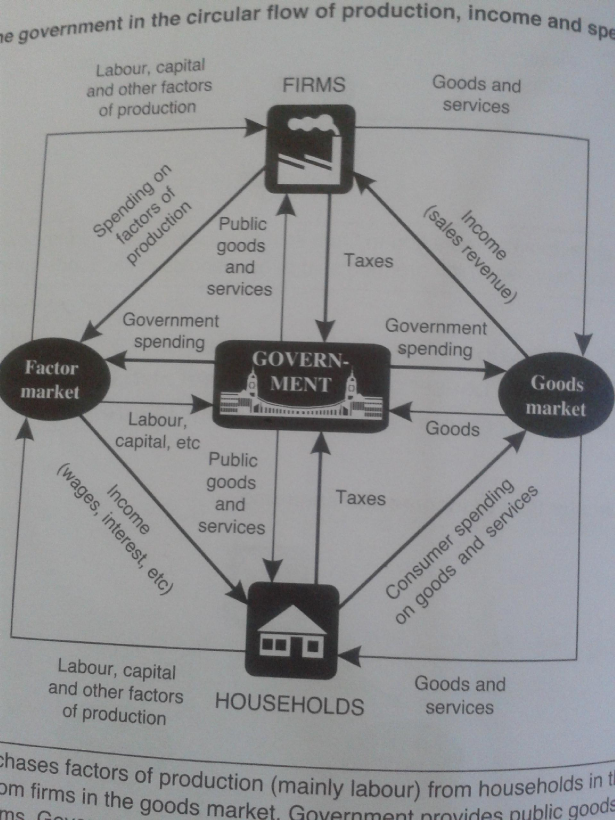
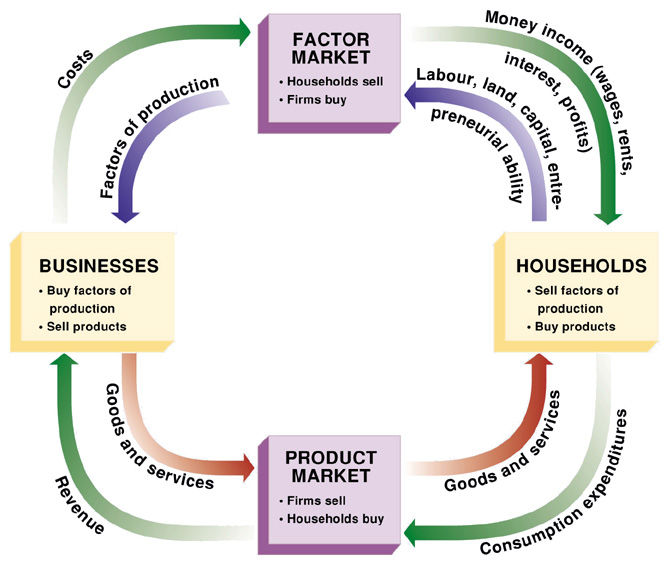
- CIRCULAR FLOW OF PRODUCTION, INCOME AND SPENDING
- HOUSEHOLD
- individuals, family, joint income aka consumers
- consumption: satisfy needs and wants
- aggregate consumption= all households combined: 'C"
- CIRCULAR FLOW OF GOODS AND SERVICES AND OF
INCOME AND SPENDING (AKA 'MONETARY FLOW') COMBINED
- they flow in opp directions
- they flow in opp directions
- CIRCULAR FLOW OF GOODS AND SERVICES AND OF
INCOME AND SPENDING (AKA 'MONETARY FLOW') COMBINED
- aggregate consumption= all households combined: 'C"
- consumption: satisfy needs and wants
- individuals, family, joint income aka consumers
- GOVT (local,
regional,
national)
- aka 'public sector'
- "G"
- injection into flow
- injection into flow
- "T' taxes
- leakage out of flow
- leakage out of flow
- transfer payments
- authority to enforce lawa
- aka 'public sector'
- FIRMS
- create goods using factors
of production> sold in
goods market to consumers
- buyers in factors market, sellers in goods market
- capital formation aka investment "I"
- injection into flow
- injection into flow
- capital formation aka investment "I"
- buyers in factors market, sellers in goods market
- create goods using factors
of production> sold in
goods market to consumers
- FOREIGN SECTOR
- open economy
- balance of
payments: tracks
flow in and out
- exports "x"
- injection
- injection
- imports "Z"
- leakage
- leakage
- exports "x"
- open economy
- Production is created by the factors of production (natural resources, labour, capital and entrepreneurship).
These factors ear income (rent, salaries, interest, profit). Spending is done by households, firms, govt and the
foreign sector)
- C+I+G+X-Z
- C+I+G+X-Z
- HOUSEHOLD
- major markets
- factors market
- goods and services
- tangible and intangible
- tangible and intangible
- financial markets
- mechanisms allow to uy and sell
financial securities, commodities at
low transaction costs
- mechanisms allow to uy and sell
financial securities, commodities at
low transaction costs
- factors market
- CIRCULAR FLOW OF PRODUCTION, INCOME AND SPENDING
- Q: What goods, what quantities, how produced, for whom?
- A: tradition, command, the market mixed
- Total production, income and spending in the mixed economy
- A few things to watch out for
- fallacy of composition
- whole is not sum of parts
- whole is not sum of parts
- corelation and causation
- two events tending to occur together or in sequence doesn't mean one caused the other. Rather need a logical theory
- two events tending to occur together or in sequence doesn't mean one caused the other. Rather need a logical theory
- definition of levels is not same as rates of change
- levels: the value
- rate of change: increase or decrease in value eg in prices 'inflation rate'
- base from which rate starts is nb
- levels: the value
- fallacy of composition
- calculating percentages
- what is one number (x) as a percentage of another (y)? x/y times 100
- Calculate change between x and y as a percentage of x? y/x - 1 times 100
- calculate the percentage of an amount ie x% of y? x/100 times y
- find an amount after a given percentage increase ie x increased by y%? y/100 +1 times x
- what is one number (x) as a percentage of another (y)? x/y times 100
Recursos multimedia adjuntos
¿Quieres crear tus propios Mapas Mentales gratis con GoConqr? Más información.