
Mapa mental
Chapter 9: Intelligence and Psychological Testing
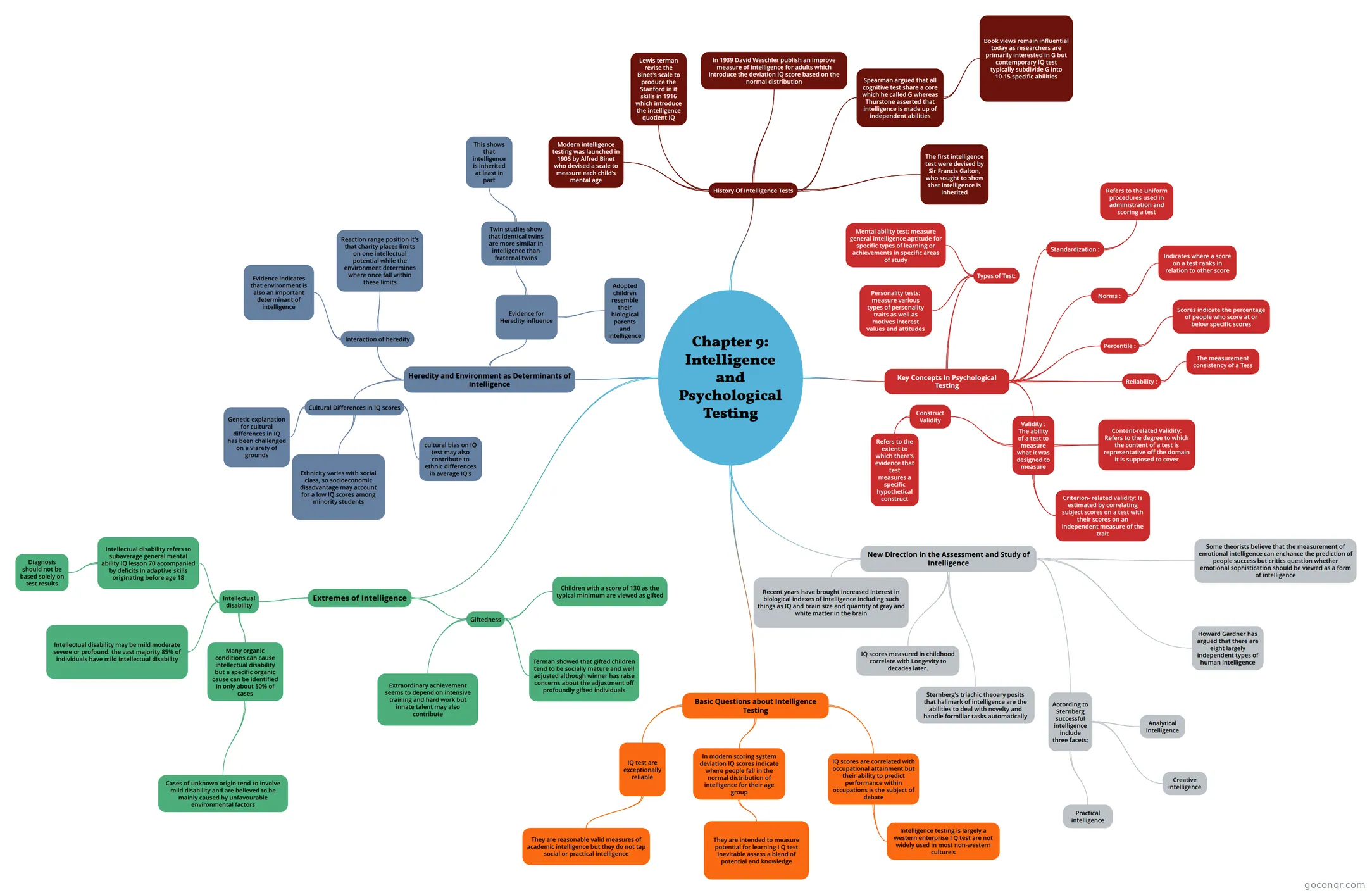
Mind map: Intelligence and psychological testing
Contenido del mapa
Chapter 9: Intelligence and Psychological Testing
Basic Questions about Intelligence Testing
- IQ test are exceptionally reliable
- They are reasonable valid measures of academic intelligence but they do not tap social or practical intelligence
- In modern scoring system deviation IQ scores indicate where people fall in the normal distribution of intelligence for their age group
- They are intended to measure potential for learning I Q test inevitable assess a blend of potential and knowledge
- IQ scores are correlated with occupational attainment but their ability to predict performance within occupations is the subject of debate
- Intelligence testing is largely a western enterprise I Q test are not widely used in most non-western culture's
- IQ test are exceptionally reliable
Extremes of Intelligence
- Intellectual disability
- Intellectual disability refers to subaverage general mental ability IQ lesson 70 accompanied by deficits in adaptive skills originating before age 18
- Diagnosis should not be based solely on test results
- Intellectual disability may be mild moderate severe or profound. the vast majority 85% of individuals have mild intellectual disability
- Many organic conditions can cause intellectual disability but a specific organic cause can be identified in only about 50% of cases
- Cases of unknown origin tend to involve mild disability and are believed to be mainly caused by unfavourable environmental factors
- Intellectual disability refers to subaverage general mental ability IQ lesson 70 accompanied by deficits in adaptive skills originating before age 18
- Giftedness
- Children with a score of 130 as the typical minimum are viewed as gifted
- Terman showed that gifted children tend to be socially mature and well adjusted although winner has raise concerns about the adjustment off profoundly gifted individuals
- Extraordinary achievement seems to depend on intensive training and hard work but innate talent may also contribute
- Intellectual disability
Key Concepts In Psychological Testing
- Standardization :
- Refers to the uniform procedures used in administration and scoring a test
- Types of Test:
- Mental ability test: measure general intelligence aptitude for specific types of learning or achievements in specific areas of study
- Personality tests: measure various types of personality traits as well as motives interest values and attitudes
- Reliability :
- The measurement consistency of a Tess
- Norms :
- Indicates where a score on a test ranks in relation to other score
- Percentile :
- Scores indicate the percentage of people who score at or below specific scores
- Validity : The ability of a test to measure what it was designed to measure
- Construct Validity
- Refers to the extent to which there's evidence that test measures a specific hypothetical construct
- Criterion- related validity: Is estimated by correlating subject scores on a test with their scores on an independent measure of the trait
- Content-related Validity: Refers to the degree to which the content of a test is representative off the domain it is supposed to cover
- Construct Validity
- Standardization :
Heredity and Environment as Determinants of Intelligence
- Interaction of heredity
- Reaction range position it's that charity places limits on one intellectual potential while the environment determines where once fall within these limits
- Evidence indicates that environment is also an important determinant of intelligence
- Cultural Differences in IQ scores
- Genetic explanation for cultural differences in IQ has been challenged on a viarety of grounds
- Ethnicity varies with social class, so socioeconomic disadvantage may account for a low IQ scores among minority students
- cultural bias on IQ test may also contribute to ethnic differences in average IQ's
- Evidence for Heredity influence
- Twin studies show that Identical twins are more similar in intelligence than fraternal twins
- This shows that intelligence is inherited at least in part
- Adopted children resemble their biological parents and intelligence
- Twin studies show that Identical twins are more similar in intelligence than fraternal twins
- Interaction of heredity
History Of Intelligence Tests
- Modern intelligence testing was launched in 1905 by Alfred Binet who devised a scale to measure each child's mental age
- In 1939 David Weschler publish an improve measure of intelligence for adults which introduce the deviation IQ score based on the normal distribution
- Lewis terman revise the Binet's scale to produce the Stanford in it skills in 1916 which introduce the intelligence quotient IQ
- Spearman argued that all cognitive test share a core which he called G whereas Thurstone asserted that intelligence is made up of independent abilities
- Book views remain influential today as researchers are primarily interested in G but contemporary IQ test typically subdivide G into 10-15 specific abilities
- The first intelligence test were devised by Sir Francis Galton, who sought to show that intelligence is inherited
New Direction in the Assessment and Study of Intelligence
- Recent years have brought increased interest in biological indexes of intelligence including such things as IQ and brain size and quantity of gray and white matter in the brain
- IQ scores measured in childhood correlate with Longevity to decades later.
- Sternberg's triachic theoary posits that hallmark of intelligence are the abilities to deal with novelty and handle formiliar tasks automatically
- According to Sternberg successful intelligence include three facets;
- Analytical intelligence
- Creative intelligence
- Practical intelligence
- Howard Gardner has argued that there are eight largely independent types of human intelligence
- Some theorists believe that the measurement of emotional intelligence can enchance the prediction of people success but critics question whether emotional sophistication should be viewed as a form of intelligence
Información
- Descripción
- Mind Map on Human Memory, created by kayla lawrence on 28/11/2016.
- Creado por
- kayla lawrence
- Visitas
- 91
- Valoración