Psychology of Sport

Descripción

Mapa Mental sobre Psychology of Sport, creado por Amy Lauren Stens el 04/04/2014.
Amy Lauren Stens
Mapa Mental por Amy Lauren Stens, actualizado hace más de 1 año
Amy Lauren Stens
Creado por Amy Lauren Stens hace más de 12 años
33
1

Resumen del Recurso

Psychology of Sport
  1. Why is a sport psychologist important?

    Nota:

    • "study of behaviour in sport"
    1. sportscotland institute of sport
      1. Performance factors: physiology, nutrition, biomechanics, lifestyle, skill acquisition,tactics +psychology
        1. time management, relaxation, sponsorship and media commitments..etc
        2. -understand pressures of comp and control behaviour
          1. elite athletes, coaching, sports development, health/fitness industry, research
            1. 1. Education/Awareness

              Nota:

              • set boundaries in code of ethics inform athletes of relationship between stress, anxiety and perf
              1. 2. Assessment

                Nota:

                • inidividual consultation observation reports
                1. 3. Mental Skill training
                  1. 5. Apply techniques in comp
                    1. 6.Evaluation
                      1. STRESS affects attention:

                        Nota:

                        • "perceived threat" coping strategies inconsistent with situational demands demands on interpretation of stress whether positive (tone and activated) or negative (tense and anxious)
                        1. attentional narrowing (processing efficiency theory)
                          1. attentional inflexibility
                            1. attentional internalising + result (conscious processing theory)

                              Nota:

                              • abandon trust in automaticity (fixation stage)
                              1. Management (+verbal cues)
                                1. positive self statements
                                  1. breathing
                                    1. imagery
                                      1. thought stopping + centring

                                        Nota:

                                        • replacing negative with positive thoughts centering is directing thoughts internally centering breath is a deep breath from diaphragm followed by strong exhalation and muscle relaxation athlete narrowly focuses on task-relevant external cue
                                      2. response based (environment)/stimulus based (internally generated)/interactive model
                                        1. consequences
                                          1. physical (arousal)

                                            Nota:

                                            • heart rate blood pressure sweat: galvanic skin measure muscle tension: electromyograph brain: electroencephalograph heart: electrocardiogram
                                            1. mental/cognitive (attention)

                                              Nota:

                                              • anxiety negative mood state self doubt irrational beliefsdepression
                                              1. Manifest anxiety scale
                                                1. state-trait anxiety inventory
                                                  1. Competitive State Anxiety I-2
                                                  2. behavioural (technique/result)

                                                    Nota:

                                                    • irritability aggression forgetfullness disrupted sleep patterns unnecessary sleep disruption
                                                2. drive theory(more stress better)
                                                  1. theories
                                                    1. inverted U hypothesis (optimal is moderate)

                                                      Nota:

                                                      • low stress-lethargy, inactivated mod-flow, excitement high-tension, doubt, loss of control catastrophe theory-changes in pert not proportional to arousal
                                                      1. varies according to sport/positions
                                                        1. zone of optimal functioning for individuals

                                                          Nota:

                                                          • ideal physical and mental conditions for peak perf
                                                    2. theory of ironic processing

                                                      Nota:

                                                      • focus on what want to avoid
                                                3. cognitive-behavioural preparation
                                                  1. goal setting
                                                    1. selective attention

                                                      Nota:

                                                      • "the taking possession by the mind of one train of thought over others. Focailisation and conscious thought. Withdrawal of certain things in order to focus effectively on others" (James, 1890)
                                                      1. spotlight metaphor
                                                        1. zoom lens model
                                                          1. gradient model/allocating resources
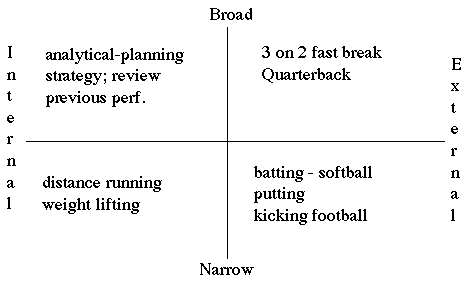
                                                            1. Broad/Narrow/External/Internal

                                                              Nota:

                                                              • Broad External-team in open env/referees Broad Internal- analysis of movement technique Narrow External-targetting sports Narrow Internal-Optimal for rhythm controlled techniques as need to be in touch with feelings
                                                              1. Test of Attentional and Interpersonal Style (TAIS) describes preferred attentional style
                                                                1. attentional style
                                                                  1. associative

                                                                    Nota:

                                                                    • internalise attention (sensory) elite less prone to injury
                                                                    1. dissociative

                                                                      Nota:

                                                                      • externalise attention less elite
                                                                2. confidence (positive self talk, musical, imagery)
                                                                  1. relaxation
                                                                    1. progressive muscular

                                                                      Nota:

                                                                      • aware of tension contraction, relaxation can't be anxious if not tense centering breath
                                                                    2. feedback from positive environment with removal of stressors
                                                                      1. behavioural routine
                                                                      2. Do particular personalities gravitate towards sport participation or does sport develop personalities?
                                                                        1. BEHAVIOUR between successful and unsuccessful athletes
                                                                          1. Trait approach (genetics) not possible on personality traits alone

                                                                            Nota:

                                                                            • central core (personality responses behaviour (environment) Hollander (1976)
                                                                            1. Interaction
                                                                            2. psychological skills
                                                                              1. State approach: environment
                                                                                1. Cognition theory: (Cybernetic)

                                                                                  Nota:

                                                                                  • information processing rational decision making Intervention: positive self talk allows realization of ability not enhanced and individual sports use it more than team
                                                                                  1. motivational self talk

                                                                                    Nota:

                                                                                    • Build self belief Improve skills Create optimal mood Control effort Focus attention Change bad habits
                                                                                    1. Instructional self talk
                                                                                    2. Behaviourism (Skinner)/Environment
                                                                                      1. stimulus sought
                                                                                        1. history of reward/punishment

                                                                                          Nota:

                                                                                          • Structure environment e.g Minigames so guarantee positive experiences
                                                                                          1. level of deprivation
                                                                                          2. Humanism (Mazlow's hierarchy needs)

                                                                                            Nota:

                                                                                            • councelling/interview remover barriers/stressors
                                                                                            1. self actualisation
                                                                                              1. Social approval
                                                                                                1. protection
                                                                                                2. Psychoanalysis (Freud)-no BASES accredited sports psychologists based on this
                                                                                                  1. id- unconscious core
                                                                                                    1. superego- couscience (morality)
                                                                                                      1. ego-reality orientation
                                                                                                      2. Psychobiological approach (Physiology)
                                                                                                        1. ANS
                                                                                                          1. Eustress/Distress
                                                                                                            1. clinical psychology
                                                                                                          2. intrinsic motivations

                                                                                                            Nota:

                                                                                                            • "For the love of the game" Proprioceptive high
                                                                                                            1. extrinsic motivations

                                                                                                              Nota:

                                                                                                              • instrumental benefits that success in sport offers
                                                                                                            2. Psychomotor features
                                                                                                              1. Perceptual/cue utilization/selective attention
                                                                                                                1. Decision-making

                                                                                                                  Nota:

                                                                                                                  • likelihood of success confidence in ability
                                                                                                                  1. Effector

                                                                                                                    Nota:

                                                                                                                    • Motor output: movement technique produced by cerebellular apparatus Skill= learned ability to bring about pre-determined results with max certainty minimal outlay of time/energy

                                                                                                                  Recursos multimedia adjuntos

                                                                                                                  Mostrar resumen completo Ocultar resumen completo