
36325820
Description

Mind Map by Jennifer Iglesias, updated more than 1 year ago

|
Created by Jennifer Iglesias
over 3 years ago
|
|
The Role of Inferential Ability in Listening
Comprehension in English as a Foreign Language
- Brief review of existing literature
- For skilled readers, syntactic knowledge is important for accurately understanding the meaning of a
text, but for skilled readers, who have sufficient knowledge of syntax, higher-order cognitive skills,
such as inference, seem to be important. play a more important role than syntactic knowledge
- Less skilled readers often do not integrate information from a text because they have little
space in working memory, compared to skilled readers, and that this could be a source of
their comprehension problems; if the immediately preceding text cannot be recalled.
- Expert readers appear to comprehend a text by making use of inferences
and actively trying to construct a meaningful representation of the text.
- Slow word recognition or poor working memory capacity may explain why less skilled readers
are inferior to skilled readers in integrating information and comprehending a given text.
- Making inferences is considered an indispensable cognitive process
in understanding the meaning of a text in both listening and reading.
- For skilled readers, syntactic knowledge is important for accurately understanding the meaning of a
text, but for skilled readers, who have sufficient knowledge of syntax, higher-order cognitive skills,
such as inference, seem to be important. play a more important role than syntactic knowledge
- Linguistic level
- Types
- Buck (1991) suggests that there are five
different inferential types from the point of
view of listening comprehension testing.
- Inference type 1: Guessing how a
particular character feels at a particular
moment in the narrative/story.
- Type of inference 2: Finding the reasons
for information clearly stated in the text.
- Inference type 3: Making an inference about
some aspect of a story, which is very similar to
the previous type, expecting the listener not
to ask about the clearly stated information.
- Inference type 4:
Making predictions
about how listeners
think a story will
unfold.
- Inference type 5: Finding
reasons for what seemed
like an obvious inference
made by a test constructor.
- Inference type 1: Guessing how a
particular character feels at a particular
moment in the narrative/story.
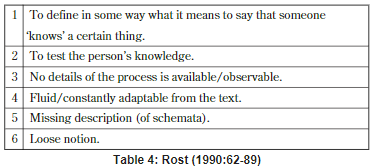
- Rost (1990) states that there are four types/terms
related to the listener's construction of meaning
with the word "understanding"
- AU: Acceptable
understanding.
- TU: Target
understanding.
- NU:
Non-understanding.
- MU:
Misunderstanding.
- UN: The listener is unable to make an
adequate inference from what the
speaker has just said.
- MU: Conflict between the type of inference the speaker
expected the listener to draw from the speaker's utterances,
and the inferences the listener has actually drawn.
- UA: Inferences drawn by a listener that are
satisfactory to both the speaker and the listener.
- TU: Denotes a specific interpretation
intended by the speaker.
- AU: Acceptable
understanding.
- Buck (1991) suggests that there are five
different inferential types from the point of
view of listening comprehension testing.
- Listeners must activate inferential ability using at least four different levels:
phonetic/phonological, lexical/semantic, grammatical, and pragmatic
- The ability to understand and produce a communicative act is called pragmatic competence, which
usually includes knowledge of social distance, social status differences between the speakers involved,
cultural knowledge, e.g., politeness norms, and linguistic knowledge, both explicit and implicit.
- Types
- Examples
- Inference ability falls mainly into two central categories;
inferential ability relating to backgroundknowledge, and
secondly to politeness.
- The term schema was first used by Piaget in
1926, so it was not an entirely new concept.
- Although the term ‘inferential ability’ itself is not used
in Schema theory, schema, or backgroundknowledge,
is a critical component for comprehension.
- Anderson et al. (1977), demostrate how readers
and listeners utilice eschemata to interpret
texts.
- Inference ability falls mainly into two central categories;
inferential ability relating to backgroundknowledge, and
secondly to politeness.
- Problems
- Many researchers refer to the problems of researching
the role of inferential ability incomprehension.
- We can never actually observe the problems
students mayexperience and the skills they use.
- We can only infer what listeners did with the message
and what they found difficult by examining their
response, whether spoken, written, or nonverbal.
- We can only infer what listeners did with the message
and what they found difficult by examining their
response, whether spoken, written, or nonverbal.
- Inference power, or the ability to infer using individual background knowledge, is at
the core of understanding, but it is not easy to define what background knowledge is
- Many researchers refer to the problems of researching
the role of inferential ability incomprehension.
Media attachments





Want to create your own Mind Maps for free with GoConqr? Learn more.