
6458714
Description

Mind Map by Beth Howard, updated more than 1 year ago
More

|
Created by Beth Howard
over 9 years ago
|
|
|
|
Copied by Beth Howard
over 9 years ago
|
|
1_The Structure Of An Atom
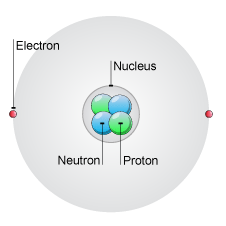
- Electrons
- Have a relative charge of -1
- Electrons are held in shells
- Have a relative charge of -1
- Neutrons
- The Neutrons are found in the nucleus
- Neutrons are neutral, they have no charge
- The Neutrons are found in the nucleus
- Protons
- The Protons are found in the Nucleus
- Have a relative charge
of +1
- The number of protons in an atom is its atomic
number
- The Protons are found in the Nucleus
- The Structure
- The Neutrons and Protons are
found in the nucleus which is at the
centre of the diagram.
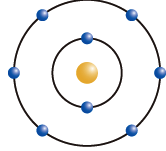
- Electrons are around the nucleus in shells.
- Depending on the shell, it depends how many electrons fit onto it.
- The first shell around the
nucleus can hold up yo 2
electrons, the second and third
can hold up to 8
- The first shell around the
nucleus can hold up yo 2
electrons, the second and third
can hold up to 8
- The number of protons is
always the same as the
number of electrons
- The number of electrons
on the outer most shell
shows what group the
element is in
- For example, in this diagram,
there are 6 electrons on the
outer ring, this means it must
be in group 6 on the periodic
table.
- If you count up
the number of
electrons on the
diagram, it
equals the
atomic number
of the element
- For example, in this diagram,
there are 6 electrons on the
outer ring, this means it must
be in group 6 on the periodic
table.
- The Neutrons and Protons are
found in the nucleus which is at the
centre of the diagram.
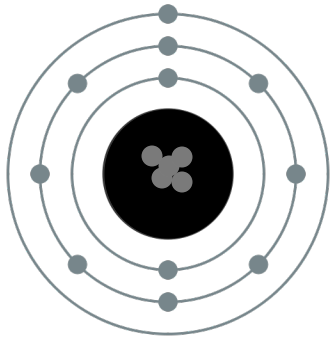
- Example
- This atom diagram has the electron number - 2,8,1
- It has 3 shells and the last shell
has 1 electron on it, this means it
is in group 1 on the periodic table
- The total number of electrons is 11. This
means the element must be Sodium.
- This atom diagram has the electron number - 2,8,1
- Theories
- Dalton
- He came up with some theories in the
1800's. He did many tests and came to
these main conclusions
- All matter is made of atoms
- Atoms can't be made any smaller
- Compounds are made when 2 or
more atoms are joined together
- All matter is made of atoms
- He came up with some theories in the
1800's. He did many tests and came to
these main conclusions
- JJ Thompson
- He discovered the electron in 1897.
He found out that atoms could
be broken into smaller peices.
- He discovered the electron in 1897.
He found out that atoms could
be broken into smaller peices.
- Rutherford
- In 1911 Ernest Rutherford used
experiments to show that an atom
contains a central nucleus. This
supported the fact that an atom can
be broken into smaller pieces.
- In 1911 Ernest Rutherford used
experiments to show that an atom
contains a central nucleus. This
supported the fact that an atom can
be broken into smaller pieces.
- Bohr
- Neil further developed
Rutherford idea of the
atomic model. He found
out that electrons orbit
the nucleus in shells.
- Neil further developed
Rutherford idea of the
atomic model. He found
out that electrons orbit
the nucleus in shells.
- Dalton
Media attachments
Want to create your own Mind Maps for free with GoConqr? Learn more.