
3803638
Descrição

FlashCards por surbeckkatie, atualizado more than 1 year ago

|
Criado por surbeckkatie
aproximadamente 11 anos atrás
|
|
| Questão | Responda |
| Chemical Bond | When 2 or more electrons rearrange Valence Electrons to increase stability. |
| Ionic Bond | Forms when valence electrons are transferred from one atom to another. |
| Covalent Bond | When electrons are shared, forming molecules. |
| Non-Polar Covalent Bond | When electrons are shared equally because atoms have the same electronegativity. |
| Polar | Describes a molecule in which the positive and negative charges are separated. |
| Polar Covalent Bond | When electrons are shared unequally, creating partially charged ends or poles. |
| Molecule | The smallest unit of substance that keeps all of the physical and chemical properties of that substance. |
| Molecular Compound | A chemical compound whose simplest units are molecules. |
| Chemical Formula | Representation of a substance using symbols for its constituent elements. |
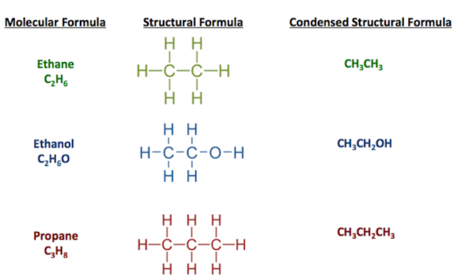
| Molecular Formula | A chemical formula that shows the number of and kinds of atoms in a molecule. |
| Bond Energy | The difference in the electronegativity of the two atoms bonding together. |
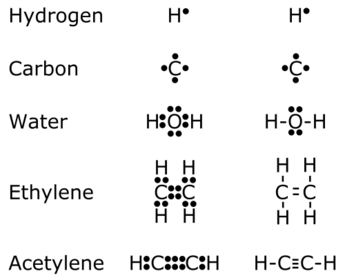
| Electron Dot Notation/Lewis Structure | Diagrams that show the bonding between atoms of a molecules and the lone pairs of electrons that may exist in the molecule. |
| Structural Formula | A graphic representation of the molecule structure, showing how the atoms are arranged. |
| Single Bond/Covalent Bond | The chemical bond that involves the sharing of electron pairs between atoms. blue (nonmetal) - blue (nonmetal) = covalent bond |
| Multiple Bond | A bond where two or more electron pairs are shared between atoms. |
| Resonance | A method of describing the delocalized electrons in some molecules where the bonding cannot be explicitly expressed by a Lewis Structure. |
| * Ionic Compounds | A chemical compound in which ions are held together in a lattice structure by ionic bonds. |
| Formula Unit | The empirical formula of any ionic or covalent network. |
| Lattice Energy | A measure of the strength of bonds in an ionic compound. |
| Polyatomic Ion | A charged particle which has 2 or more atoms held together by covalent bonds. |
| Metallic Bond | The type of chemical bond formed between atoms in a metallic element, formed by the valence electrons moving freely through the metal lattice. |
| Malleability | Quality of something that can be shaped into something else without breaking, i.e. hammering or rolling. |
| Ductility | A solid material's ability to deform under stress, i.e. being stretched into wire. |
| VSEPR (Valence Shell Electron Pair Repulsion Theory) | Model in chemistry used to predict the shape of individual molecules based on the extent of electron-pair electrostatic repulsion. |
| Hybridization | The concept of mixing atomic orbitals into new hybrid orbitals suitable for the pairing of electrons to form chemical bonds. |
| Hybrid Orbitals | Atomic orbitals tat result when two or more atomic orbitals of an isolate atom mix. |
| Dipole | The separation of charges within a molecule between two covalently bonds atoms. |
| Hydrogen Bonding | A chemical bond in which a hydrogen atom of one molecule is attracted to an electronegative atom (Ni, O, F) usually of another molecule. |
| London Dispersion Forces | Weakest intermolecular force; Temporary attractive force that results when the electrons in two adjacent atoms occupy positions that make the atoms form temporary dipoles. |
| Intermolecular Forces | Forces of attraction or repulsion which act between neighboring particles. |
| Intramolecular Forces | Any force that hold together the atoms making up a molecular compound. |
Quer criar seus próprios Flashcards gratuitos com GoConqr? Saiba mais.