
4248259

| Questão | Responda |
| What are the physiological determinants of maximum muscle strength? (2) | 1) Muscle size => the amount of contractile proteins 2) The ability to recruit muscle fibres |
| What is a tendon and what does it do? | It is made up of collagen it is important to enable movement it transmits forces quickly |
| What are muscle fibres made up of? And what makes up those? | Myofibrils Sarcomeres |
| In what two ways are sarcomeres arranged and what does each arrangement influence? | Sarcomeres in series - speed Sarcomeres in parallel - force |
| What does in vivo mean? | Within the muscle/living thing |
| What does in vitro mean? | Outside the living being eg after a muscle biopsy |
| After resistance training how much is muscle strength increased by? What % did the size increase by? | 20-40% 5-10% |
| What two methods can we use to measure muscle strength in vivo? | Dynamic strength eg 1RM Maximum isometric strength |
| What methods can we use to measure neuromuscular activation in vivo? | Voluntary muscle activation |
| How does voluntary muscle activation work? | |
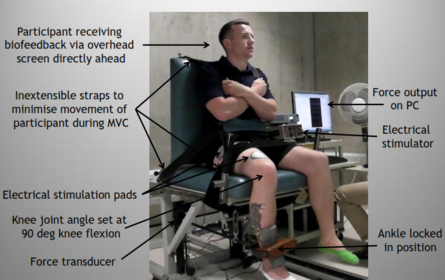
| What is interpolated twitch technique? | A method to measure the participants ability to activate muscle. |
| How does the interpolated twitch technique work? | After MVC an electric charge is applied forcing the muscle to contract. The difference between the plateau and the peak gives the % of muscle the participant can consciously contract. Normally around 90-95% |
| How can we measure muscle size in vivo? (3) | MRI scan Ultrasound EMG |
| What happens to muscle architecture after resistance training? | The pennation angle changes allowing more muscle fibres to fit The pennation angle increases, the area increases, the footprint stays the same. |
| What is muscle specific force? | The intrinsic force producing capacity of a muscle |
| What causes an increase in muscle specific force in vivo? (2) | A change in fibre type composition A change in isolated single fibre contractile characteristics |
| Name the 5 isolated single fibre contractile characteristics | *Max force (Po) *Size (CSA, volume) *Specific tension (Po/CSA) *Max shortening velocity (Vo) *Max Power |
| What does histochemistry measure? | A change in fibre type composition, displays different fibre types as different colours. |
| How does SDS PAGE work? | A gel is between 2 sheets of glass. An electric current pulls the muscle through the gel. Type 2x is the heaviest so stays at the top, Type 1 is the latest so it pulled to the bottom. |
| Define the anatomical cross-sectional area (ACSA) What is the limitation? | Surface area that is cut straight through the muscle. If the fibres are at an angle it may underestimate the area. |
| Define the physiological cross-sectional area (PCSA) | Surface area where all muscle fibres are cut at 90*, this way the max surface area is accurate. |
| Where is collagen found? LEARN FOR EXAM | It surrounds muscle fasicles and makes up tendons. |
Quer criar seus próprios Flashcards gratuitos com GoConqr? Saiba mais.