
10077521
Descrição

Mapa Mental por Sharni Knight, atualizado more than 1 year ago

|
Criado por Sharni Knight
mais de 8 anos atrás
|
|
Human Ear
- Anatomy
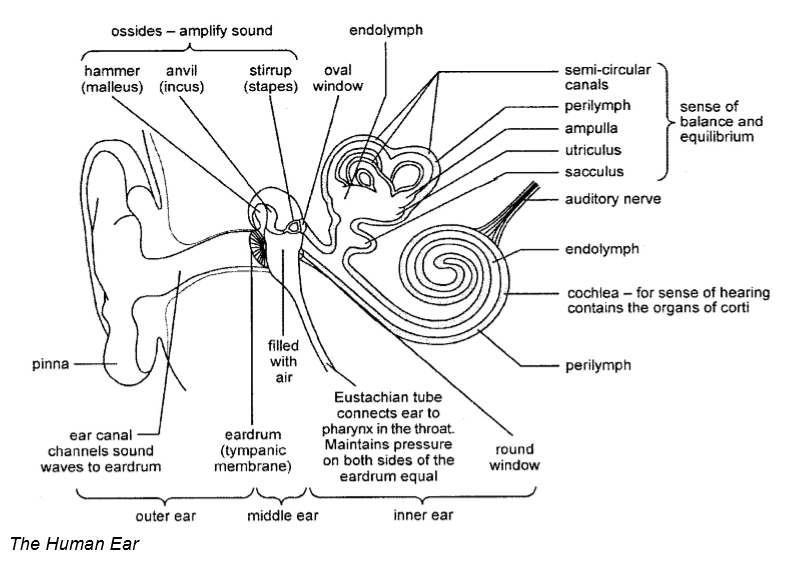
- Pinna
- Large, fleshy external part of the ear
- Collects sound and channels it into ear
- Large, fleshy external part of the ear
- Ossides
- Three tiny bones: hammer, anvil and stirrup
- Amplify the vibrations from the tympanic membrane
- Three tiny bones: hammer, anvil and stirrup
- Vestibular nerve
- Nerve travelling from ear to brain
- Transmits electrochemical signals to brain
- Nerve travelling from ear to brain
- Round window
- Membrane between cochlea and middle ear
- Bulges outward to allow pressure
differences in cochlea
- Membrane between cochlea and middle ear
- Tympanic Cavity
- Region linking ossicles of middle
ear with cochlea in inner ear
- Picks up vibrations from ossicles
and passes them onto fluid in
cochlea
- Region linking ossicles of middle
ear with cochlea in inner ear
- Tympanic Membrane
- Eardrum, membrane that stretches
across ear canal
- Vibrates when sound waves reach it and transfers
mechanical energy to middle ear
- Eardrum, membrane that stretches
across ear canal
- Ear Canal
- Channels sound waves to eardrum
- Channels sound waves to eardrum
- Eustachian Tube
- Connects ear to pharynx in throat,
maintains pressure on both sides of
eardrum equal
- Connects ear to pharynx in throat,
maintains pressure on both sides of
eardrum equal
- Pinna
- Mechanoreceptors
- Organs of Corti are receptors located in cochlea
of ear, stimulated by sound waves, converting
sound waves to impulses
- Organs of Corti are receptors located in cochlea
of ear, stimulated by sound waves, converting
sound waves to impulses
- Ossicles
- Three little bones: hammer, anvil and stirrup, located in
middle ear. Amplify sound
- Three little bones: hammer, anvil and stirrup, located in
middle ear. Amplify sound
- Otis media
- Inflammation and infection of middle ear causing pressure on
eardrum
- Inflammation and infection of middle ear causing pressure on
eardrum
- Path of Sound
- Sound waves collected by pinna, passed down
external auditory canal
- Vibrations reach eardrums (tympanic
membranes)
- Eardrum vibrates according to frequency of
sound waves
- Vibrations transmitted to three
ossicles in middle ear, amplifying
vibrations
- Stirrup passes vibration through oval
window, into inner ear
- Oval window vibrates causing wave movements in
liquid of perilymph
- Wave movements transferred to endolymph inside cochela
- Hair cells on organs of Corti, brush/bend
against the membranes, converting mechanical
stimulus of sound wave into impulse
- Impulse passed through auditory nerve to
auditory centre in cerebral cortex of brain
- Sensation of sound is perceived
and interpreted by cerebral
cortex
- Excess vibrations passed out
through round window,
preventing sound pressure and
echoes
- Sound waves collected by pinna, passed down
external auditory canal
- Balance
- Vestibular apparatus plays a
role in maintenance of balance
in body
- Consists of two membranous sacs, utriculus and
sacculus, three semicircular canals
- Sacculus and utriculus
- Membranous sacs filled
with endolymph, part of
inner ear
- Membranous sacs filled
with endolymph, part of
inner ear
- Macula
- Receptor in utriculus and sacculus
detecting position of head in space
with respect to gravity
- Receptor in utriculus and sacculus
detecting position of head in space
with respect to gravity
- Ampulla
- Widened part at base of
semicircular canals,
contains crista
- Widened part at base of
semicircular canals,
contains crista
- Crista
- Receptor in semicircular canals detecting
changes in speed or movement of head
- Receptor in semicircular canals detecting
changes in speed or movement of head
- Sacculus and utriculus
- Consists of two membranous sacs, utriculus and
sacculus, three semicircular canals
- Vestibular apparatus plays a
role in maintenance of balance
in body
- Hearing defects
- Middle ear infection
- Otitis media
- Inflammation of middle ear
- Middle ear becomes infected with bacteria, extreme pain as
pressure builds up behind eardrum
- Pus collects in middle ear cavity
- Eustachian tube becomes blocked so lack of
ability to equalise pressure on both sides of
eardrum
- Eardrum may burst. Antibiotics
generally prescribed
- Treated using grommets. Tiny tube inserted into eardrum allowing air
to enter middle ear. Does work of poorly functioning Eustachian tube
- Otitis media
- Deafness
- Lost ability to detect sounds either partially or completely
- Result of:
- Sensorineural hearing loss
- Insensitivity of cochlea due to abnormalities of hair
cells of the Organs of Corti. Can also be loss of
function of auditory nerve system
- Insensitivity of cochlea due to abnormalities of hair
cells of the Organs of Corti. Can also be loss of
function of auditory nerve system
- Noise-induced hearing loss
- 3000 to 6000 Hz
- Common causes: very loud music, power tools, factory
machinery, working on jet engines and guns
- Common causes: very loud music, power tools, factory
machinery, working on jet engines and guns
- 3000 to 6000 Hz
- Genetic hearing loss
- Recessive gene will only result in impairment when inherited from both parents
- Recessive gene will only result in impairment when inherited from both parents
- Diseases could cause hearing loss or impairment
- Measles
- Auditory nerve damage
- Auditory nerve damage
- Meningitis
- Damage to auditory nerve or cochlea
- Damage to auditory nerve or cochlea
- Autoimmune disease
- Damage to cochlea
- Damage to cochlea
- Mumps
- Could result in sensorineural hearing loss in one or both ears
- Could result in sensorineural hearing loss in one or both ears
- Foetal alcohol syndrome
- Cause hearing loss in up to 65% babies
- Cause hearing loss in up to 65% babies
- Syphilis
- Up to 35% infected babies will eventually become deaf
- Up to 35% infected babies will eventually become deaf
- Physical trauma
- Measles
- Sensorineural hearing loss
- Lost ability to detect sounds either partially or completely
- Middle ear infection
- Hearing aids and cochlear implants
- Hearing aid
- Apparatus worn in or behind ear. Amplifies
sound, so person hears better
- Apparatus worn in or behind ear. Amplifies
sound, so person hears better
- Cochlear implant
- Surgically implanted device
- Stimulates auditory nerves with electronic fields in cochlea
- Surgically implanted device
- Hearing aid
Anexos de mídia
Quer criar seus próprios Mapas Mentais gratuitos com a GoConqr? Saiba mais.