
853882
Descrição

Mapa Mental por moeingthelawn, atualizado more than 1 year ago

|
Criado por moeingthelawn
mais de 12 anos atrás
|
|
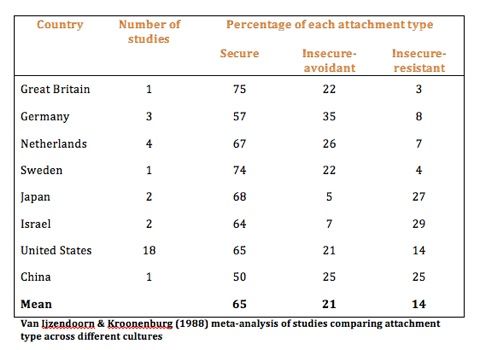
van IJzendoorn and Kroonenberg (1988):
Cross-cultural variations
- Carried out a meta-analysis of 32 studies that have used
the Strange Situation, undertaken in 8 different countries
- BEE (1999)
- There is considerable consistency
across the cultures
- This may be due to the same caregiver-infant
interactions, which would produce similar secure and
insecure attachments in all cultures
- HOWEVER, caregiver-infant interacts may be cultural rather than innate
- Japan and Israel studies show that a greater proportion of
insecure infants were classified as resistant rather than avoidant
- Japan and Israel studies show that a greater proportion of
insecure infants were classified as resistant rather than avoidant
- HOWEVER, caregiver-infant interacts may be cultural rather than innate
- Similarity between countries
may be due to mass media and
its increasing effects
- This may be due to the same caregiver-infant
interactions, which would produce similar secure and
insecure attachments in all cultures
- There is considerable consistency
across the cultures
- Contrasting study: GROSSMAN
and GROSSMAN (1991)
- German infants more likely to be
classified as insecurely attached
instead of securely attached
- German cultural norm of keeping interpersonal
distance between parents and children
- Infants do not engage in proximity-seeking
behaviours (as expected from American
infants) in Strange Situation and thus seem to
be insecurely attached
- Infants do not engage in proximity-seeking
behaviours (as expected from American
infants) in Strange Situation and thus seem to
be insecurely attached
- German infants more likely to be
classified as insecurely attached
instead of securely attached
- Therefore, it may not be appropriate to make
direct comparisons between the findings of
different countries due to cultural differences
- Table does not tell us sample size of studies
- In many cases, only a fairly small number of infants
were involved in most of the studies
- In the one China study, only 36 infants participated.
Therefore, generalizations and conclusions about
cultural differences need to be taken with caution
- In the one China study, only 36 infants participated.
Therefore, generalizations and conclusions about
cultural differences need to be taken with caution
- In many cases, only a fairly small number of infants
were involved in most of the studies
Anexos de mídia
Quer criar seus próprios Mapas Mentais gratuitos com a GoConqr? Saiba mais.